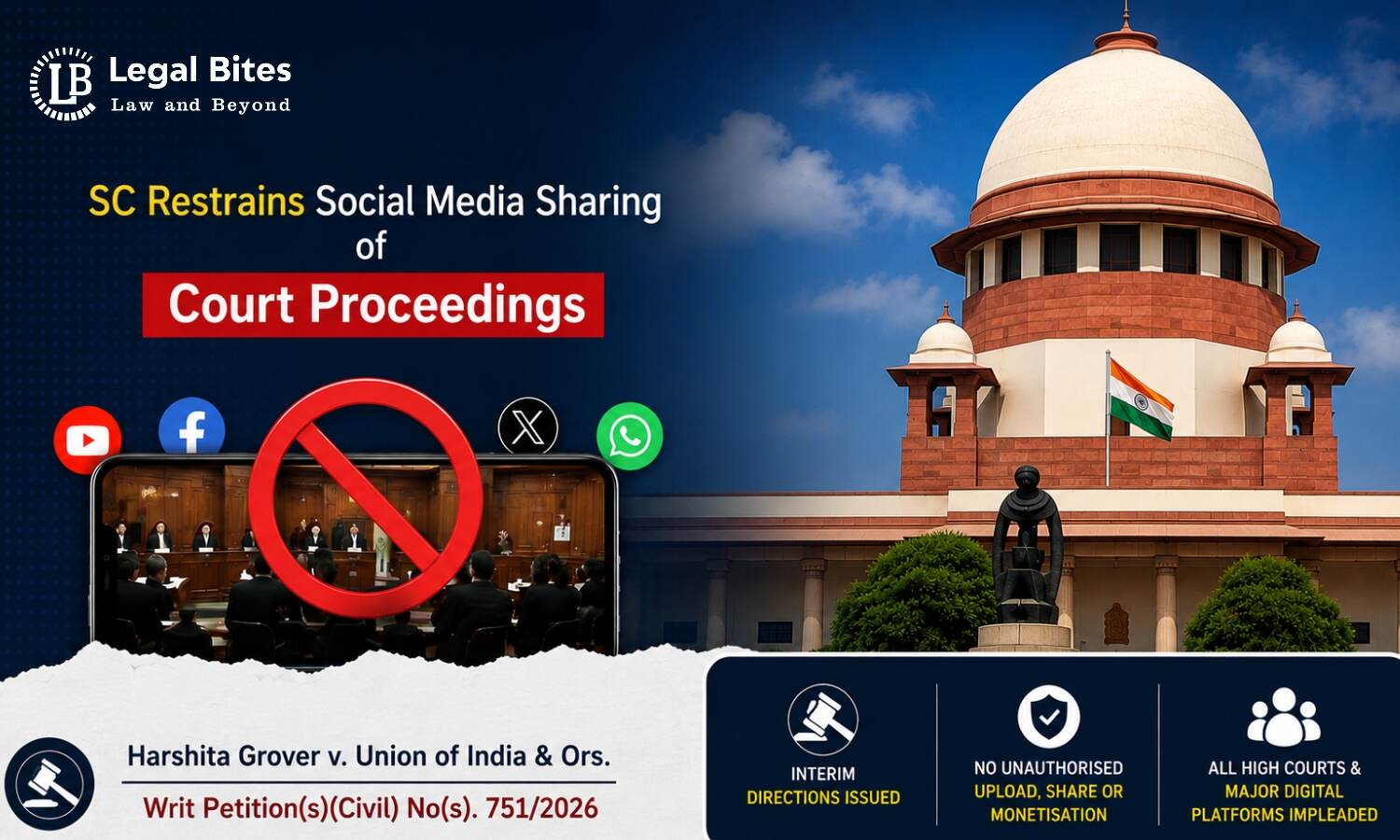
The Supreme Court has issued interim directions prohibiting the unauthorised extraction, uploading, sharing and monetisation of audio-video recordings of court proceedings on social media and digital platforms. The directions were passed in Harshita Grover v. Union of India & Ors., a PIL seeking a comprehensive framework for live streaming and recording of court proceedings.
Interim Restraint on Sharing Court Hearing Videos
As an interim measure, the Supreme Court directed that no person shall extract, disseminate, monetise, post, repost, upload, transmit, modify, store or host audio-video recordings of judicial proceedings on social media or any other digital platform without prior permission from the Secretary General of the Supreme Court or the Registrar General of the concerned High Court.
The direction is intended to prevent the unauthorised circulation and commercial exploitation of court proceedings while the larger issues concerning live streaming and public access are under consideration.
High Courts Directed to Submit Status Reports
Recognising the need for a uniform approach towards live streaming, the Court directed all High Courts to submit status reports indicating:
- Whether they have adopted the Model Rules for Live Streaming and Recording of Court Proceedings circulated by the Supreme Court; and
- The impact and feasibility of implementing continuous and uninterrupted live streaming of court proceedings.
Union Government Asked to Identify Nodal Ministries
The Bench also directed the Union of India to place before the Court a proposal identifying the Nodal Ministries responsible for implementing the reliefs sought in the writ petition.
Digital Platforms Impleaded
To ensure effective implementation of any future directions, the Supreme Court impleaded several major technology companies and social media intermediaries, including:
- Meta Platforms
- X
- YouTube
The Court further directed one of the respondents to furnish information relating to all intermediaries operating in the relevant space.
No Impact on Reporting by Recognised News Media
Importantly, the Supreme Court clarified that its interim directions will not affect the reporting of court proceedings by recognised news outlets, thereby preserving the freedom of legitimate court reporting while restricting unauthorised circulation of official recordings.
Significance of the Order
The interim order represents an important step in balancing judicial transparency, public access to court proceedings, and the need to prevent misuse or commercial exploitation of official recordings. As more courts adopt live-streaming technology, the Supreme Court’s directions seek to ensure that recordings are not selectively edited, monetised or circulated without judicial authorisation.
The matter has been listed for further hearing.
Important Link
Law Library: Notes and Study Material for LLB, LLM, Judiciary, and Entrance Exams