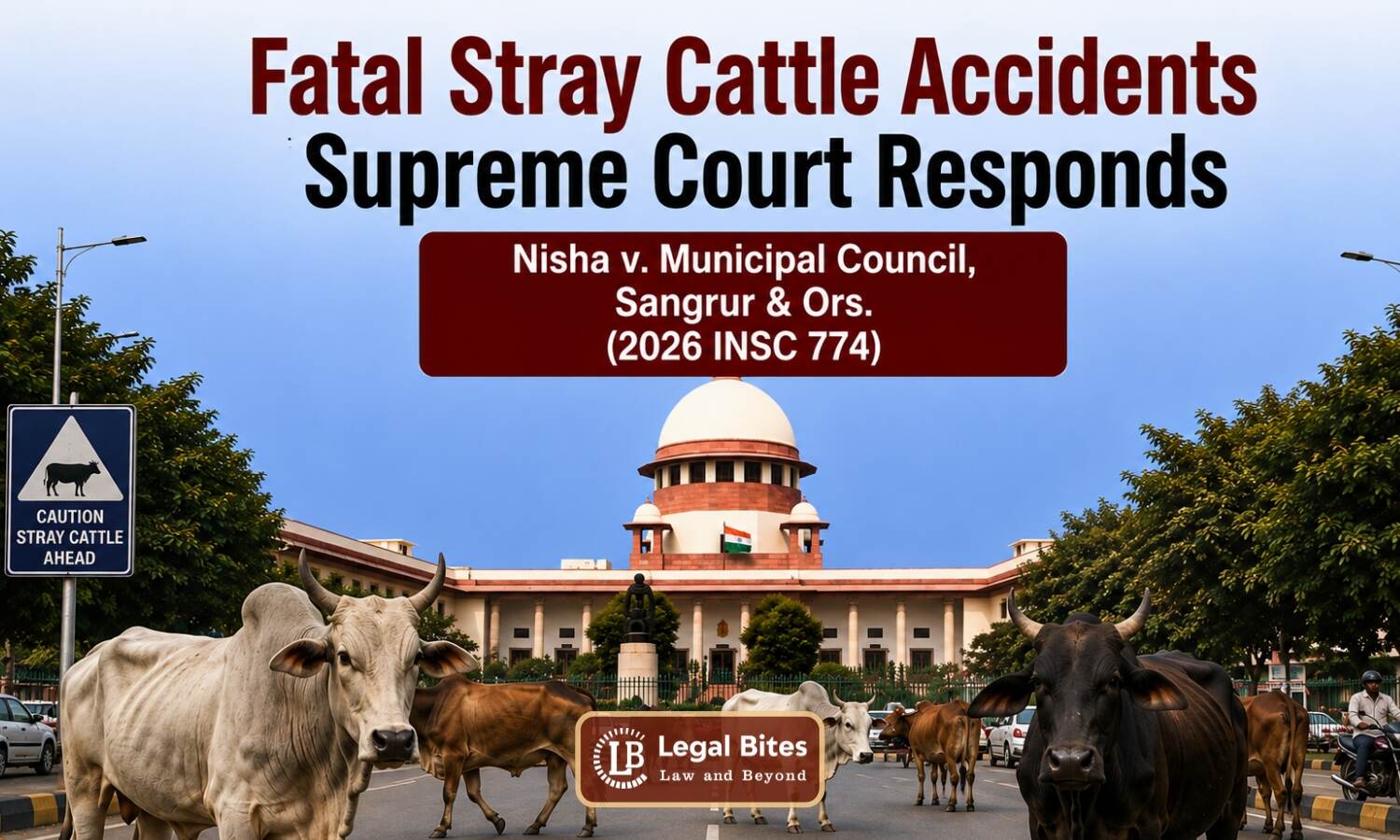
In Nisha v. Municipal Council, Sangrur & Ors. (2026 INSC 774), the Supreme Court of India transformed an individual compensation dispute into an important examination of the growing menace of stray cattle on public roads. The case arose from the death of a pedestrian attacked by a stray bull, but the Court observed that such incidents have become increasingly common across the country.
Stressing that public safety and animal welfare are complementary constitutional objectives, the Court called upon governments, local authorities, and cattle owners to adopt effective preventive measures, strengthen animal shelter infrastructure, and establish accountability mechanisms to prevent avoidable loss of human and animal life.
Facts of the Case
The appellant, Nisha, is the widow of Vijay Kumar, who was attacked by a stray bull on 21 September 2007 while walking on a public road in Sangrur, Punjab. The attack caused severe head injuries, resulting in his death. The police immediately recorded a Daily Diary Report (DDR). During his lifetime, Vijay Kumar sought compensation from the authorities, but no relief was granted. After his death, his widow approached the Punjab and Haryana High Court seeking compensation.
The learned Single Judge awarded compensation of ₹29.32 lakh with interest by applying principles similar to those under the Motor Vehicles Act. However, the Division Bench set aside the judgment, holding that disputed questions of fact could not be decided in writ proceedings under Article 226 and that the claimant should pursue a civil suit. Challenging this decision, Nisha approached the Supreme Court.
The appellant argued that after almost two decades, relegating the family to a civil suit would amount to denial of justice. The respondents, on the other hand, contended that liability of the Municipal Council had not been established and that principles under the Motor Vehicles Act could not be mechanically applied.
Issues Before the Supreme Court
The Supreme Court considered the following issues:
- Whether the Division Bench was justified in dismissing the writ petition on the ground of disputed questions of fact.
- Whether compensation could be awarded in writ jurisdiction in the peculiar facts of the case.
- Whether the State and local authorities owe a duty to prevent accidents caused by stray cattle.
- What systemic measures are required to address the increasing incidents involving stray animals on public roads.
Supreme Court’s Key Highlights
- The Court held that justice cannot be denied merely because the litigation has remained pending for years.
- The incident of the stray bull attack was never disputed by the authorities.
- Stray cattle accidents have become a nationwide public safety concern requiring urgent policy intervention.
- Existing constitutional and statutory provisions already provide an adequate legal framework for protecting both animals and human beings.
- Governments must implement effective systems for cattle identification, animal shelters, owner accountability, and victim compensation.
- The Court directed circulation of the judgment to all States and Union Territories for appropriate action.
Supreme Court’s Reasoning
Justice Cannot Be Defeated by Technicalities
The Supreme Court observed that the writ petition had been pending for several years before the High Court. Sending the claimant to initiate fresh civil proceedings after nearly twenty years would effectively leave the family remediless.
The Court noted that the occurrence of the incident had never been denied by the authorities. Since the essential facts were undisputed, the Division Bench ought not to have dismissed the writ petition solely on technical grounds.
Stray Cattle Accidents Are No Longer Isolated Incidents
The Court observed that reports of accidents involving stray cattle have become commonplace across the country. Referring to official statistics, it noted that India had over 203 lakh stray dogs and stray cattle according to the 2019 census and that more than 1,100 persons lost their lives annually due to animal-related incidents between 2018 and 2020. These figures demonstrate that stray cattle are not merely an inconvenience but constitute a serious public safety challenge requiring immediate governmental attention.
One of the Court’s most striking observations was:
“They are not meant to be natural speed breakers, placed willy-nilly on the National Highways, roads and streets.”
Constitutional Duty Towards Animals and Human Life
The Court carefully balanced constitutional values. It referred to Article 48, which directs the State to organise agriculture and animal husbandry and preserve cattle, and Article 51A(g), which casts a fundamental duty upon every citizen to have compassion for all living creatures. The Court emphasised that constitutional compassion towards animals cannot mean permitting them to roam unattended on roads, where both animals and human beings are exposed to unnecessary danger.
The Court also relied upon earlier decisions, including State of Gujarat v. Mirzapur Moti Kureshi Kassab Jamat, Animal Welfare Board of India v. A. Nagaraja, and Animal Welfare Board of India v. Union of India, reiterating that while animals deserve protection from unnecessary pain and suffering, governments also have an obligation to protect human life from avoidable accidents.
Existing Laws Already Provide the Necessary Framework
The Supreme Court observed that India does not suffer from a lack of legislation. It analysed the Cattle Trespass Act, 1871, noting that it already provides mechanisms for impounding stray cattle, establishing pounds, and imposing penalties. Likewise, the Prevention of Cruelty to Animals Act, 1960 obligates persons responsible for animals to prevent unnecessary suffering and envisages animal welfare institutions and shelters. The Court further referred to the Animal Birth Control Rules, 2023, which define “animal shelters” for rehabilitation and treatment of abandoned animals.
The Court also surveyed the legislative framework of 24 States and Union Territories, highlighting provisions relating to gaushalas, cattle shelters, cattle preservation boards, and welfare institutions. The Court concluded that the real challenge lies not in the absence of law but in its ineffective implementation.
Responsibility of Owners and Authorities
The Court made it clear that responsibility cannot rest solely upon municipal authorities. Owners who abandon cattle after they become economically unproductive must also be held accountable.
The Court observed:
“The reality of animals being let go after they cease to serve a useful, economic purpose cannot be denied. The owners choosing to make such a decision should be held responsible and ensure safe transfer of such animals to the shelters run by the appropriate authority. The authorities at such shelters should issue a receipt acknowledging such transfer and cause the details of such animal to be entered/altered in the database of tagging.”
This observation reflects the Court’s attempt to establish a system of accountability where cattle owners cannot simply abandon animals after they cease to be economically beneficial. Simultaneously, governments must maintain proper tagging, registration, and shelter records to prevent animals from returning to public roads.
Directions Issued by the Court
Recognising that the problem affects the entire country, the Supreme Court made several important recommendations to the Union and State Governments:
- Proper tagging and identification of cattle.
- Creation and maintenance of reliable databases.
- Strengthening and adequate funding of gaushalas and animal shelters.
- Holding negligent cattle owners accountable.
- Establishing effective compensation mechanisms for victims of stray cattle accidents.
- Better coordination among municipal bodies, police, animal husbandry departments, and local authorities.
- Strict implementation of existing statutory provisions instead of merely enacting new laws.
The Court further directed that copies of the judgment be forwarded to all Chief Secretaries of States, Administrators of Union Territories, and Member Secretaries of the State Legal Services Authorities for necessary action.
Final Decision
Allowing the appeal, the Supreme Court set aside the judgment of the Division Bench of the Punjab and Haryana High Court. Considering the peculiar facts, prolonged delay, and undisputed nature of the incident, it awarded ₹15 lakh as compensation to the appellant. At the same time, the Court clarified that the quantum of compensation was awarded in the special facts of the case and should not be treated as a precedent for future cases.
Conclusion
The decision in Nisha v. Municipal Council, Sangrur & Ors. is significant not merely because it grants compensation to a grieving family but because it recognises stray cattle accidents as a serious governance issue affecting road safety across India. The judgment harmonises constitutional values of animal welfare with the State’s obligation to protect human life and demonstrates that effective implementation of existing laws is the need of the hour.
By recommending comprehensive measures relating to tagging, shelters, owner responsibility, and institutional coordination, the Supreme Court has laid down an important roadmap for reducing stray cattle accidents while ensuring humane treatment of animals. It is likely to serve as an influential policy guide for governments and local authorities in addressing one of India’s most persistent public safety concerns