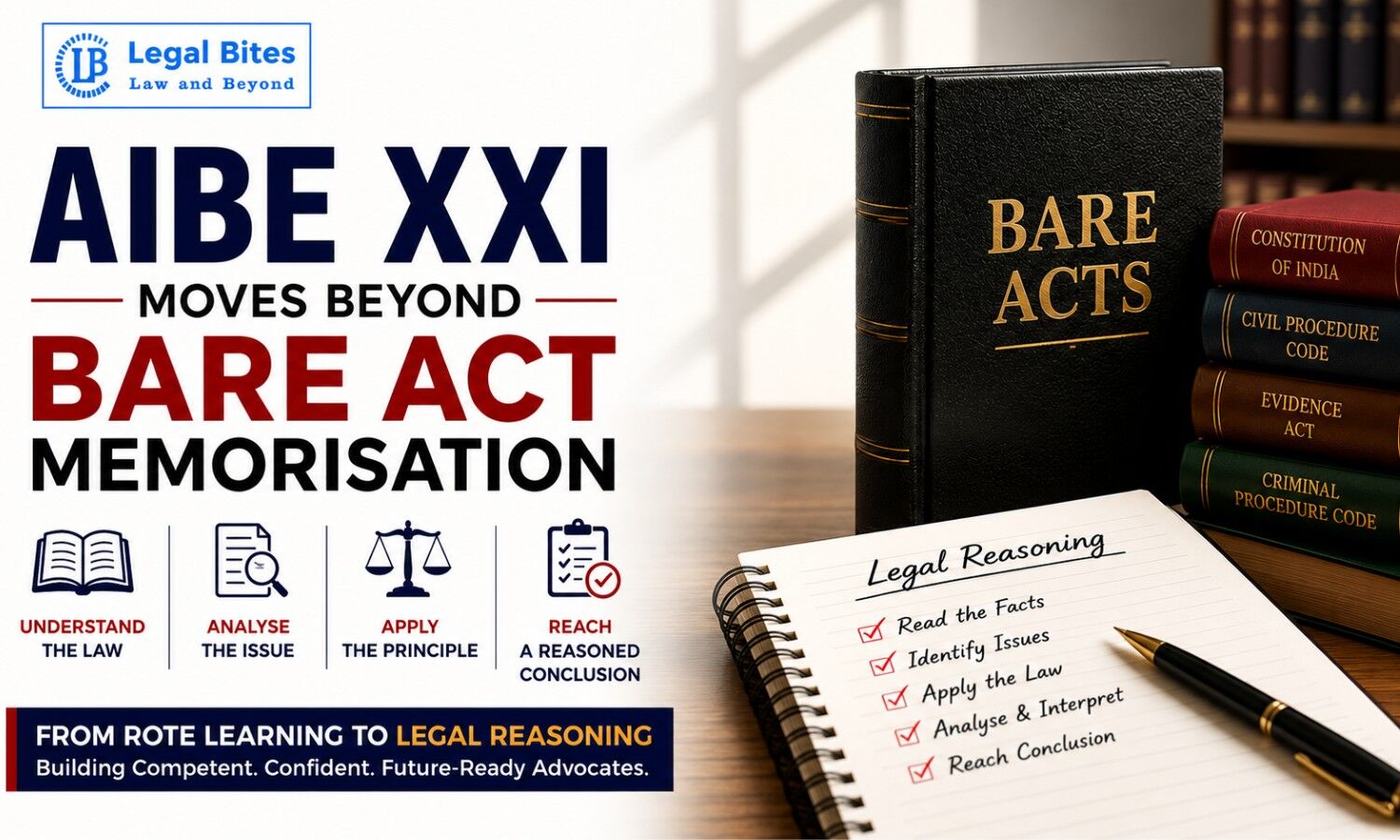
The evolving pattern of AIBE XXI suggests that the legal profession is placing renewed emphasis on competence, analytical ability, and genuine legal understanding.
For years, many candidates viewed the AIBE as a largely procedural hurdle, an examination where success often depended on familiarity with Bare Acts, quick identification of keywords, and basic statutory navigation skills. However, this year’s paper felt noticeably different.
Many questions required candidates to think, analyse, and apply legal principles rather than merely reproduce statutory language. The examination appeared to move beyond testing memory and toward assessing legal understanding, a shift that deserves serious attention.
Beyond Bare Acts: A Move Towards Conceptual Questions
One of the most striking aspects of AIBE XXI (2026) was the nature of the questions. Several questions were framed in a manner that required candidates to understand the underlying legal principle before arriving at an answer.
Instead of asking what a particular section states, the paper frequently demanded an understanding of how the law operates in a factual situation. Candidates had to identify legal issues, distinguish between competing options, and apply established principles to practical scenarios.
This represents a significant departure from the perception that the AIBE is merely an open-book exercise.
Greater Emphasis on Application-Based Learning
Candidates were tested on constitutional doctrines, judicial precedents, arbitration, professional ethics, CPC, criminal law, environmental law, taxation, and contemporary legislations through assertions-reasons, legal scenarios, and analytical propositions.
A practising advocate is not expected to recite statutory provisions from memory. Rather, an advocate must understand facts, identify legal issues, interpret the law, and advise clients accordingly. Courtrooms do not reward keyword recognition; they reward legal reasoning.
By introducing more application-oriented questions, the examination appears to be testing the very skills that advocates use in their daily professional lives.
Tougher? Certainly. Unfair? Not at All.
There is little doubt that many candidates found the paper more challenging than previous editions. Social media discussions immediately reflected concerns regarding the increased difficulty level.
However, difficulty should not automatically be equated with unfairness.
Every profession maintains certain minimum standards before granting entry into practice. Medicine, accountancy, engineering, and other professional disciplines expect candidates to demonstrate competence before they are entrusted with public responsibilities.
The legal profession should be no different. If the objective of the AIBE is to certify that a law graduate possesses the minimum competence required to practise law, then questions testing legal understanding and analytical ability are entirely justified.
Strengthening the Quality of Legal Practice
The consequences of inadequate legal understanding extend far beyond examination halls.
Advocates are entrusted with protecting liberty, defending rights, assisting courts, and guiding citizens through complex legal systems. Weak conceptual foundations can affect not only individual clients but also the overall quality of justice delivery.
A bar examination that encourages genuine legal understanding contributes to raising professional standards across the board.
In the long run, this benefits litigants, courts, and the legal profession itself.
A Message for Law Schools and Students
The changing pattern of the AIBE also carries an important lesson for law schools and law students.
Legal education cannot be confined to memorising provisions and examination-oriented preparation. Greater emphasis must be placed on understanding principles, analysing judgments, solving practical problems, and developing legal reasoning skills.
Students who focus solely on rote learning may find it increasingly difficult to succeed in examinations that test application and interpretation.
The future of legal education lies in cultivating analytical thinkers rather than provision collectors.
Restoring Meaning to the Bar Examination
The purpose of a bar examination is not merely to issue a certificate. It is to ensure that those entering the profession possess the foundational competence necessary to serve clients and assist in the administration of justice.
When an examination becomes too predictable or excessively dependent on mechanical methods, it risks losing its purpose.
AIBE XXI appears to be an attempt to restore that purpose by evaluating whether candidates can actually think like advocates.
That is a welcome development.
Conclusion
While opinions may differ on the difficulty of AIBE XXI, one thing is increasingly clear: the examination is shifting toward testing legal reasoning, conceptual clarity, and practical understanding rather than mere statutory navigation.
This shift may initially discomfort candidates accustomed to a different pattern. Yet, from the perspective of professional standards and the long-term health of the legal profession, it is a step in the right direction.
The legal profession deserves advocates who can do more than locate provisions. It deserves advocates who can understand facts, apply principles, construct arguments, and contribute meaningfully to the administration of justice.
If AIBE XXI has indeed begun moving in that direction, it marks a positive evolution in legal assessment and a welcome development for the future of the Bar.
Important Link
Law Library: Notes and Study Material for LLB, LLM, Judiciary, and Entrance Exams