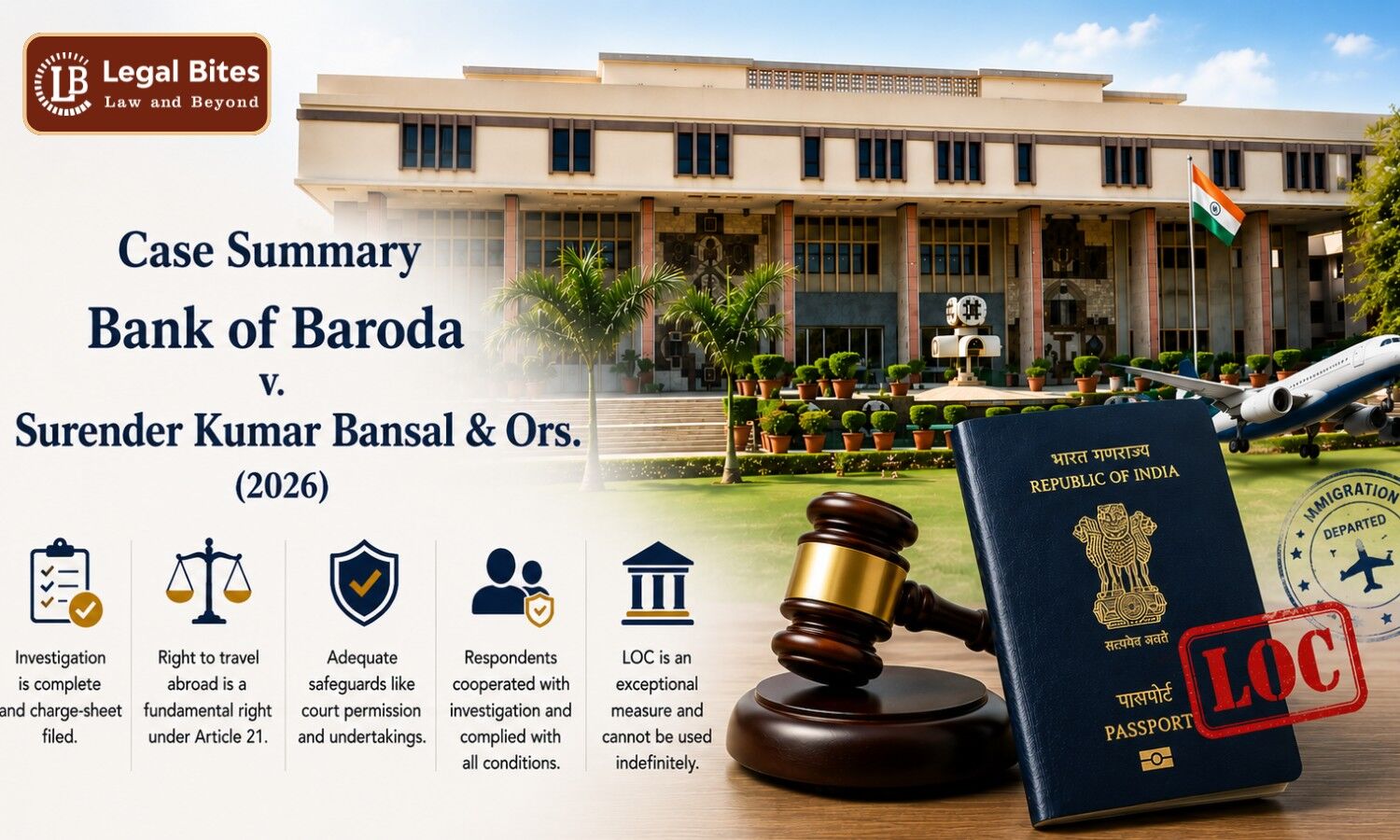
In a significant judgment concerning the balance between an individual’s fundamental right to travel abroad and the State’s power to restrict movement through a Look Out Circular (LOC), the Delhi High Court in Bank of Baroda v. Surender Kumar Bansal & Ors. upheld the quashing of an LOC issued against two company directors who were facing criminal proceedings arising out of a bank loan default. The Court emphasised that an LOC is an exceptional coercive measure and cannot be continued indefinitely once its purpose has been achieved, particularly when the accused have cooperated with the investigation and complied with court-imposed conditions.
The Division Bench comprising Chief Justice Devendra Kumar Upadhyaya and Justice Tejas Karia dismissed the appeal filed by Bank of Baroda against the order of a Single Judge that had set aside the LOC while imposing safeguards to ensure the respondents’ participation in criminal proceedings. The judgment reiterates that restrictions on international travel must be justified by compelling reasons and must withstand constitutional scrutiny under Article 21 of the Constitution
Facts of the Case
The dispute arose out of financial assistance extended by a consortium of banks to M/s SSK Trading Private Limited. The company initially functioned as a proprietorship concern owned by Surender Kumar Bansal and was later converted into a private limited company in 2007. The respondents, Surender Kumar Bansal and another director, served as directors and personal guarantors of the borrowing company.
Subsequently, the loan account became a Non-Performing Asset (NPA). As a consequence, proceedings were initiated under the SARFAESI Act, 2002, and recovery proceedings were commenced before the Debt Recovery Tribunal (DRT) by the lead consortium bank.
In addition to the civil recovery process, the Central Bureau of Investigation (CBI) registered an FIR on 12 April 2018 against the respondents following a complaint made by the lead consortium bank. After the investigation, a charge sheet was filed, and criminal proceedings were initiated against the respondents. The criminal trial remained pending before the competent court.
Meanwhile, a Look Out Circular was issued against the respondents on 3 January 2020 by the Bureau of Immigration, Ministry of Home Affairs. The LOC was later renewed in December 2020. Aggrieved by the continued restrictions on their travel, the respondents approached the Delhi High Court through a writ petition challenging the LOC.
During the pendency of the writ proceedings, the Debt Recovery Tribunal allowed the recovery application and directed the borrower company and its directors to pay over ₹31.84 crore along with interest and costs.
Proceedings Before the Single Judge
The respondents challenged the LOC before the Delhi High Court through a writ petition. After considering the facts and developments that had occurred since the filing of the petition, the Single Judge observed that:
- Investigation had already been completed.
- A charge-sheet had been filed.
- Criminal trial was pending.
- The respondents had previously been permitted by courts to travel abroad on multiple occasions.
- There was no allegation that they had ever violated the conditions imposed while travelling abroad.
The Court noted that the respondents had undertaken foreign travel to the United Kingdom, Scotland, and the United Arab Emirates after obtaining judicial permission and had always returned to India. No instance of misuse of liberty had been reported.
Consequently, the Single Judge quashed the LOC and imposed safeguards, including:
- Filing affidavits before the Trial Court, undertaking cooperation with the trial.
- Restriction on foreign travel without prior permission of the Trial Court.
- Liberty to authorities and banks to seek reopening of the LOC if the respondents violated any conditions imposed by the Court or the investigating agency.
Appeal Before the Division Bench
Bank of Baroda challenged the Single Judge’s order through an intra-court appeal. The principal grievance of the bank was that the safeguards imposed by the Single Judge were insufficient to protect the bank’s financial interests. According to the appellant, the respondents owed substantial amounts pursuant to the DRT’s recovery order, and permitting them to travel abroad could adversely affect the recovery process.
The bank argued that:
- The conditions imposed by the Single Judge were linked to the criminal proceedings.
- The bank had no locus to participate effectively in criminal trial proceedings.
- Therefore, the safeguards did not adequately secure recovery of public money owed to the bank.
The appellant also relied upon certain observations made by the Supreme Court in proceedings arising from the Bombay High Court judgment in Viraj Chetan Shah v. Union of India, where interim directions had required affected individuals to seek court permission before travelling abroad.
Arguments of the Respondents
The respondents opposed the appeal and submitted that:
- They had cooperated fully with the investigation.
- They had never attempted to evade the process of law.
- The investigating agencies themselves had deleted or withdrawn LOCs issued against them.
- Their passports were already deposited with the Enforcement Directorate.
- Bail conditions imposed by the Special Court already prohibited foreign travel without judicial permission.
They further highlighted that whenever they had travelled abroad, they had done so only after obtaining court permission and had always complied with the conditions imposed by the courts. Accordingly, they argued that no justification existed for continuing the LOC.
Issues Before the Court
The principal issues before the Division Bench were:
- Whether the Single Judge was justified in quashing the Look Out Circular.
- Whether the safeguards imposed by the Single Judge were adequate.
- Whether the bank’s recovery interests justified continuation of the LOC.
- Whether continued operation of the LOC violated the respondents’ right to travel abroad.
Court’s Analysis
Completion of Investigation
The Court attached considerable significance to the fact that the investigation had already concluded and a charge-sheet had been filed.
The primary purpose of an LOC is to secure the presence of an individual during investigation or legal proceedings. Once the investigation is complete and adequate safeguards exist to ensure participation in the trial, continuation of an LOC becomes difficult to justify.
The Court observed that the respondents remained subject to judicial oversight and could not travel abroad without permission from the competent court.
No Misuse of Earlier Travel Permissions
The Division Bench noted that the respondents had travelled abroad on four separate occasions pursuant to judicial orders.
Importantly:
- They had always obtained permission.
- They had returned to India.
- They had never violated any condition imposed by the courts.
The Court found that their conduct demonstrated respect for the judicial process and reduced any apprehension that they might abscond.
Adequate Safeguards Already Existed
The Court further observed that multiple safeguards were already in place.
These included:
- Bail conditions.
- Deposit of passports with the Enforcement Directorate.
- Requirement of obtaining court permission before foreign travel.
- Undertakings to cooperate with trial proceedings.
- Liberty granted to authorities to seek revival of the LOC in case of violation.
The Court concluded that these measures adequately protected both the interests of the criminal justice system and the concerns expressed by the bank.
LOC as an Exceptional Coercive Measure
One of the most important observations in the judgment concerns the nature of an LOC. The Court held that the power to issue an LOC is an exceptional coercive power because it directly affects an individual’s liberty and right to travel abroad. Therefore, such power must be exercised with great caution and only in exceptional circumstances.
The Court emphasised that LOCs cannot be allowed to operate mechanically or indefinitely.
Reliance on Constitutional Principles
The Division Bench relied upon earlier precedents, including:
- Rajesh Kumar Mehta v. Union of India.
- Maneka Gandhi.
Referring to the constitutional principles laid down in Maneka Gandhi, the Court reiterated that the right to travel abroad forms part of personal liberty protected under Article 21 of the Constitution.
Any restriction on this right must:
- Be supported by law.
- Follow a fair procedure.
- Be justified by compelling circumstances.
The Court reaffirmed that no person can be deprived of the right to travel abroad except in accordance with a legally valid and constitutionally compliant procedure.
Decision
The Delhi High Court dismissed the appeal filed by Bank of Baroda. The Court upheld the Single Judge’s order quashing the Look Out Circular and found no reason to interfere with the safeguards already imposed. It held that sufficient protections existed to ensure the respondents’ participation in the criminal proceedings and that continuation of the LOC was not justified in the circumstances of the case.
The appeal and all pending applications were accordingly dismissed without any order as to costs.
Conclusion
The Delhi High Court’s decision in Bank of Baroda v. Surender Kumar Bansal & Ors. serves as an important reminder that Look Out Circulars are not meant to function as perpetual restraints on liberty. Once investigation is complete, the accused has cooperated with authorities, and adequate safeguards are in place, continuation of an LOC may become disproportionate and constitutionally suspect.
The judgment reinforces the principle that personal liberty and the right to travel abroad remain fundamental rights that can be curtailed only for compelling and legally sustainable reasons. While recognising the concerns of financial institutions and investigating agencies, the Court ultimately reaffirmed that coercive restrictions must yield when their purpose has been fulfilled and less restrictive safeguards are available.
Important Link
Law Library: Notes and Study Material for LLB, LLM, Judiciary, and Entrance Exams