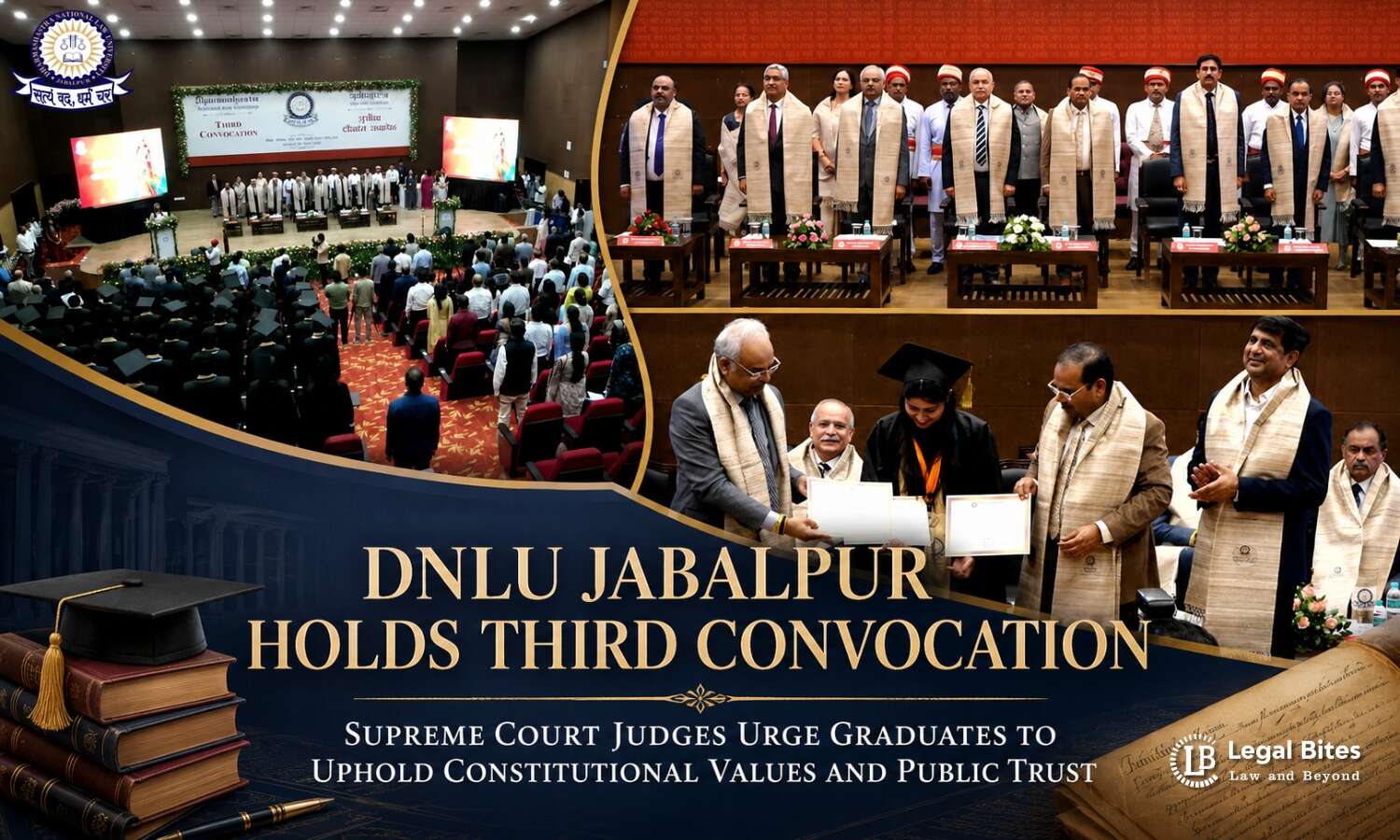
Jabalpur, June 14, 2026: Dharmashastra National Law University (DNLU), Jabalpur, celebrated its Third Convocation Ceremony on Sunday at the PDPM IIITDM Campus, marking a significant milestone in the institution’s academic journey. Degrees were conferred upon 162 graduands, while distinguished members of the judiciary addressed students on constitutional values, professional ethics, environmental stewardship, and the future of legal practice.
The convocation was presided over by the Chancellor of DNLU and Acting Chief Justice of the Madhya Pradesh High Court, Hon’ble Shri Justice Vivek Rusia. The ceremony was attended by the University’s Visitor and Chief Guest, Hon’ble Shri Justice Jitendra Kumar Maheshwari, Judge of the Supreme Court of India. Also present were Hon’ble Shri Justice Satish Chandra Sharma and Hon’ble Shri Justice Sanjeev Sachdeva, Judges of the Supreme Court of India, along with Hon’ble Shri Justice Rajendra Menon, Chairperson of the Armed Forces Tribunal.
Justice J.K. Maheshwari Calls on Graduates to Develop Constitutional Imagination
Delivering the Convocation Address, Justice Jitendra Kumar Maheshwari reflected on DNLU’s growth since its inception and encouraged graduates to embrace the deeper purpose of the legal profession.
Drawing upon over four decades of judicial experience, Justice Maheshwari described law as one of the few professions that places immense power for public good in the hands of ordinary individuals. He urged graduates to cultivate a “constitutional imagination” that allows them to identify and protect the rights of vulnerable individuals behind every legal controversy.
He reminded students that constitutions are judged by how they treat the unpopular, powerless and marginalized. Stressing the importance of reason over power in courtrooms, he highlighted the value of honest dissent, respectful disagreement, and the recognition that even law has its limits.
Justice Vivek Rusia Announces Mediation Certificate Course
In his Presidential Address, Justice Vivek Rusia emphasized the human dimension of legal practice, reminding graduates that every case file represents a real individual, often facing one of the most difficult moments of life.
Recalling his own journey through the legal system of Madhya Pradesh, Justice Rusia urged young lawyers to respect ordinary litigants and trial courts, observing that the strength of the rule of law is tested at the grassroots level.
On the occasion, he announced the launch of a new “Certificate Course on Mediation: Transforming Conflict into Consensus”, designed for both lawyers and non-lawyers. The initiative aims to promote accessible justice beyond conventional courtroom settings.
Justice Rusia also advised graduates to prioritise timely and honest resolution of disputes over procedural delays, use technology responsibly, and preserve professional integrity above short-term victories. He concluded his address with the maxim, “Yato Dharmas Tato Jayah” where there is dharma, there is victory.
Justice Satish Chandra Sharma Highlights Duty Towards Future Generations
Delivering the Keynote Address, Justice Satish Chandra Sharma focused on what he described as the defining responsibility of the present generation, the obligation owed to those who cannot speak for themselves.
Justice Sharma referred to future generations and the natural environment as the two “silent parties” deserving legal protection. Invoking the public trust doctrine, he explained that natural resources such as air, rivers, and forests are held in trust for future generations and cannot be exploited irresponsibly.
Extending this principle, he reminded graduates that their legal education and professional privileges are also held in trust and should be used for broader societal benefit rather than merely personal advancement.
Justice Sanjeev Sachdeva Stresses Credibility and Preparation in Advocacy
In his Special Address, Justice Sanjeev Sachdeva shared practical lessons from his nearly twenty-five years at the Bar before elevation to the Bench.
He advised graduates that successful advocacy depends more on preparation than eloquence and that clarity of language remains the highest expression of legal learning. Lawyers, he noted, must carefully listen to the questions courts are actually asking.
Justice Sachdeva described credibility as the most valuable asset a lawyer can possess one that takes years to build and can be lost quickly. He reminded graduates that advocates are officers of the court before they are representatives of clients.
Encouraging young lawyers to engage in pro bono work and public-interest causes, he urged them to help widen access to justice for those who remain excluded from the legal system.
Justice Rajendra Menon Reflects on Duty, Discipline and Service
Addressing the gathering as Special Invitee, Justice Rajendra Menon, Chairperson of the Armed Forces Tribunal and one of the founders of DNLU, reflected on the institution’s evolution over the years.
Drawing upon his experience in the Armed Forces Tribunal, he emphasized the importance of discipline and consistency, observing that while talent may create opportunities, only discipline sustains success.
Justice Menon also paid tribute to members of the armed forces who safeguard the nation’s security and spoke about his experience administering relief for victims of a major industrial disaster. He remarked that justice ultimately seeks to ensure that individuals experiencing suffering do not feel abandoned by society.
Vice-Chancellor Highlights DNLU’s Academic and Infrastructure Achievements
Earlier in the ceremony, Vice-Chancellor Prof. (Dr.) Manoj Kumar Sinha welcomed the dignitaries, graduates, and their families while presenting the University’s Annual Report.
Prof. Sinha highlighted several major achievements during the year, including DNLU students’ victory at the prestigious Nuremberg Moot Court Competition in Germany, the hosting of national conferences and book launches, and the University’s role as a regional centre for both CLAT and AILET examinations.
He reported that DNLU currently has 716 students, including 47 doctoral scholars, and noted that women now constitute a majority of the student population.
The Vice-Chancellor also shared updates on the development of the University’s permanent campus, stating that Phase I has been completed and Phase II is progressing significantly, while acknowledging the support of the Government of Madhya Pradesh and the guidance of the High Court of Madhya Pradesh.
The conferment of degrees and presentation of medals were conducted by Registrar Dr. Praveen Tripathi.
162 Degrees Awarded, 10 Gold Medals Presented
At the Third Convocation, DNLU conferred degrees upon 162 graduates, including:
- 105 graduates from the B.A., LL.B. (Hons.) programme
- 55 graduates from the LL.M. programme
- 2 scholars awarded the degree of Doctor of Philosophy (Ph.D.)
The University also awarded 10 gold medals recognising outstanding academic performance across various disciplines.
Among the notable awardees:
- Justice Dr. R.C. Lahoti Gold Medal for batch toppers – Ms. Ishika Sharma and Ms. Poorva Sharma
- Meena Ram Gold Medal for topping International Law – Ms. Rashmi Mishra
- Senior Advocate Shri R.P. Agrawal Memorial Gold Medal for Constitutional Law – Ms. Poorva Sharma
- Dr. Baji Nath Sharma Gold Medal for Legal Theory/Jurisprudence – Mr. Vasujit Dubey
Other academic achievers included Ms. Poorva Sharma as B.A., LL.B. (Hons.) University Topper, Ms. Ishika Sharma as LL.M. University Topper, Ms. Sakshi Pandey in LL.M. Criminal Law and Human Rights, Ms. Pragati Rajak as LL.M. General Topper, and Ms. Ishika Sharma in LL.M. Business Law and Intellectual Property Rights.
Book on Justice R.C. Lahoti’s Procedural Jurisprudence Released
A major highlight of the convocation was the release of the book titled “Procedural Jurisprudence of Justice R.C. Lahoti: A Thematic Study of his Lordship’s Decisions on the Code of Civil Procedure”.
The book has been edited by Dr. Praveen Tripathi and Shri Devmani Bansal, carries a foreword by Justice J.K. Maheshwari, and is published by Satyam Law International.
The publication examines Justice R.C. Lahoti’s landmark judgments delivered between 1988 and 2005 during his tenure at the Madhya Pradesh High Court, Delhi High Court, and the Supreme Court of India.
A Convocation Focused on Constitutional Values and Public Service
The Third Convocation of DNLU Jabalpur emerged as more than a ceremonial graduation event. Through the addresses of leading judges of the Supreme Court of India and distinguished jurists, graduates were encouraged to view legal education not merely as a pathway to professional success but as a public trust grounded in constitutional values, integrity, discipline, environmental responsibility and service to society.