The conclusion of arguments does not by itself bring judicial proceedings to an end. A court must thereafter pronounce its judgment in accordance with the procedure prescribed by law. Order XX of the Code of Civil Procedure, 1908 (CPC) governs the pronouncement, signing and essential contents of judgments and also prescribes important timelines where judgment is not delivered immediately.
Judgment Must Be Pronounced in Open Court
Order XX Rule 1 CPC provides that after a case has been heard, the Court shall pronounce its judgment in open Court.
The judgment may be pronounced immediately after the hearing or as soon thereafter as may be practicable. Where the Court proposes to pronounce judgment on a future date, it must fix a date for that purpose and give due notice to the parties or their pleaders.
Thus, the CPC contemplates two situations:
- judgment may be pronounced immediately after the hearing; or
- judgment may be reserved and pronounced on a subsequently fixed date.
The provision ensures that the formal pronouncement of the Court’s decision takes place through a transparent judicial process.
If Judgment Is Reserved, How Soon Should It Be Pronounced?
Order XX Rule 1 specifically addresses the situation where judgment is not pronounced immediately.
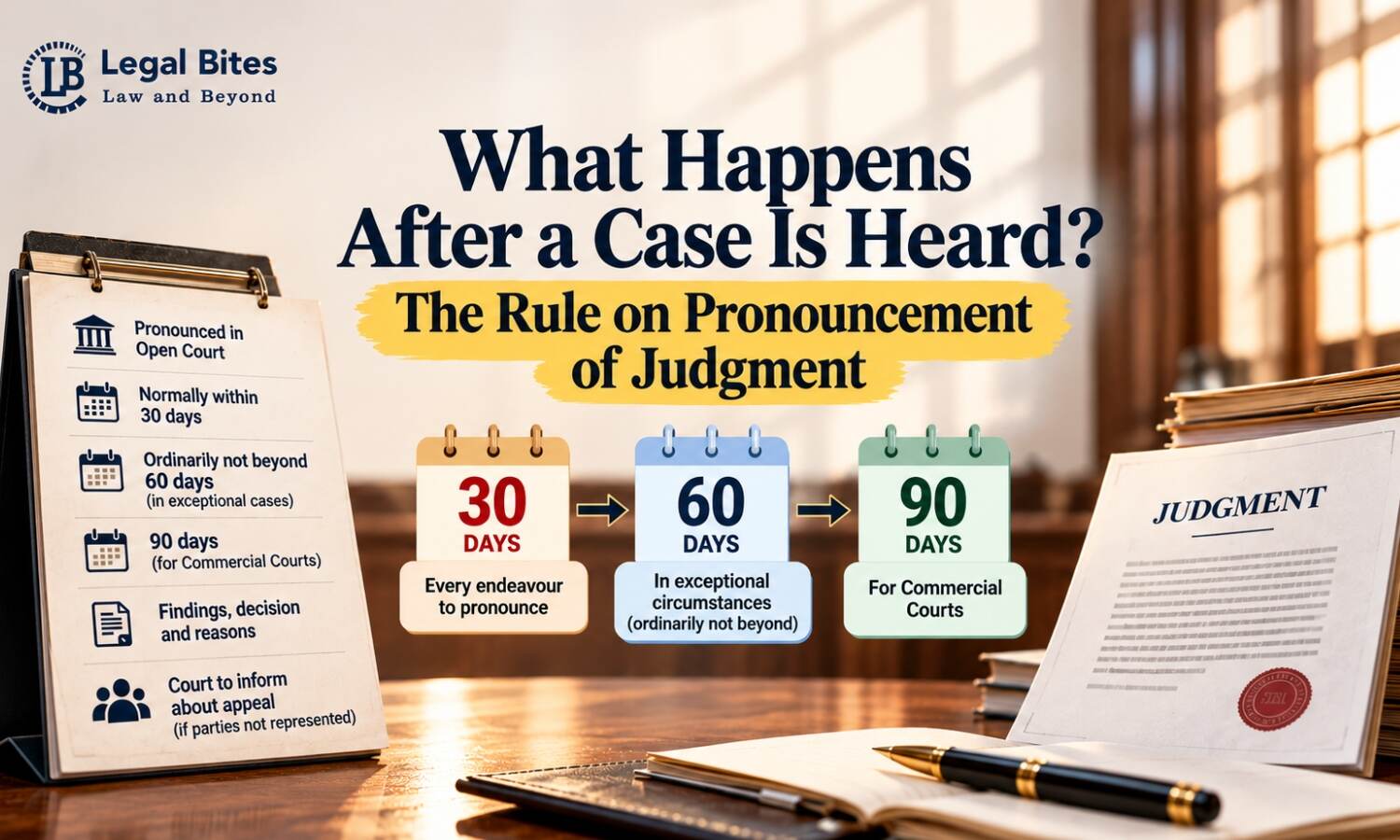
The provision states that every endeavour shall be made to pronounce the judgment within 30 days from the date on which the hearing of the case was concluded.
The expression “every endeavour” is significant. The provision recognises that judgment may not always be delivered immediately after arguments conclude, particularly where the matter requires consideration of extensive pleadings, evidence or legal submissions. At the same time, it seeks to ensure that pronouncement is not indefinitely postponed.
Therefore, 30 days from the conclusion of hearing is the ordinarily contemplated period within which every endeavour should be made to pronounce judgment.
Can Pronouncement Go Beyond 30 Days?
Yes. Order XX Rule 1 itself recognises circumstances in which pronouncement within 30 days may not be practicable.
Where exceptional and extraordinary circumstances make it impracticable to pronounce judgment within that period, the Court may fix a future date.
However, the Rule further provides that such date shall not ordinarily be beyond 60 days from the date on which the hearing of the case was concluded.
Accordingly, the statutory framework may be understood as:
Hearing concluded → endeavour to pronounce within 30 days → exceptional and extraordinary circumstances → ordinarily not beyond 60 days.
Where a future date is fixed, due notice of that date must be given to the parties or their pleaders.
Special Rule for Commercial Courts
The position is specifically modified in relation to commercial disputes. For a Commercial Court, Commercial Division or Commercial Appellate Division, the applicable provision requires judgment to be pronounced within 90 days of the conclusion of arguments.
Copies of the judgment are also required to be issued to all parties to the dispute through electronic mail or otherwise.
This provision must therefore be distinguished from the general 30-day and ordinarily 60-day framework contained in Order XX Rule 1 for other civil proceedings.
Is the Court Required to Read the Entire Judgment?
A judgment may sometimes run into several pages. The CPC does not require the Judge to read the entire written judgment aloud in open Court.
Under Order XX Rule 1(2), where a written judgment is to be pronounced, it is sufficient if the Court reads out:
- its findings on each issue; and
- the final order passed in the case.
Therefore, the formal requirement of pronouncement does not mean that every paragraph of a written judgment must be orally read in Court.
Can a Judgment Be Dictated in Open Court?
Order XX also recognises pronouncement of judgment by dictation in open Court. Under Rule 1(3), a judgment may be pronounced by dictation in open Court to a shorthand writer where the Judge has been specially empowered by the High Court for that purpose.
Where this procedure is followed, the transcript must, after necessary corrections, be:
- signed by the Judge;
- dated with the date on which the judgment was pronounced; and
- made part of the record.
Thus, the CPC accommodates different modes of pronouncement while preserving the authenticity of the judicial record.
Can a Successor Judge Pronounce a Judgment Written by the Previous Judge?
Yes.
An interesting situation may arise where a Judge has written the judgment but ceases to hold that particular office before formally pronouncing it.
Order XX Rule 2 CPC addresses this situation by permitting a Judge to pronounce a judgment that was written but not pronounced by his or her predecessor.
The provision avoids the necessity of restarting the decision-making process merely because there has been a change of Judge after the judgment has already been written.
When Must the Judgment Be Signed?
Pronouncement is accompanied by another important procedural requirement: dating and signing the judgment.
Under Order XX Rule 3 CPC, the judgment must be dated and signed by the Judge in open Court at the time it is pronounced.
Once the judgment has been signed, the general rule is that it cannot afterwards be altered or added to.
There are, however, recognised exceptions. Rule 3 expressly preserves alteration as permitted:
- under Section 152 CPC; or
- on review.
Section 152 deals with correction of clerical or arithmetical mistakes in judgments, decrees or orders, or errors arising from accidental slips or omissions.
The restriction under Rule 3 gives finality to the judgment as formally pronounced and authenticated while retaining the limited corrective mechanisms recognised by the CPC.
What Must a Judgment Contain?
Order XX does not merely prescribe when a judgment should be pronounced. It also deals with what the judgment should contain.
Order XX Rule 4 makes a distinction between judgments of Courts of Small Causes and those of other Courts.
A judgment of a Court of Small Causes need not contain more than:
the points for determination and the decision thereon.
For other Courts, however, the judgment must contain:
1. A concise statement of the case
2. The points for determination
3. The decision on those points
4. The reasons for the decision
The requirement to state reasons is particularly important. A judgment is not merely an announcement of which party succeeds; it records the reasoning through which the Court reaches its conclusion.
Court Must Ordinarily Decide Each Issue
Civil suits frequently involve several disputed questions of fact and law. These are crystallised into issues before the Court.
Order XX Rule 5 CPC requires the Court, where issues have been framed, to state its finding or decision along with reasons upon each separate issue.
There is, however, an exception.
If the finding on one or more issues is itself sufficient to decide the suit, the Court need not necessarily determine every remaining issue.
The Rule therefore combines the requirement of reasoned adjudication with recognition that deciding an unnecessary issue may serve no practical purpose where another finding completely disposes of the suit.
What If the Parties Are Not Represented by Lawyers?
Order XX contains another useful procedural safeguard that is sometimes overlooked.
Under Rule 5A, except where both parties are represented by pleaders, when the Court pronounces judgment in a case that is subject to appeal, it must inform the parties present in Court about:
- the Court to which the appeal lies; and
- the period of limitation for filing the appeal.
The Court must also place on record the fact that such information was given.
The provision is particularly relevant for an unrepresented litigant who may otherwise be unaware of where an appeal must be filed or the time available for doing so.
Pronouncement Is More Than Merely Announcing the Result
Order XX shows that the delivery of a judgment is itself a regulated stage of civil proceedings.
The CPC does not treat a judgment merely as an announcement that the plaintiff or defendant has succeeded. It regulates when the judgment should be pronounced, how it may be pronounced, what it should contain, when it must be signed and the extent to which it may subsequently be altered.
The general scheme can be remembered simply:
Case heard → Judgment pronounced in open Court → Ordinarily endeavour within 30 days → Exceptional circumstances may extend the date, ordinarily not beyond 60 days → Judgment dated and signed → Decision supported by reasons.
For specified commercial courts and divisions, the separate 90-day requirement from the conclusion of arguments must be kept in mind.
Conclusion
The conclusion of a hearing marks the beginning of the final stage of adjudication rather than the completion of the judicial process. Order XX CPC provides the procedural framework through which the Court’s determination is converted into a formally pronounced and authenticated judgment.
The requirement of pronouncement in open Court, the timelines governing reserved judgments, the obligation to record findings and reasons, and the rule against alteration after signing collectively promote certainty and transparency in civil adjudication.
For litigants as well as law students, the central point is worth remembering: after a case has been heard, the Court must pronounce its judgment in open Court, either immediately or in accordance with the timeline and procedure contemplated under Order XX CPC.