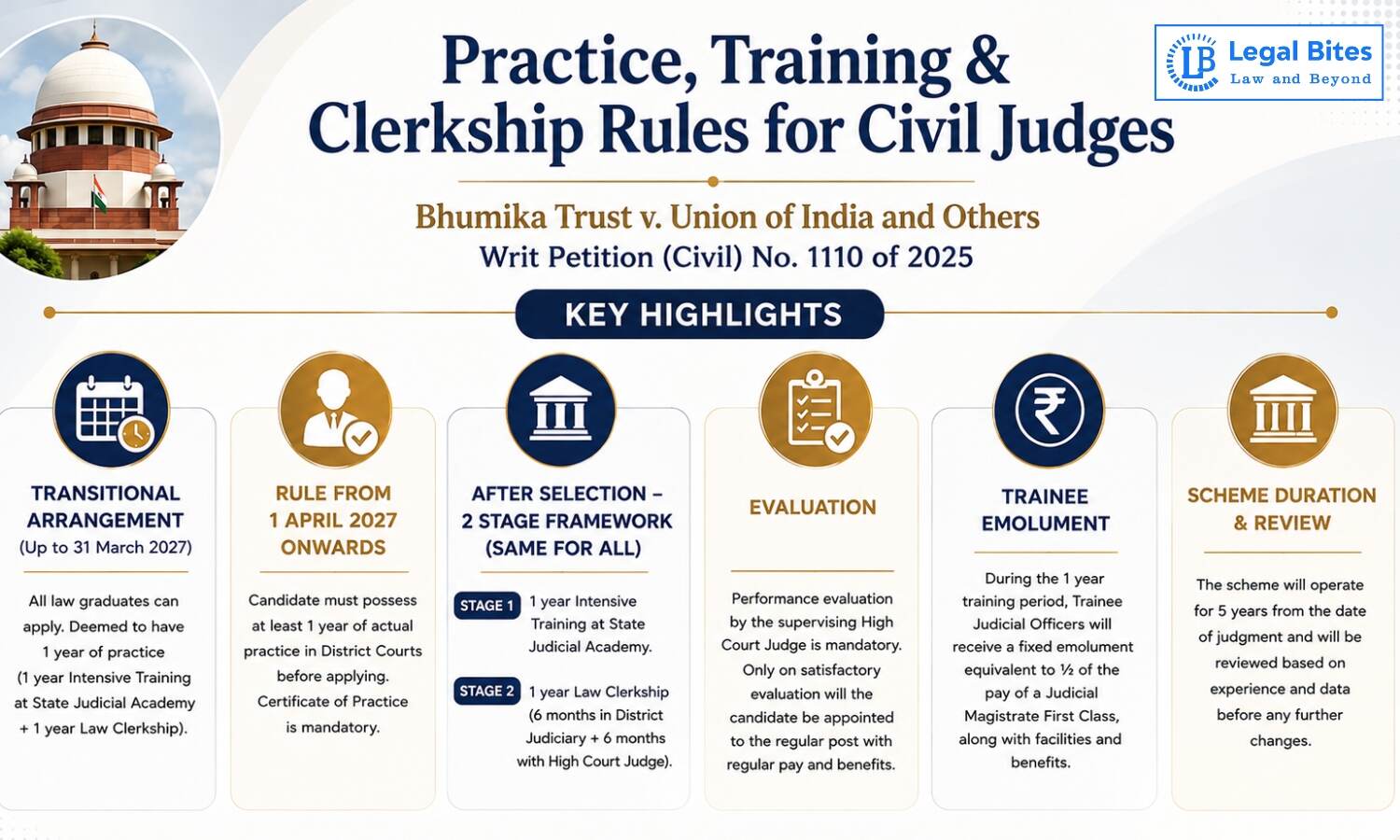
In a significant ruling concerning recruitment to the subordinate judiciary, the Supreme Court of India has modified its 2025 judgment requiring three years of practice at the Bar before a candidate could appear for recruitment as a Civil Judge (Junior Division). The Court has now devised a new framework under which, after the transitional period, candidates will need one year of actual practice, followed, upon selection, by one year of intensive training at a State Judicial Academy and one year of structured Law Clerkship.
The judgment was delivered on August 21, 2026, in Bhumika Trust v. Union of India and Others, Writ Petition (Civil) No. 1110 of 2025, along with review petitions and connected applications. The majority judgment was authored by Chief Justice of India Surya Kant on behalf of himself and Justice Augustine George Masih. Justice K. Vinod Chandran delivered a separate opinion disagreeing with the review of the earlier three-year practice requirement.
The ruling does not reject the importance of courtroom experience. Instead, the majority attempts to strike a balance between practical exposure at the Bar, accessibility of judicial service to young law graduates and structured institutional preparation for judicial office.
Background: How the Three-Year Practice Requirement Evolved
The question of whether prior practice should be mandatory for appointment as a Civil Judge has undergone several changes over the past three decades.
In the Second All India Judges’ Association case in 1993, the Supreme Court directed States to prescribe three years of practice as a lawyer as an essential qualification for recruitment at the lowest level of the judiciary. The rationale was that judicial officers deal with serious questions concerning life, liberty, property and reputation and therefore require practical exposure to courts.
The position changed after the Shetty Commission examined qualifications for entry into judicial service. The Commission noted the changes that had taken place in legal education, including the introduction of three-year LL.B. programmes and integrated five-year law courses with greater practical components.
The Supreme Court subsequently accepted the Commission’s recommendation in the Third All India Judges’ Association case in 2002 and removed the mandatory three-year practice requirement. Fresh law graduates consequently became eligible for recruitment to the judicial service. At the same time, the Court recommended that recruits undergo training for not less than one year and preferably two years before taking on judicial responsibilities.
This position continued for more than two decades.
Supreme Court Restored Three-Year Practice Requirement in 2025
The issue was reconsidered by the Supreme Court in 2025 after responses were sought from High Courts and State Governments regarding the experience of recruiting fresh law graduates directly into judicial service.
The Court recorded concerns that candidates entering directly from law colleges sometimes lacked familiarity with court procedure, courtroom decorum and the practical functioning of courts. Concerns were also raised regarding their ability to deal with urgent proceedings and their interactions with advocates, litigants, superiors and court staff.
Consequently, in its judgment dated May 20, 2025, the Supreme Court restored the requirement of three years’ practice at the Bar for candidates seeking to appear for recruitment as Civil Judges (Junior Division).
The earlier judgment also directed that experience acquired while working as a Law Clerk with a Judge or Judicial Officer would count while calculating the period of practice. Candidates selected as Civil Judges were further required to undergo at least one year of training before presiding over a court.
Why Was the 2025 Judgment Reconsidered?
The restoration of the three-year requirement led to review petitions and other proceedings before the Supreme Court.
One of the proceedings was instituted by Bhumika Trust, which represented several hundred persons with disabilities and sought, among other reliefs, relaxation of the practice requirement for the candidates represented by it.
The Court initially observed that the eligibility standard should ordinarily remain uniform across different categories of candidates. Before reaching a final conclusion, however, it sought suggestions from High Courts as well as Law Universities and National Law Schools across the country.
The petitioners and review petitioners questioned whether three years of practice was necessarily the most effective method of preparing future judicial officers.
Their principal argument was that the quality of practice varies considerably. Merely spending three years enrolled as an advocate does not necessarily mean that a candidate has acquired meaningful experience in trials, evidence, advocacy or court procedure.
Another concern was that the requirement could discourage talented young graduates from judicial service by delaying their entry.
Economic and Social Impact of Three Years’ Practice
An important aspect considered during the proceedings was the economic reality faced by junior advocates. It was argued that young advocates, particularly outside major metropolitan centres, may earn little or no assured remuneration during their initial years. A mandatory three-year waiting period could therefore create a substantial barrier for candidates from economically weaker and marginalised backgrounds.
Concerns were also placed before the Court regarding women candidates. It was argued that delaying eligibility could interact with social and familial responsibilities and thereby create an additional obstacle to their participation in judicial service.
The majority ultimately acknowledged that the burden of the restored requirement would not fall equally on all candidates. Young advocates without established professional networks or financial support could find it particularly difficult to sustain several years of practice with little assured income. Women and persons with disabilities could encounter additional barriers.
The Court nevertheless declined to create separate eligibility standards for different categories, noting concerns expressed by several High Courts regarding fragmented standards for judicial recruitment.
Views of High Courts and National Law Universities
The Court received a wide range of suggestions from High Courts and law universities. Several High Courts supported a uniform requirement and opposed separate exemptions for particular categories of candidates. Their position was that a Civil Judge must, from the outset, understand court procedure, appreciation of evidence and drafting of judicial orders.
At the same time, suggestions were made that relevant practical experience need not be restricted exclusively to conventional advocacy.
The High Courts of Manipur and Jharkhand, for example, suggested that experience could include Law Clerkships, research attachments with Judges or Courts and apprenticeships with experienced practitioners.
A substantial body of opinion from law universities favoured a shorter practice period accompanied by stronger post-selection training.
The National Law University, Jodhpur suggested one year of practice, reinforced by structured judicial clerkships and intensive institutional training. Other universities suggested combinations of judicial academy instruction, attachments with District Judges, Senior Advocates and supervised judicial work.
The submissions also emphasised that the number of years spent at the Bar may not necessarily be an accurate indicator of competence because the experience available to junior lawyers varies significantly depending upon the chamber, court, mentor and opportunities available to them.
Supreme Court: Some Courtroom Exposure Remains Essential
The majority did not accept the argument that prior practical exposure should disappear altogether. It affirmed the fundamental reasoning underlying the 2025 judgment: a person entering judicial service should not be completely unfamiliar with the functioning of courts.
According to the Court, a Civil Judge deals from the very beginning with matters affecting life, liberty, property and personal rights. Exposure to courts, lawyers, litigants and judicial functioning can contribute to qualities such as judicial temperament, patience, empathy and courtroom discipline.
The Court therefore held that requiring some practical exposure before judicial office is neither unreasonable nor inconsistent with the objective of maintaining a competent and independent subordinate judiciary.
The real question, however, was different: Does that exposure necessarily have to consist of three years of conventional practice at the Bar before a candidate can even take the examination?
On this question, the majority adopted a more flexible approach.
Three Years at the Bar Alone Does Not Guarantee Competence
The Supreme Court recognised that the mere passage of time at the Bar cannot be the sole measure of meaningful courtroom experience.
The quality of a young lawyer’s practice can depend upon the chamber in which the lawyer works, the nature of the court, opportunities to appear, mentoring and the candidate’s financial circumstances.
The Court also noted that judicial training infrastructure has changed significantly. Judicial Academies now exist across the country and can provide structured and supervised instruction in skills that a junior advocate might otherwise acquire only unevenly during practice.
The majority consequently emphasised a combination of professional exposure and institutional judicial training, rather than relying solely on the number of years for which a candidate has remained enrolled as an advocate.
Higher Legal Education Will Not Count as Practice
The Court separately considered applications seeking to count the period spent pursuing higher legal education towards the practice requirement.
That request was rejected. The Court reasoned that the object of the requirement is to develop familiarity with and understanding of the actual functioning of the judicial system. Time spent pursuing higher legal education therefore cannot substitute the practical exposure contemplated by the requirement.
This distinction is important. Academic advancement and practical judicial exposure may both be valuable, but the Court treated them as serving different purposes for determining eligibility for entry-level judicial service.
The New Model: Practice + Judicial Academy + Clerkship
The central feature of the judgment is the Court’s attempt to replace an exclusively time-based practice requirement with a structured model of professional and institutional exposure.
The Court explained that practice and training are complementary rather than mutually exclusive. Practice at the Bar exposes a candidate to the adversarial system. Judicial training, on the other hand, prepares a candidate for the fundamentally different responsibility of deciding disputes.
Accordingly, the Court prescribed a combination consisting broadly of:
- practical exposure before selection;
- intensive institutional training after selection; and
- supervised Law Clerkship before independent judicial work.
The clerkship is intended to expose trainee officers to court proceedings, judicial decorum, interaction with advocates and litigants, analysis of cases, evaluation of submissions, application of procedural law and preparation of judicial orders.
Special Transitional Arrangement Until March 31, 2027
The Supreme Court created a distinct transitional regime for recruitment notifications or advertisements issued after the May 20, 2025 judgment and up to March 31, 2027. For these recruitments, all law graduates will be eligible to apply notwithstanding the three-year practice requirement.
The Court has deemed such candidates to have completed one year of active practice for purposes of their applications. They will not have to submit a separate Certificate of Practice for this deemed period.
This is a one-time transitional arrangement designed to address the position of students and recent graduates whose academic and professional plans were made when fresh graduates remained eligible for judicial service.
Selected Candidates Will First Become ‘Trainee Judicial Officers’
Candidates selected during the transitional period will not immediately begin exercising independent judicial functions. They will initially be designated as “Trainee Judicial Officers”.
They must undergo one year of compulsory intensive training at the concerned State Judicial Academy. The Court has directed that this year of institutional training will be treated as equivalent to one year of practice at the Bar for purposes of the three-year requirement.
During this period, trainee officers will receive a fixed emolument equivalent to one-half of the remuneration payable to a Judicial Magistrate First Class in the concerned State, together with facilities and benefits ordinarily provided to trainees at the State Judicial Academy.
One-Year Structured Law Clerkship After Training
Successful completion of Judicial Academy training will be followed by another one year of structured Law Clerkship. The clerkship will be divided into two stages:
- the first six months will be under the supervision of the Principal District/District and Sessions Judge or members of the Higher Judicial Services; and
- the remaining six months will be under a sitting Judge of the concerned High Court.
This one-year clerkship will also be treated as equivalent to one year of practice at the Bar.
During the clerkship, trainee officers will continue to receive the same emoluments admissible during their Judicial Academy training, without further allowance.
Evaluation Before Regular Judicial Appointment
Completion of training and clerkship will not automatically result in independent judicial posting. At the conclusion of the clerkship, the High Court Judge under whom the trainee has served must submit a reasoned evaluation report regarding the trainee’s performance and suitability.
The Court indicated that assessment should consider factors including:
- conduct and diligence;
- analytical ability;
- understanding of procedure;
- ability to deal with cases;
- quality of legal reasoning; and
- suitability for judicial office.
The Supreme Court nevertheless cautioned that the assessment must remain objective and reasoned and should not become an additional undefined barrier to appointment.
Once the evaluation is satisfactory, the trainee will be appointed to the regular post and become entitled to the regular pay scale and other service benefits.
What Happens From April 1, 2027?
The most consequential long-term change applies to recruitment notifications and advertisements issued on or after April 1, 2027.
From that date, every candidate seeking to appear for the Civil Judge (Junior Division) examination must possess at least one year of actual practice.
The practice must be verified through a Certificate of Practice. The certificate cannot be issued unless the candidate’s presence and participation in effective judicial proceedings have been recorded in accordance with a mechanism to be prescribed by the respective High Courts.
Importantly, the judgment specifies that the application will be entertained only upon submission of a certificate showing one year of actual practice in the District Courts.
Thus, the new permanent framework does not completely abolish prior practice. It reduces the pre-examination requirement from three years to one year, while shifting the remaining practical preparation into a structured post-selection regime.
Training and Clerkship Remain Mandatory Even After One Year of Practice
Candidates applying under the regime beginning April 1, 2027 will not be exempted from post-selection training merely because they have already completed one year of actual practice.
Once selected, they must undergo:
One year of intensive training at the State Judicial Academy + six months of Law Clerkship at the district judiciary level + six months of Law Clerkship under a sitting High Court Judge.
Therefore, the framework effectively combines one year of pre-selection actual practice with two years of structured post-selection preparation before the candidate assumes regular independent judicial responsibilities.
High Courts and States Must Amend Recruitment Rules
The Supreme Court directed State Governments, in consultation with their respective High Courts, to make and officially notify the necessary amendments to the applicable recruitment rules.
These amendments must be completed within three months from the date of the judgment.
The Court also clarified that recruitment advertisements already issued after the 2025 judgment, as well as future advertisements, must conform to the framework laid down in the present decision.
No Separate Eligibility Standard for Persons with Disabilities
Although the proceedings included concerns raised on behalf of persons with disabilities, the majority did not establish a separate practice requirement exclusively for such candidates.
Instead, the Court considered that its revised framework adequately addressed the grievances, including the need for appropriate accommodation for persons with disabilities.
This approach also reflected the concern expressed by several High Courts that entry standards should remain uniform rather than being fragmented across different categories of candidates.
Why the Supreme Court Modified the Earlier Rule
The judgment reflects an attempt to reconcile two competing considerations. On one side is the institutional need for judges who understand how courts actually function. The Supreme Court did not retreat from its view that practical courtroom exposure is important.
On the other side is the recognition that three years of formal practice before a candidate may even sit for a judicial service examination can create substantial barriers without necessarily guaranteeing three years of meaningful courtroom experience.
The Court was particularly conscious that fresh and recent graduates had organised their education and preparation around a system that, for more than two decades, allowed direct entry into judicial service examinations. The sudden restoration of three years’ practice therefore significantly altered their prospects.
The majority ultimately sought to secure what it described as both practical readiness and intellectual merit, rather than pursuing one at the expense of the other.
Justice K. Vinod Chandran’s Separate Opinion
The decision was not unanimous. Justice K. Vinod Chandran disagreed with the need to review the earlier three-judge Bench decision prescribing three years of practice at the Bar.
At the beginning of his separate judgment, Justice Chandran stated that he was unable to persuade himself that review of the earlier well-considered decision prescribing three years’ practice before embarking on a judicial career was imperative. He emphasised the limited contours of review jurisdiction and approached the case from the standpoint of whether there was an error apparent on the face of the record.
The existence of this separate opinion is significant because it demonstrates that the debate was not merely about the desirable duration of practice, but also about whether the conditions for exercising the Supreme Court’s review jurisdiction had been satisfied.
The Scheme Will Operate for Five Years
The Supreme Court has expressly stated that the new arrangement should not be treated as immutable. Judicial recruitment, according to the Court, is an evolving process. Its effectiveness must therefore be assessed on the basis of actual experience.
The scheme will remain in force for five years from the date of the judgment. After completion of that period, material concerning the quality of recruitment, efficacy of training and clerkship, performance of officers recruited under the scheme and other relevant empirical information will be placed before the Supreme Court.
The Court may thereafter reconsider the framework if necessary.
Key Takeaways for Judiciary Aspirants
The ruling fundamentally changes the manner in which the practice requirement will operate.
- For recruitment advertisements covered by the transitional period up to March 31, 2027, all law graduates can apply despite the earlier three-year rule and will be deemed to possess one year of active practice for application purposes.
- For advertisements issued on or after April 1, 2027, candidates will need one year of actual practice in District Courts, supported by the prescribed Certificate of Practice.
- After selection, candidates will not immediately take charge as regular Civil Judges. They must complete one year of intensive Judicial Academy training followed by one year of structured Law Clerkship, divided equally between the district judiciary and the concerned High Court.
- Only after satisfactory evaluation will the trainee enter regular judicial service and receive the regular pay and service benefits of the post.
Conclusion
The Supreme Court’s August 21, 2026 judgment represents a substantial recalibration of entry-level judicial recruitment. The Court has retained the principle that future Civil Judges should have real exposure to the functioning of courts but substantially altered how that experience is to be acquired.
Instead of requiring every aspirant to complete three years at the Bar before even competing for judicial service, the Court has adopted a combination of one year of actual practice, intensive Judicial Academy training and supervised Law Clerkship.
The decision therefore does more than simply reduce the practice requirement from three years to one year. It introduces a structured pathway intended to ensure that young judges acquire practical understanding not merely through the passage of time at the Bar, but through supervised exposure to advocacy, adjudication, court procedure and judicial decision-making.
For judiciary aspirants, the most important distinction is the date of recruitment: advertisements up to March 31, 2027 fall under the transitional arrangement, while advertisements issued on or after April 1, 2027 will require one year of actual certified practice before a candidate can appear for the Civil Judge examination. The new scheme will operate for five years, after which the Supreme Court intends to evaluate its effectiveness on the basis of experience and empirical material.