For years, workplace sexual harassment compliance in India largely revolved around one familiar question: Has the organisation constituted an Internal Committee? That question remains important. But it is no longer the whole picture.
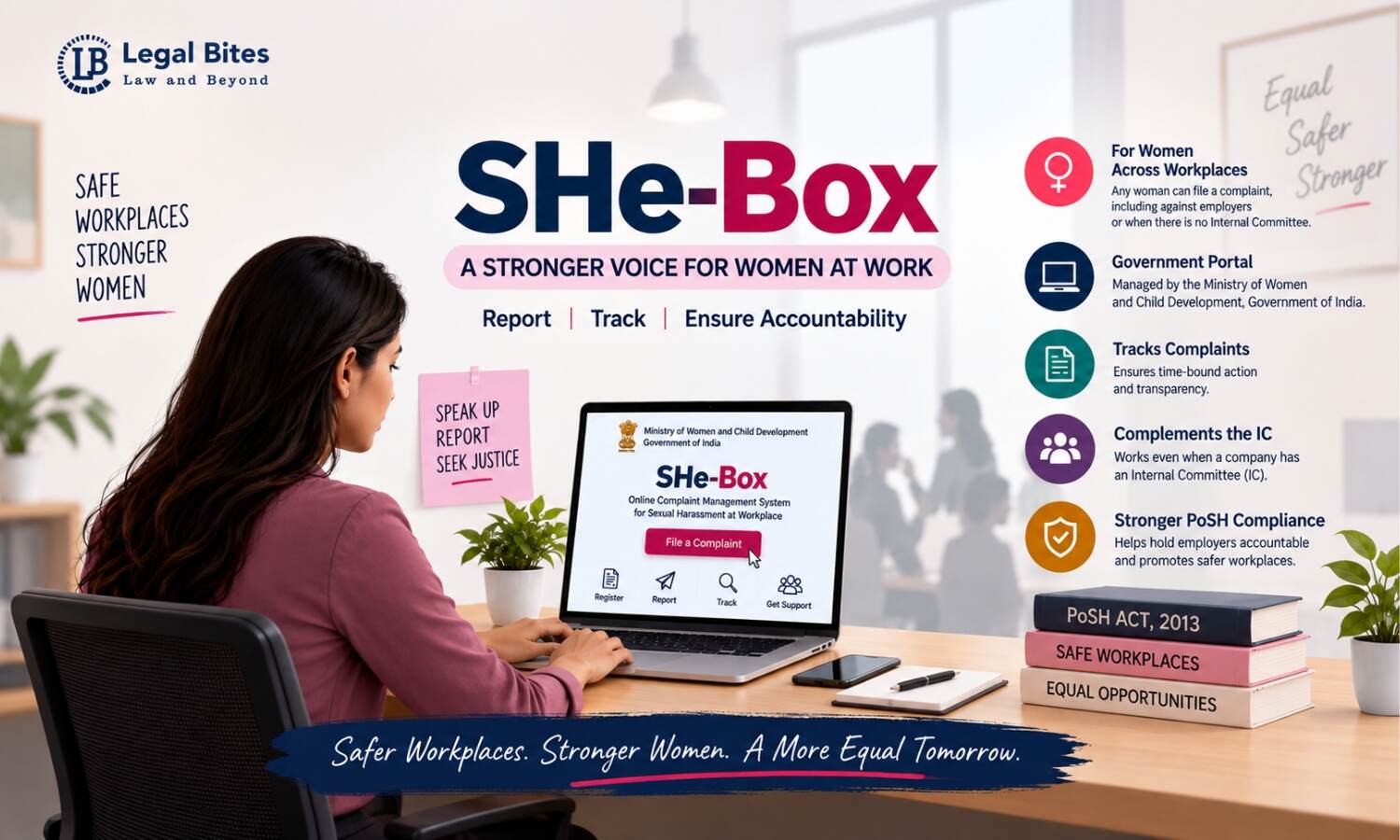
The Government’s revamped Sexual Harassment electronic Box (SHe-Box) has added a digital layer to the implementation of the Sexual Harassment of Women at Workplace (Prevention, Prohibition and Redressal) Act, 2013, commonly known as the POSH Act.
For employers, this raises an obvious question: if a company already has a properly constituted Internal Committee, why should SHe-Box matter?
The answer lies in understanding the distinction between the two. The Internal Committee is the statutory redressal body under the POSH Act. SHe-Box is the Government’s digital platform connecting complainants, Internal Committees, Local Committees and administrative authorities within a more visible and monitorable compliance framework.
What is SHe-Box?
SHe-Box stands for Sexual Harassment electronic Box. The revamped SHe-Box portal was launched by the Ministry of Women and Child Development (MWCD) on 29 August 2024 as a digital governance initiative for implementation of the POSH Act.
It provides a single-window online platform through which women across organised and unorganised sectors, and public and private workplaces, can register and track complaints relating to sexual harassment at the workplace.
Importantly, SHe-Box is also designed as a centralised repository of information concerning Internal Committees (ICs) and Local Committees (LCs) across the country.
The Government has described the revamped portal as a mechanism intended to make the complaint process easier, more secure and transparent while also creating a national database for monitoring and accountability.
Does SHe-Box Replace the Internal Committee?
No. This is perhaps the most important point for employers and employees to understand. The legal obligation to constitute an Internal Committee continues to arise from Section 4 of the POSH Act.
Every employer of a workplace covered by Section 4 is required to constitute an Internal Committee by a written order. Where offices or administrative units are located at different places or at divisional or sub-divisional levels, an Internal Committee is required at those administrative units or offices as contemplated by the provision.
The Committee must include:
- a woman Presiding Officer employed at a senior level;
- at least two employee members, preferably committed to the cause of women, having experience in social work or legal knowledge; and
- one external member from an NGO or association committed to the cause of women, or a person familiar with issues relating to sexual harassment.
At least half of the members nominated to the Committee must be women.
Creating an account on SHe-Box therefore does not satisfy the employer’s obligation to constitute a legally compliant Internal Committee.
Equally, having an Internal Committee does not make SHe-Box irrelevant.
The two perform different functions.
So, What Happens When a Complaint is Filed on SHe-Box?
This is where the relationship between SHe-Box and an organisation’s Internal Committee becomes clearer. A complaint filed through SHe-Box is routed to the Internal Committee of the concerned workplace or the Local Committee of the concerned district, as applicable.
Where the relevant IC or LC is already registered on the portal, the complaint can be automatically submitted and forwarded to that Committee.
Where the workplace’s Internal Committee is not registered on the portal, the system provides a process for obtaining details of the workplace from the complainant and informing the concerned State and District Nodal Officers so that steps can be taken for the registration of that IC. Thus, SHe-Box does not ordinarily create a parallel inquiry body sitting above the company’s Internal Committee.
Instead, it provides a digital gateway through which a complaint can reach the statutory body that is supposed to deal with it.
Why Does SHe-Box Matter to a Company That Already Has an IC?
Because the significance of SHe-Box goes beyond simply providing another place to lodge a complaint.
1. Employees no longer have to depend entirely on the employer’s internal reporting channel
Traditionally, an employee wishing to invoke the PoSH mechanism might approach the Presiding Officer or another member of the Internal Committee through the process communicated by the employer. SHe-Box creates an additional digital access point.
A woman can use the portal to lodge a workplace sexual-harassment complaint, and the complaint can then be routed to the appropriate IC or LC.
This is particularly significant where an employee does not know whom to approach internally or is uncomfortable beginning the process through the organisation’s own reporting channels.
2. The Internal Committee becomes part of a broader digital ecosystem
An IC should no longer be viewed merely as a committee whose constitution order remains somewhere in the organisation’s HR records.
The Government is progressively creating a centralised digital repository of Internal Committees and Local Committees.
As of 27 March 2026, the Ministry reported that more than 1.61 lakh workplaces having more than 10 employees across the public and private sectors had been onboarded on SHe-Box. Details of more than 68,460 Internal Committees and 777 Local Committees were available on the portal.
That scale demonstrates that SHe-Box is increasingly becoming an important component of the country’s PoSH implementation infrastructure.
3. It strengthens monitoring of whether Internal Committees actually exist
This may ultimately be one of the portal’s most important functions. The existence of a statutory requirement to constitute an IC does not necessarily establish that every eligible workplace has actually constituted one.
A centralised repository makes it easier for the administrative machinery to identify workplaces whose IC information has not been made available.
The Ministry has stated that the Supreme Court, through orders dated 3 December 2024, 12 August 2025 and 6 January 2026 in Aureliano Fernandes v. State of Goa & Ors., directed Chief Secretaries to have District Officers conduct surveys concerning public and private organisations and the constitution of ICs under Section 4. The States were further directed to ensure that the collected information is onboarded onto SHe-Box.
The result is important for employers: PoSH compliance is increasingly capable of being monitored institutionally rather than remaining solely within an organisation’s files.
Who Handles the Complaint: IC or Local Committee?
Under Section 4 of the POSH Act, 2013, every employer of a workplace must constitute an Internal Committee (IC) by written order. Where offices or administrative units are situated at different places or at divisional or sub-divisional levels, an IC must be constituted at all such units or offices.
Under Section 6, the District Officer must constitute a Local Committee (LC) to receive complaints from establishments where an IC has not been constituted because the establishment has less than ten workers, and also where the complaint is against the employer himself.
SHe-Box does not replace the IC or LC. It provides a digital route through which complaints can be directed to the appropriate statutory committee under the POSH Act.
Can Someone Other Than the Aggrieved Woman File Through SHe-Box?
The Government’s explanation of the revamped portal states that a complaint may be filed by the aggrieved woman or another person on her behalf.
Where another person files the complaint, the portal requires details concerning that person’s relationship with the complainant as well as an undertaking from the complainant and prescribed information concerning the aggrieved woman.
This digital functionality must, however, be understood alongside Section 9 of the POSH Act and the POSH Rules, 2013, which govern the making of complaints and the circumstances in which another person may make a complaint where the aggrieved woman is unable to do so.
What About Confidentiality?
Confidentiality is a central requirement under the PoSH framework.
Section 16 of the PoSH Act restricts publication or communication to the public, press and media of specified information relating to the complaint and inquiry proceedings, including the identity and addresses of the aggrieved woman, respondent and witnesses, subject to the terms of the provision.
SHe-Box has been designed to mask complainant details for confidentiality. Except the Chairperson of the concerned IC or LC, other persons are not able to see the complainant’s details or the nature of the complaint registered through the portal.
The digital nature of the mechanism therefore does not remove the confidentiality obligations imposed by the POSH Act.
SHe-Box Also Matters for Compliance Monitoring
The PoSH Act already contains several reporting and monitoring obligations.
Under Section 19, an employer is required, among other things, to provide a safe working environment, display the consequences of sexual harassment and the order constituting the Internal Committee, organise awareness programmes and workshops, provide necessary facilities to the IC or LC, assist in securing attendance of persons before the Committee, and monitor timely submission of reports by the IC.
Under Section 21, the Internal Committee or Local Committee must prepare an annual report and submit it to the employer and District Officer.
Under Section 22, the employer must include information concerning the number of cases filed and their disposal in the organisation’s annual report or, where no such annual report is required, intimate the information to the District Officer.
Section 23 further requires the appropriate Government to monitor implementation of the Act and maintain data concerning cases filed and disposed of.
Seen against these provisions, SHe-Box fits into a larger movement towards centralised information, traceability and monitoring of PoSH implementation.
Is Registration on SHe-Box the Same as PoSH Compliance?
No. This distinction deserves emphasis. An organisation should not assume:
“Our IC details are on SHe-Box, therefore we are POSH compliant.”
POSH compliance is considerably broader. An employer must ensure, among other things, that its Internal Committee is constituted in accordance with Section 4; appointments and tenure comply with the Act; the external member satisfies the statutory requirement; employees are made aware of the mechanism; prescribed workshops and awareness programmes are organised; complaints are dealt with according to the statutory procedure; confidentiality is maintained; reports are prepared and submitted; and other duties under Section 19 are fulfilled.
SHe-Box can strengthen accessibility and governmental monitoring, but it does not cure defects in the constitution or functioning of an Internal Committee.
What Happens if an Employer Does Not Constitute an IC?
Under Section 26 of the POSH Act, failure to constitute an Internal Committee under Section 4, failure to take action under Sections 13, 14 and 22, or contravention or attempted contravention of other provisions of the Act or Rules can attract a fine extending to ₹50,000.
A repeat offence can result in enhanced punishment and may also have consequences for the employer’s licence, registration or approval for carrying on business or activity, subject to the statutory framework.
SHe-Box does not create this liability; the liability comes from the POSH Act itself. What the portal changes is the environment in which such compliance can be identified, recorded and monitored.
What Should Companies Do Now?
For employers, the practical approach should be to treat SHe-Box and the Internal Committee as complementary parts of the POSH compliance framework, rather than alternatives.
Organisations should verify that:
- a valid Internal Committee has been constituted wherever Section 4 requires it;
- its composition and tenure comply with the POSH Act;
- the external member satisfies the statutory criteria;
- IC information maintained/onboarded for SHe-Box purposes is accurate and current;
- the appropriate nodal officer and responsible personnel understand how complaints received through the portal will be handled;
- employees know both the organisation’s internal complaint mechanism and the availability of SHe-Box;
- statutory confidentiality is preserved even where the complaint originates digitally;
- complaints are dealt with within the timelines prescribed under the Act; and
- annual reporting and other statutory obligations continue to be complied with independently of portal registration.
The Bigger Shift: From Having an IC to Demonstrable Compliance
The significance of SHe-Box is ultimately larger than the portal itself. The POSH Act has always imposed obligations on employers. What is changing is the visibility of compliance.
A company may have an Internal Committee on paper. But increasingly, regulators and administrative authorities can seek to know whether that Committee exists, whether its details are current, whether complaints are reaching the appropriate body and whether the statutory machinery is actually functioning.
SHe-Box provides the digital infrastructure for part of that process. For employees, it creates a centralised route for accessing the statutory complaint mechanism.
For Internal Committees, it provides another channel through which complaints may reach them. For employers, it reinforces the need to move beyond formal constitution of an IC towards continuous, verifiable POSH compliance.
And for the Government, it provides something the decentralised statutory framework previously made difficult to achieve: a more structured national picture of how workplace sexual harassment redressal mechanisms are functioning.