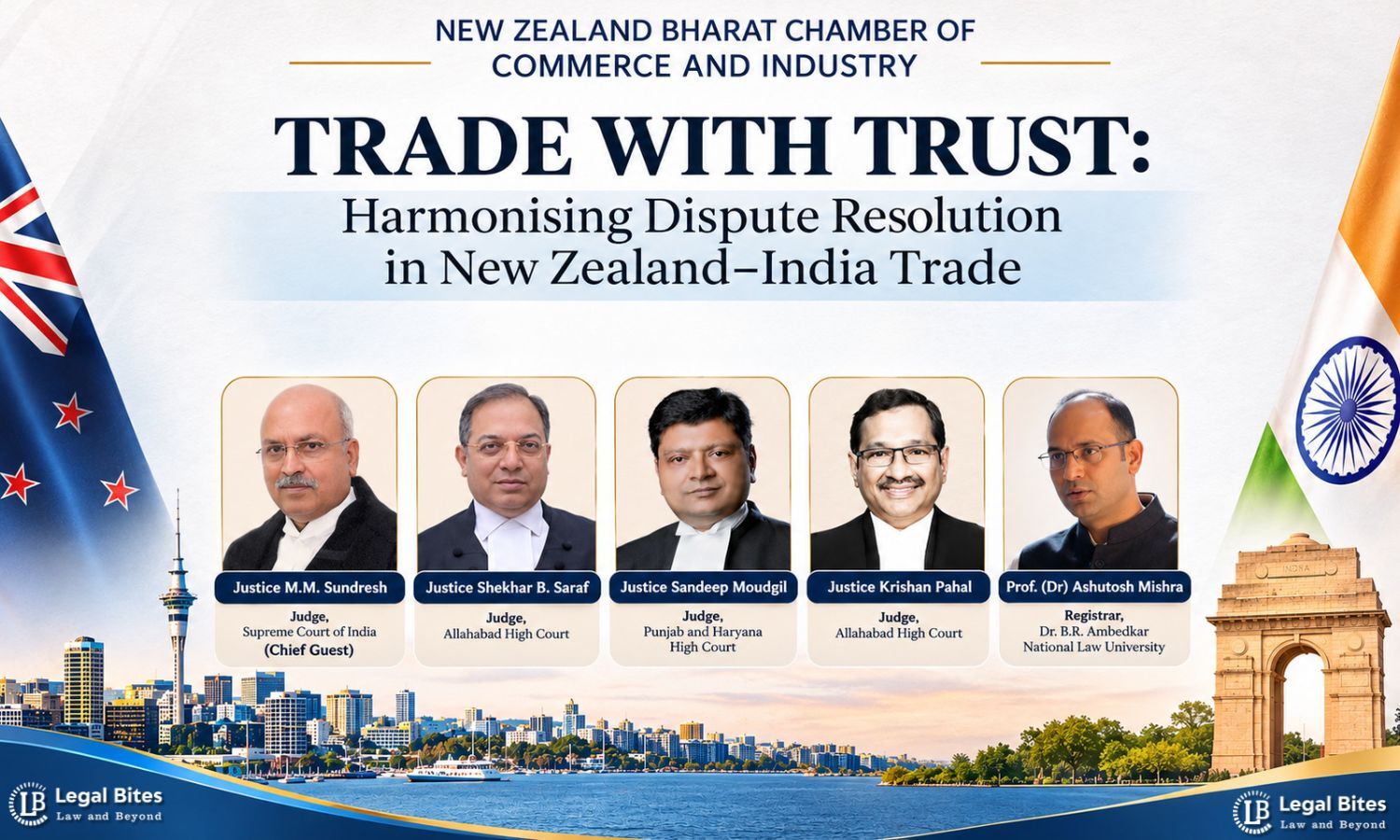
Auckland, November 2026: Hon’ble Mr Justice M.M. Sundresh, Judge, Supreme Court of India, graced the international legal symposium titled “Trade with Trust: Harmonising Dispute Resolution in New Zealand–India Trade” as the Chief Guest and delivered the keynote address on the evolving jurisprudence of international arbitration. The symposium witnessed the participation of Hon’ble Mr Justice Shekhar B. Saraf, Judge, Allahabad High Court; Hon’ble Mr Justice Sandeep Moudgil, Judge, Punjab and Haryana High Court; Hon’ble Mr Justice Krishan Pahal, Judge, Allahabad High Court; and Prof. (Dr) Ashutosh Mishra, Registrar, Dr. B.R. Ambedkar National Law University. The Rt Hon Sir Anand Satyanand, former Governor-General of New Zealand, graced the occasion as the Guest of Honour.
Organised by the New Zealand Bharat Chamber of Commerce and Industry (NZBCCI) and hosted by the Auckland Business Chamber, the symposium brought together distinguished members of the judiciary, legal academia, diplomatic community and business fraternity to deliberate on strengthening cross-border commercial dispute resolution and fostering greater legal and economic cooperation between India and New Zealand.
The symposium assumed particular significance against the backdrop of the India–New Zealand Free Trade Agreement (FTA), with both countries aiming to expand bilateral trade in goods and services to approximately NZ$7 billion by 2030. The deliberations focused on the importance of reliable arbitration, effective mediation, specialised commercial courts and predictable enforcement mechanisms in building trust and confidence among international business stakeholders.
Justice M.M. Sundresh on the Evolving Jurisprudence of International Arbitration
Delivering the keynote address on “Evolving Jurisprudence of International Arbitration,” Justice M.M. Sundresh presented a comprehensive perspective on the historical evolution, contemporary developments and emerging challenges of international arbitration, with particular emphasis on India’s growing role in the global dispute resolution landscape.
Justice Sundresh traced the evolution of arbitration from ancient dispute resolution practices to its emergence as a sophisticated international legal mechanism. He highlighted the significance of the Alabama Claims Arbitration of 1872, the establishment of the Permanent Court of Arbitration, the New York Convention of 1958 and the UNCITRAL Model Law in shaping the foundations of modern international arbitration.
His address underscored the importance of party autonomy, neutrality, procedural flexibility and enforceability of arbitral awards in building confidence among international commercial stakeholders.
India’s Transition Towards a Pro-Arbitration Jurisprudence
Examining the development of Indian arbitration jurisprudence, Justice Sundresh discussed the gradual transition from an interventionist judicial approach towards greater recognition of arbitral autonomy, territoriality and finality of awards.
He referred to several landmark decisions of the Supreme Court of India, including Bhatia International v. Bulk Trading S.A., Bharat Aluminium Co. v. Kaiser Aluminium Technical Services Inc. (BALCO), Enercon (India) Ltd. v. Enercon GmbH and Vijay Karia v. Prysmian Cavi E Sistemi SRL.
These decisions illustrate the judiciary’s evolving approach towards determining the seat of arbitration, limiting judicial interference and facilitating the enforcement of foreign arbitral awards.
Justice Sundresh also examined the recent Constitution Bench decision in Gayatri Balasamy v. ISG Novasoft Technologies Ltd., which recognised the limited power of courts to modify arbitral awards under appropriate circumstances without undertaking a reassessment of their merits.
India’s Potential to Become a Global Arbitration Hub
A significant aspect of Justice Sundresh’s address was India’s potential to emerge as a preferred destination for international commercial arbitration.
Referring to India’s increasing participation in proceedings before the Singapore International Arbitration Centre (SIAC), he highlighted that the number of cases involving Indian parties increased from 89 in 2022 to 160 in 2023 and 183 in 2024, reflecting the growing reliance of Indian businesses on international arbitration.
However, India’s emergence as a global arbitration hub would require more than legislative reforms. Institutional independence, predictable enforcement of arbitral awards, specialised judicial expertise, professional competence and regulatory certainty remain essential to strengthening international commercial confidence.
Justice Sundresh also examined the proposals contained in the Draft Arbitration and Conciliation (Amendment) Bill, 2024, including recognition of emergency arbitration, technology-enabled proceedings, procedural reforms and greater institutional involvement in arbitral processes.
He highlighted the contribution of institutions such as the Mumbai Centre for International Arbitration (MCIA), Delhi International Arbitration Centre (DIAC) and other domestic arbitration institutions in developing India’s dispute resolution infrastructure.
Emerging Frontiers of International Arbitration
Looking beyond conventional commercial disputes, Justice Sundresh explored the expanding relevance of arbitration in cross-border investments, mergers and acquisitions, renewable energy, environmental, social and governance (ESG) obligations, international insolvency and technology-driven dispute resolution.
He discussed the challenges arising from the intersection of arbitration and cross-border insolvency, particularly the need to reconcile party autonomy with the collective nature of insolvency proceedings.
Another significant dimension of his address concerned the growing application of artificial intelligence and online dispute resolution in arbitral proceedings. While recognising the potential of AI to improve efficiency through document review, translation, evidence management and predictive analysis, he also highlighted concerns relating to confidentiality, algorithmic bias, transparency, data security and procedural fairness.
The address emphasised that technological innovation must assist, rather than replace, the independent judgment and decision-making responsibilities of arbitrators.
Justice Sundresh’s keynote presented a forward-looking vision for India — moving from being predominantly a participant in international arbitration conducted in foreign jurisdictions to becoming a trusted destination for resolving international commercial disputes.
Justice Shekhar B. Saraf on Enforcement of Foreign Arbitral Awards
Hon’ble Mr Justice Shekhar B. Saraf, Judge, Allahabad High Court, delivered an address on “Enforcement of Foreign Arbitral Awards: Judicial Restraint and the Rule of Finality.” Drawing a comparative analysis of Indian and New Zealand arbitration laws, he highlighted the importance of distinguishing between judicial supervision at the seat of arbitration and enforcement proceedings in another jurisdiction. Referring to the New York Convention, Section 48 of the Arbitration and Conciliation Act, 1996, and landmark judicial precedents, Justice Saraf emphasised that enforcement proceedings must not become an opportunity to reopen the merits of an arbitral award. He advocated carefully drafted arbitration agreements, procedural fairness and advance consideration of enforcement requirements, underscoring that judicial restraint and predictable enforcement are fundamental to international commercial confidence.
Justice Sandeep Moudgil on Commercial Courts and Early Dispute Resolution
Hon’ble Mr Justice Sandeep Moudgil, Judge, Punjab and Haryana High Court, addressed the symposium on the “Role of Commercial Courts in Early Dispute Resolution.” He highlighted the transformative role of the Commercial Courts Act, 2015, particularly Section 12A, which mandates pre-institution mediation in commercial suits not contemplating urgent interim relief. Justice Moudgil emphasised that specialised commercial courts should function not merely as adjudicatory institutions but also as facilitators of early settlement through mediation, negotiation and effective case management. He underlined the importance of speedy dispute resolution in reducing litigation costs, preserving business relationships, strengthening investor confidence and promoting ease of doing business.
Justice Krishan Pahal on International Commercial Mediation
Hon’ble Mr Justice Krishan Pahal, Judge, Allahabad High Court, spoke on “International Commercial Mediation,” drawing upon the ancient wisdom of the Rig Veda to highlight the enduring significance of dialogue, cooperation and mutual understanding in resolving disputes. He examined the evolution of mediation as an effective mechanism for preserving commercial relationships and discussed India’s Mediation Act, 2023, alongside international developments under the UNCITRAL framework and the Singapore Convention on Mediation. Justice Pahal also highlighted opportunities for India–New Zealand cooperation through institutional partnerships, judicial roundtables, professional exchange programmes and cross-border co-mediation protocols. His address advocated the transformation of mediation from an alternative dispute resolution mechanism into a preferred instrument of international commercial harmony.
Prof. (Dr) Ashutosh Mishra on Bilateral Trade and Institutional Cooperation
Prof. (Dr) Ashutosh Mishra, Registrar, Dr. B.R. Ambedkar National Law University, contributed an academic and institutional perspective through his session on “Bilateral Trade Dynamics: Institutional Frameworks and Comparative Dispute Resolution Practices.” His session focused on the relationship between institutional legal frameworks and the expansion of cross-border commerce, with particular reference to comparative dispute resolution practices in India and New Zealand. The academic dimension of the symposium complemented the judicial perspectives by bringing attention to the role of legal institutions in developing reliable arbitration and commercial law frameworks that support international trade and investment.
Strengthening India–New Zealand Legal and Commercial Relations
The symposium also featured the Rt Hon Sir Anand Satyanand, former Governor-General of New Zealand, as the Guest of Honour. The programme brought together representatives of the diplomatic, legal and business communities, with a special closing address scheduled by Simon Bridges, Chief Executive Officer of the Auckland Business Chamber.
The deliberations highlighted a fundamental principle of international commerce: sustainable trade relationships depend not only on market access and economic opportunities but also on the credibility of the legal mechanisms available to businesses.
With arbitration, mediation, commercial courts and institutional cooperation forming the central themes of the symposium, the Auckland gathering provided an important platform for strengthening judicial dialogue and exploring practical pathways towards harmonised dispute resolution between India and New Zealand.
Justice M.M. Sundresh’s keynote, in particular, placed India’s evolving arbitration jurisprudence within a broader international context, highlighting the country’s opportunities to contribute to and shape the future of global commercial dispute resolution.