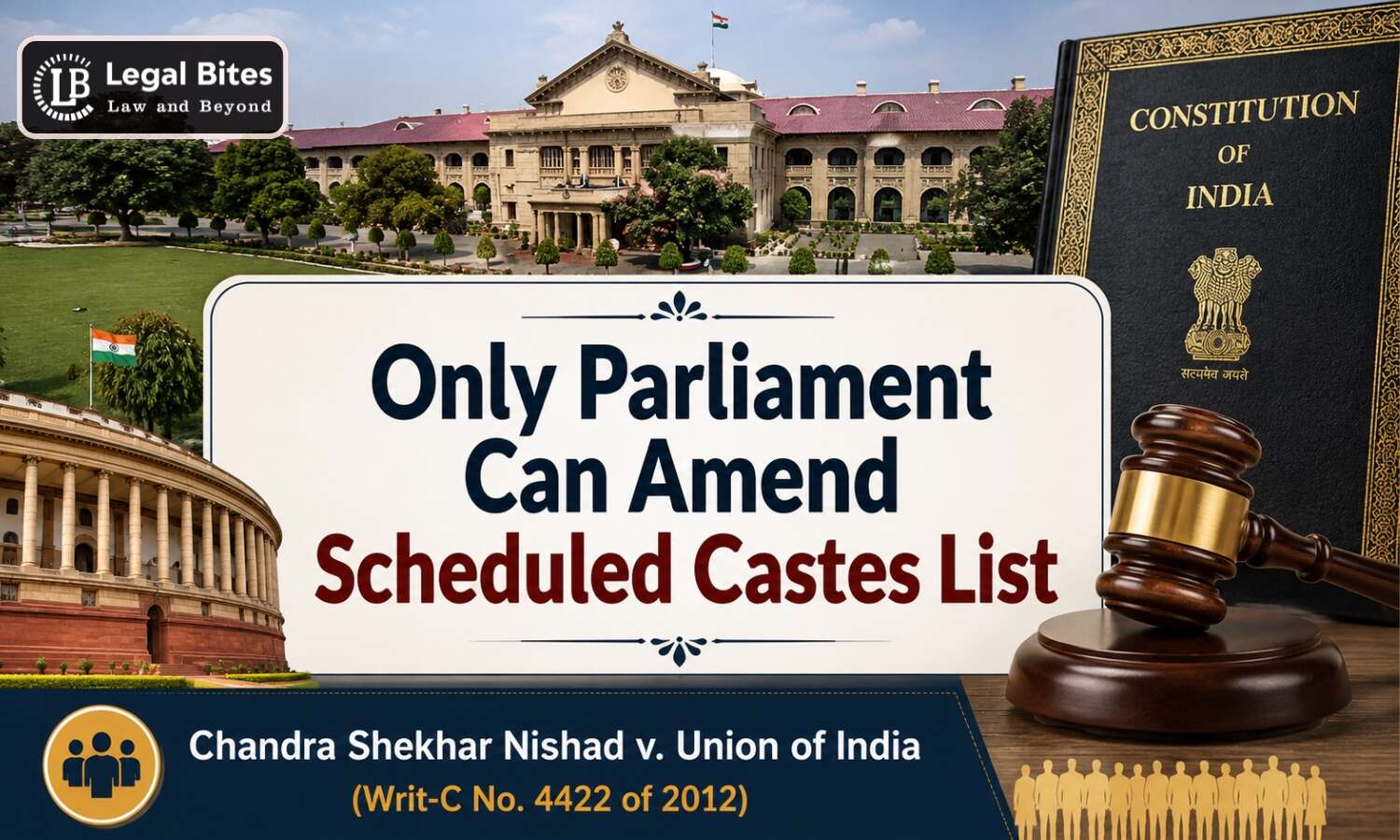
In a significant judgment reaffirming the constitutional scheme governing Scheduled Castes, the Allahabad High Court has held that neither courts nor State Governments possess the authority to alter, expand, or reinterpret the Scheduled Castes list notified under Article 341 of the Constitution of India. The Court emphasised that any inclusion or exclusion from the Scheduled Castes list can only be effected through legislation enacted by Parliament.
The decision came in Chandra Shekhar Nishad v. Union of India (Writ-C No. 4422 of 2012), where the petitioner sought recognition of several communities, including Nishad, Kewat, Mallah, Kashyap, and Bind, as Scheduled Castes by treating them as synonyms or generic names of the caste “Majhwar,” which is already included in the Constitution (Scheduled Castes) Order, 1950. The High Court rejected the plea and reiterated the settled constitutional position that the Presidential Orders issued under Articles 341 and 342 are conclusive and cannot be modified except by Parliament.
The judgment is an important reaffirmation of constitutional federalism, reservation jurisprudence, and the limits of judicial intervention in matters relating to Scheduled Castes and Scheduled Tribes.
Background of the Dispute
The petitioner approached the Court seeking directions to include the communities Mallah and Majhwar in the Scheduled Castes list and to extend Scheduled Caste benefits to them. Subsequently, the petitioner clarified that the real grievance was not merely inclusion but recognition of Nishad, Kashyap, Kewat, Mallah, and Bind as synonymous with the Scheduled Caste “Majhwar.”
The argument advanced on behalf of the petitioner was that these communities belonged to the same traditional occupational group of boatmen and were historically treated as synonymous with Majhwar. Reliance was placed on census records, dictionaries, and earlier judicial decisions to argue that these castes should receive the same constitutional status and reservation benefits as those of the Majhwar.
The State and Union Governments opposed the petition, arguing that the relief sought would effectively amount to amending the Constitution (Scheduled Castes) Order, 1950, something that only Parliament can do under Article 341(2) of the Constitution.
Constitutional Framework: Articles 341 and 342
The Court undertook an extensive examination of Articles 341 and 342 of the Constitution.
Article 341 empowers the President to specify, through a public notification, the castes that shall be deemed Scheduled Castes in relation to a State or Union Territory. Article 341(2) further provides that Parliament may by law include or exclude any caste from the list so notified. Similar provisions exist for Scheduled Tribes under Article 342.
The High Court emphasised that these provisions were deliberately framed to ensure certainty and avoid disputes regarding the identification of Scheduled Castes and Scheduled Tribes. Once a Presidential Order is issued, it attains finality and can only be altered through parliamentary legislation.
The Court observed that the constitutional scheme clearly excludes any power in State Governments, tribunals, or courts to amend or expand the notified lists.
Why the Court Rejected the “Synonym” Argument
The central question before the Court was whether Nishad, Kashyap, Kewat, Mallah, and Bind could be treated as synonyms of Majhwar.
The petitioner relied upon census manuals and linguistic references suggesting similarities among these communities. However, the Court held that such material cannot override the constitutional mechanism prescribed under Article 341.
According to the Court, the Constitution (Scheduled Castes) Order, 1950 specifically mentions “Majhwar” but does not mention Nishad, Mallah, Kewat, Kashyap, or Bind. If the framers of the Presidential Order intended these castes to be included as synonyms or sub-castes, they would have been expressly mentioned alongside Majhwar, as has been done in several other entries where multiple names or variants of a caste are listed together.
The Court further observed that these communities are separately recognised as Other Backward Classes (OBCs) in Uttar Pradesh and therefore cannot be judicially transformed into Scheduled Castes merely by claiming social or occupational similarity with Majhwar.
Reliance on Constitutional Bench Precedents
A major feature of the judgment is its detailed reliance on Constitution Bench decisions of the Supreme Court.
B. Basavalingappa v. D. Munichinnappa
The petitioner relied heavily on this decision, where the Supreme Court had permitted an inquiry into whether “Voddar” and “Bhovi” referred to the same community.
The Allahabad High Court noted that even in Basavalingappa, the Supreme Court had cautioned that generally it is not permissible to modify a Presidential Order by producing evidence to show that an unlisted caste should be deemed part of a listed caste. The decision was based on highly unusual and exceptional circumstances.
Bhaiya Lal v. Harikishan Singh
The Court considered this subsequent Constitution Bench decision even more relevant. In that case, the Supreme Court rejected a claim that a person belonging to the Dohar caste could claim Scheduled Caste status on the ground that Dohar was a sub-caste of Chamar.
The Supreme Court held that such an inquiry was impermissible because Article 341 requires courts to confine themselves to the castes expressly mentioned in the Presidential Order.
State of Maharashtra v. Milind
The most important precedent relied upon by the High Court was the Constitution Bench judgment in State of Maharashtra v. Milind.
In Milind, the Supreme Court authoritatively held that:
- No inquiry can be conducted to determine whether an unlisted caste is included within a listed caste.
- Scheduled Castes and Scheduled Tribes Orders must be read exactly as they stand.
- Parliament alone can amend these Orders.
- Courts, tribunals, and State Governments have no authority to alter them.
- Evidence cannot be led to establish that an unlisted community is synonymous with a listed one.
The Allahabad High Court observed that the issue raised in the present case stood fully concluded by Milind.
Effect of State Government Notifications
An important aspect of the petitioner’s case was reliance upon a 2005 State Government notification which purportedly extended Scheduled Caste benefits to certain castes, including Kahar, Kashyap, Mallah, Nishad, and Bind.
The Court noted that this notification had already been rescinded in 2007. More importantly, even if such a notification existed, a State Government lacks constitutional competence to alter the Scheduled Castes list. Only Parliament can do so under Article 341(2).
The Court also expressed disapproval of the fact that the petitioner relied upon the 2005 notification without disclosing that it had already been withdrawn.
Why Dasarathi Meher Did Not Help the Petitioner
The petitioner also relied on State of Orissa v. Dasarathi Meher, where the Supreme Court recognised that “Kuli” and “Kulis” referred to the same community.
The Allahabad High Court distinguished that case. It was observed that in Dasarathi Meher, there was no separate and distinct community by the name “Kulis.” The controversy merely concerned different spellings or descriptions of the same community.
In contrast, Nishad, Mallah, Kewat, Kashyap, and Bind are separately recognised communities with independent social identities and legal classification as OBCs. Consequently, the reasoning in Dasarathi Meher could not be applied.
Rejection of the Davinder Singh Argument
The petitioner further attempted to rely upon the Constitution Bench decision in State of Punjab v. Davinder Singh concerning sub-classification among the Scheduled Castes. The Court rejected this argument as misplaced.
It explained that Davinder Singh dealt with the question of whether a State could create sub-classifications among already recognised Scheduled Castes for equitable distribution of reservation benefits. It did not concern the inclusion of entirely new castes into the Scheduled Castes list. Therefore, the decision had no relevance to the present controversy.
The High Court clarified that sub-classification among existing Scheduled Castes is fundamentally different from recognising a new caste as a Scheduled Caste.
Constitutional Significance of the Judgment
The ruling carries significance far beyond the specific communities involved in the case.
Preservation of Constitutional Certainty
The judgment reinforces the constitutional objective of maintaining certainty regarding the identity of Scheduled Castes and Scheduled Tribes. If courts were permitted to conduct inquiries into historical, linguistic, or sociological similarities, endless litigation could arise concerning reservation eligibility.
Separation of Powers
The decision also strengthens the doctrine of separation of powers. Questions regarding inclusion or exclusion from Scheduled Castes lists involve legislative policy, socio-anthropological studies, and political consultation. These matters are constitutionally entrusted to Parliament and not to courts.
Protection of Reservation Benefits
The Court echoed the concern expressed in Milind that reservation benefits are intended for historically disadvantaged communities specifically identified under the Constitution. Allowing expansion of these categories through judicial interpretation could dilute the benefits available to genuinely eligible groups.
Limits of State Action
The judgment further clarifies that State Governments cannot indirectly modify the Scheduled Castes list through executive notifications. Any attempt to do so would violate the constitutional framework established under Article 341.
Conclusion
The Allahabad High Court’s decision is a strong reaffirmation of the constitutional architecture governing Scheduled Castes and Scheduled Tribes. By holding that only Parliament can amend the Scheduled Castes list and by rejecting attempts to treat unlisted castes as synonyms of a notified Scheduled Caste, the Court has reinforced a principle repeatedly recognised by the Supreme Court: Presidential Orders issued under Articles 341 and 342 are conclusive and cannot be altered through executive action, judicial interpretation, or sociological evidence.
The judgment underscores that constitutional benefits linked to the Scheduled Caste status must flow strictly from the statutory and constitutional framework. Communities seeking inclusion in the Scheduled Castes list must pursue the constitutionally prescribed route of legislative amendment by Parliament rather than judicial recognition. In doing so, the Court has preserved both the integrity of reservation policy and the constitutional balance between the legislature and the judiciary.