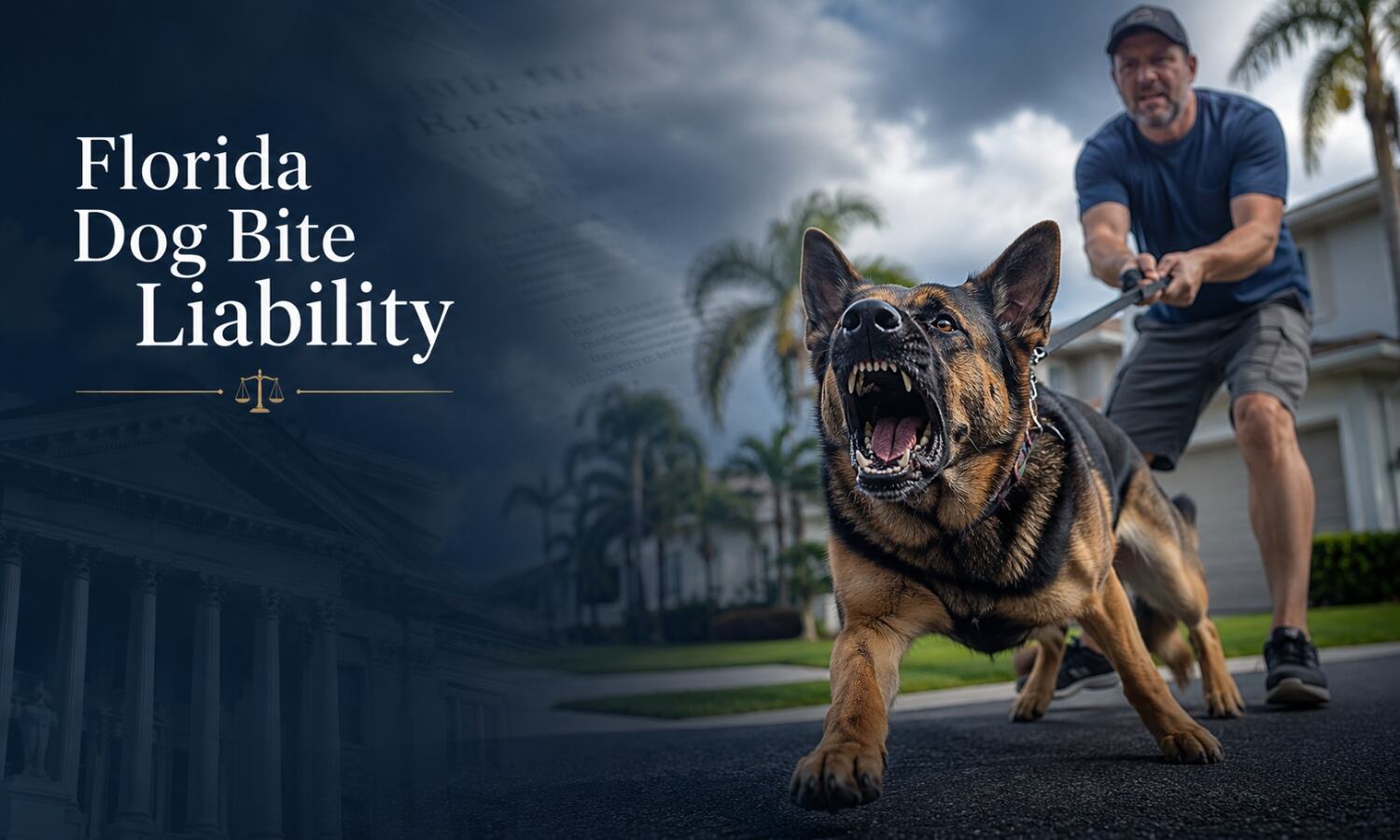
This article aims to provide a comprehensive overview of Florida’s dog bite liability laws, including the state’s strict liability framework, available legal defenses, recoverable damages, procedural requirements, and the important role an experienced attorney can play in protecting the rights of dog bite victims.
Introduction
Dog bite incidents represent a significant category of personal injury claims in the United States, with the American Veterinary Medical Association estimating that more than four and a half million people are bitten by dogs each year across the country.
In Florida, the legal framework governing such claims is particularly notable for its strict liability standard, which substantially alters the evidentiary burden placed on injured plaintiffs compared to states that apply a negligence-based approach.
This article examines Florida’s dog bite liability statute, the defences available to dog owners, the categories of compensable damages, and the practical and legal considerations that arise when pursuing a claim. It further addresses why the involvement of an experienced attorney is not merely advisable but often determinative of the outcome in such cases.
The Statutory Framework: Florida Statute 767.04
Florida is among 36 states that apply strict liability to dog bite claims. Florida Statute 767.04 establishes that the owner of a dog is liable for damages suffered by any person who is bitten by the dog while in a public place or lawfully on or in a private place, including the property of the dog’s owner.
Critically, liability attaches regardless of whether the dog had previously exhibited vicious or aggressive behaviour and regardless of whether the owner had actual knowledge of any such tendency.
This represents a significant departure from the so-called “one bite rule” historically applied in common law jurisdictions, under which a plaintiff was required to demonstrate that the owner knew or should have known the dog was dangerous.
Under Florida’s statutory framework, the mere occurrence of a bite in a covered location is sufficient to establish the owner’s liability, subject to the defences discussed below.
The practical consequence of this strict liability standard is that injured parties are not required to investigate or prove the dog’s prior history of aggression, nor are they required to establish that the owner acted carelessly in any specific respect. The statute places the burden of demonstrating an applicable defence squarely on the dog’s owner.
Statutory Defences Available to Dog Owners
Notwithstanding the strict liability standard, Florida law recognises several circumstances that may operate to reduce or eliminate an owner’s liability.
- Comparative Negligence of the Victim: Under Florida’s modified comparative negligence framework, a plaintiff’s recovery may be reduced in proportion to their own fault in contributing to the incident.
If the injured person provoked the animal, whether intentionally or through conduct that a reasonable person would recognise as likely to elicit an aggressive response, the owner’s liability may be diminished or, in cases of significant provocation, negated entirely.
Courts have examined what constitutes “provocation” carefully, and the outcome in any specific case depends substantially on the surrounding facts.
- Prominent “Bad Dog” Warning: Where a dog bite occurs on the owner’s private property and the owner has posted a conspicuous sign bearing the words “Bad Dog” in a location reasonably visible to entrants, the statute provides a defence to liability.
However, this defence does not apply where the victim is under the age of six years, or where the incident results from the owner’s negligent act or omission separate and apart from the failure to warn. The sufficiency of the signage in terms of placement, visibility, and clarity may itself become a contested factual issue.
- Trespasser Status: The strict liability provisions of Section 767.04 apply only to persons who are “lawfully” in a public or private location at the time of the bite.
A person unlawfully on another’s property, including a trespasser, does not benefit from the strict liability standard, though they may still pursue a negligence-based claim in appropriate circumstances.
Compensable Damages in Florida Dog Bite Cases
Florida law permits injured dog bite victims to seek recovery for a broad range of economic and non-economic losses. Understanding the full scope of compensable damages is essential to ensuring that a claim accurately reflects the true impact of the injury rather than only its most immediately quantifiable elements.
Economic damages include past and future medical expenses, encompassing emergency treatment, surgical intervention, hospitalisation, wound care, and any reconstructive procedures required as a result of the bite.
Given the nature of dog bites, consultations with plastic surgeons are not uncommon where scarring or disfigurement is involved. Lost wages and diminished earning capacity are also recoverable where the injury affects the victim’s ability to work.
Non-economic damages address the physical pain and suffering, emotional distress, and psychological trauma associated with the incident.
Dog attacks can produce lasting psychological consequences, including post-traumatic stress responses, phobias, and anxiety disorders, particularly in children.
Florida law does not impose a cap on non-economic damages in personal injury cases of this nature, meaning the full human cost of the injury may be presented to a jury.
Where a child is involved, the complexity of the damages calculation increases substantially. The courts are required to consider the child’s developmental stage, the potential long-term impact of physical and emotional injuries, and in severe cases, the effect on future educational and vocational prospects.
This is one of the reasons why dog bite cases involving minors tend to require particularly careful and experienced legal handling.
Procedural Considerations and the Statute of Limitations
Florida law imposes a two-year statute of limitations for personal injury claims arising from dog bites, running from the date of the incident.
Failure to file within this period will generally result in the claim being time-barred, regardless of its merits. While certain narrow exceptions exist, reliance on those exceptions involves considerable legal risk.
Beyond the limitations period, there are practical procedural reasons why early action benefits the injured party.
Evidence relevant to the claim, including surveillance footage, incident reports, and the identities and contact information of witnesses, may become unavailable or difficult to obtain with the passage of time.
Prompt legal consultation permits counsel to take the necessary steps to preserve evidence while it is still accessible.
Insurance coverage is also a threshold procedural consideration. Many dog bite claims are made against the dog owner’s homeowner’s or renter’s insurance policy.
The claims process for such policies involves specific notification requirements, time-sensitive investigation procedures, and interactions with adjusters whose professional orientation is toward minimising the insurer’s exposure.
Understanding how to navigate these dynamics is one of the core practical competencies that experienced legal counsel brings to such matters.
The Role of a Dog Bite Lawyer
The strict liability standard that Florida law establishes might suggest that dog bite claims are relatively straightforward to pursue. In practice, this is not consistently the case.
Owners and their insurers routinely contest the application of the statute, dispute the extent of the plaintiff’s injuries, raise comparative fault arguments, and challenge damage calculations.
Cases involving children, severe scarring, permanent injury, or significant psychological trauma introduce additional layers of complexity that require both legal and expert knowledge to address effectively.
An experienced dog bite lawyer brings several critical competencies to such cases. These include a thorough understanding of Florida’s statutory and common law framework, familiarity with the standards insurers and defence counsel apply in evaluating claims, and established relationships with medical and expert witnesses whose testimony may be required to substantiate the full extent of the plaintiff’s damages.
Where a case proceeds to litigation, trial experience and knowledge of local court procedures and judicial temperament become directly relevant to the outcome.
The attorneys at KFB Law in Tampa have represented individuals injured in dog attacks and animal bite incidents throughout the Tampa Bay area for over 25 years.
The firm’s approach centres on building a comprehensive evidentiary record that supports the full scope of the client’s compensable losses, engaging with insurance companies and opposing counsel from a position of thorough legal preparation, and proceeding to trial where a fair settlement cannot be achieved.
Consultations are provided at no cost to the injured party, and the firm operates on a contingency fee basis, meaning no legal fee is collected unless a recovery is obtained on the client’s behalf.
Conclusion
Florida’s strict liability statute for dog bites represents a legislative determination that the public interest is best served by placing the economic risk of dog-related injuries on owners rather than on the individuals who sustain those injuries.
That determination reflects sound policy, but its practical application in any given case depends on a careful understanding of the statute’s scope, the defences available to owners, the full range of compensable losses, and the procedural steps required to preserve and advance a claim effectively.
For any person who has been bitten or otherwise injured by a dog or other animal in Florida, the prudent course of action is to seek medical attention promptly, document the incident and its consequences as thoroughly as possible, and consult with a qualified attorney before making any representations to the dog owner, their insurer, or any other party.
The rights that Florida law confers on injured parties are real and meaningful, but realising them fully generally requires informed and experienced legal guidance from the outset.