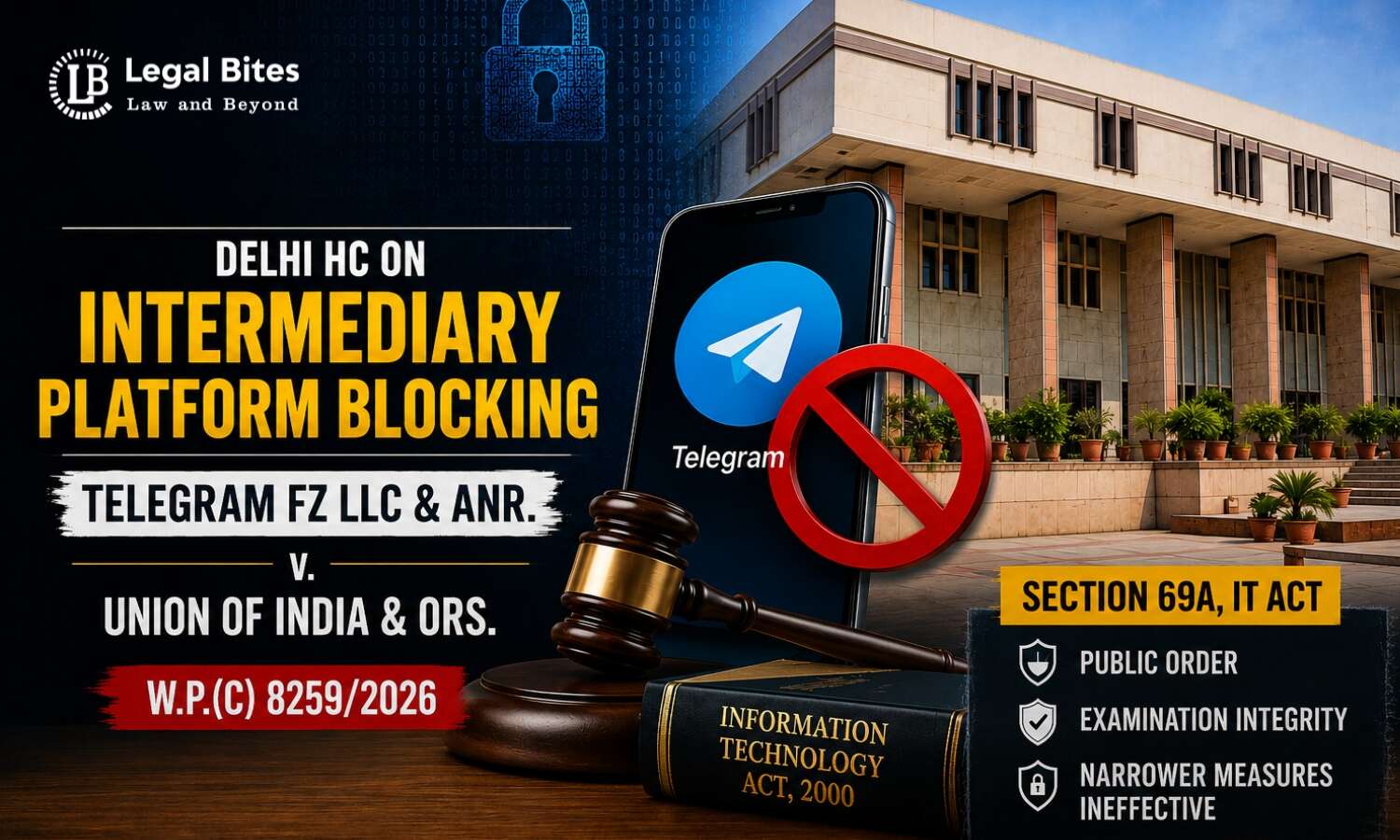
Strengthening the Government’s regulatory authority over digital intermediaries, the Delhi High Court has upheld a temporary platform-wide blocking order under Section 69A of the Information Technology Act, 2000. The decision came in Telegram FZ LLC & Anr. v. Union of India & Ors., where the Court dismissed Telegram’s challenge to a government order directing the temporary blocking of the Telegram platform across India during the conduct of the NEET-UG 2026 re-examination.
The judgment is noteworthy because it expands the understanding of the expression “information” under Section 69A and holds that the blocking power is not confined merely to specific posts, channels, messages, or URLs. According to the Court, where circumstances warrant, the provision authorises the Government to block access to an entire intermediary platform.
The ruling represents one of the most important judicial interpretations of Section 69A since the Supreme Court’s decision in Shreya Singhal v. Union of India and raises important questions concerning proportionality, platform accountability, and the future of content regulation in India.
Background of the Dispute
The controversy arose in the aftermath of allegations relating to the circulation of fake examination papers, examination fraud, and misinformation concerning NEET-UG 2026.
The National Testing Agency (NTA) informed the Ministry of Electronics and Information Technology (MeitY) that Telegram channels, bots, and groups were being extensively used for spreading purported examination papers, collecting money from students, and circulating misleading information regarding the examination. Despite repeated takedown requests, authorities alleged that new channels and mirror groups continued to emerge, making conventional enforcement ineffective.
Following complaints from the NTA and the Ministry of Home Affairs (MHA), MeitY initiated discussions with Telegram and sought corrective measures. Meetings were held, notices were issued, and Telegram submitted responses explaining its content moderation mechanisms and compliance efforts. Nevertheless, the Government concluded that the misuse persisted and intensified ahead of the scheduled re-examination.
Consequently, on 16 June 2026, MeitY passed an emergency blocking order under Section 69A of the IT Act directing:
- Temporary blocking of Telegram across India until 22 June 2026;
- Disabling Telegram’s message-editing feature until 30 June 2026;
- Directions to internet service providers and app stores to enforce the block;
- Placement of the matter before the statutory committee under the Blocking Rules, 2009.
Telegram challenged the order before the Delhi High Court.
Arguments Advanced by Telegram
Telegram argued that it had cooperated extensively with Indian authorities and had removed hundreds of offending channels and URLs identified by the Government. It maintained that it possessed sophisticated moderation systems employing artificial intelligence, machine learning, human moderators, user-reporting mechanisms, and anti-spam technologies.
The company raised several legal objections.
Lack of Proportionality
Telegram contended that blocking the entire platform affected more than 150 million Indian users who used the service for legitimate purposes. Millions of students, educators, and professionals relied upon the platform for lawful communication and educational activities.
According to Telegram, the Government could have adopted less restrictive alternatives, such as removing specific channels, bots, groups, or accounts, rather than imposing a platform-wide ban.
Violation of Section 69A
A central argument advanced by Telegram was that Section 69A authorises the blocking of specific “information” and not the blocking of an entire intermediary platform.
The company argued that the statutory language contemplated targeting particular content rather than prohibiting access to an entire communication service.
Procedural Defects
Telegram also alleged non-application of mind and argued that the Government had mechanically accepted recommendations without independently examining whether such a drastic restriction was necessary.
Reliance was placed upon the Supreme Court’s decision in Anuradha Bhasin v. Union of India, which emphasised proportionality and the requirement of adopting the least restrictive measure when restricting fundamental rights.
Government’s Stand
The Union Government defended the order by emphasising the scale and seriousness of the threat. Authorities pointed out that approximately 2.2 million students were appearing in the NEET examination and that widespread circulation of fake papers and examination fraud had the potential to create public disorder and undermine confidence in public institutions.
The Government highlighted several distinctive features of Telegram:
- Large public channels;
- Automated bots;
- Extensive file-sharing capabilities;
- Username-based anonymity;
- Cloud-based infrastructure;
- Rapid creation of mirror channels;
- Message-editing functionality capable of facilitating “backdating scams.”
According to the Government, these features enabled offending actors to recreate channels almost immediately after takedowns, rendering conventional enforcement ineffective.
The Government further argued that an application itself constitutes “information” because the statutory definition under Section 2(1)(v) includes software, codes, computer programs, and databases. Therefore, an entire platform could fall within the scope of Section 69A.
Issue One: Whether the Government Applied Its Mind Properly
The High Court first examined Telegram’s challenge based on alleged non-application of the mind. The Court emphasised that administrative decisions must contain reasons and demonstrate a nexus between the material considered and the conclusion reached.
After reviewing the impugned order and the subsequent final order passed by the statutory committee, the Court concluded that the Government had recorded adequate reasons for its action. The orders detailed the nature of examination fraud, the threat to public order, the persistence of unlawful activity despite repeated interventions, and the need for immediate action in view of the impending examination.
The Court observed that the emergency nature of the situation justified concise reasons at the interim stage, especially because a detailed post-decisional hearing was subsequently afforded to Telegram under the Information Technology (Procedure and Safeguards for Blocking Access of Information by Public) Rules, 2009.
Accordingly, the Court rejected Telegram’s challenge based on non-application of the mind.
Issue Two: Can Section 69A Be Used to Block an Entire Platform?
This was the most important aspect of the judgment.
Interpretation of “Information”
The Court undertook a detailed analysis of Section 69A and the definition of “information” under Section 2(1)(v) of the IT Act.
Section 2(1)(v) defines information broadly to include:
- Data;
- Messages;
- Text;
- Images;
- Sound;
- Voice;
- Codes;
- Computer programs;
- Software;
- Databases.
The Court held that the legislature intentionally adopted an expansive and technologically neutral definition. Since an intermediary platform consists of software, computer programs, codes, databases, and communication infrastructure, it naturally falls within the scope of “information.” Therefore, the expression cannot be restricted merely to individual posts, messages, or files.
Interpretation of “Computer Resource”
The Court also relied upon the wide definition of “computer resource” under the IT Act.
According to the Court, Telegram functions through software systems, databases, servers, and communication infrastructure that collectively qualify as computer resources. Information generated, stored, hosted, or transmitted through such resources can therefore be blocked under Section 69A.
The Court ultimately concluded that:
An application or platform itself may be blocked under Section 69A because it constitutes information generated, transmitted, stored, or hosted through a computer resource.
This represents a substantial expansion of the potential reach of Section 69A.
The Proportionality Analysis
The Court next examined whether blocking Telegram satisfied the constitutional doctrine of proportionality.
Relying on Anuradha Bhasin, the Court noted that four elements must generally be satisfied:
- Legitimate objective;
- Rational connection between measure and objective;
- Necessity of the measure;
- Adoption of the least restrictive alternative.
Legitimate Objective
The Court found that protecting examination integrity, preventing fraud, and maintaining public order constituted legitimate governmental objectives.
Rational Nexus
The Court accepted that Telegram’s architecture enabled rapid and large-scale dissemination of information. Features such as public channels, bots, file sharing, anonymity, and message editing were considered relevant to the misuse identified by authorities. The Court therefore found a rational nexus between the blocking order and the objective sought to be achieved.
Necessity
The Court attached considerable weight to evidence indicating that targeted removals had repeatedly failed.
Authorities demonstrated that offending channels were quickly replaced by mirror channels, reserve channels, successor groups, and backup accounts. Subscriber bases could be migrated almost instantaneously, allowing unlawful activity to continue despite takedown efforts.
The Court accepted the Government’s position that channel-by-channel enforcement had become ineffective.
Least Restrictive Measure
Although Telegram argued that blocking the entire platform was excessive, the Court held that, given the platform’s architecture and the urgent timeline surrounding the NEET re-examination, narrower alternatives had already been attempted and found inadequate.
Significantly, the Court emphasised the limited duration of the restrictions:
- Platform blocking only until 22 June 2026;
- Message-editing suspension only until 30 June 2026.
The temporary and event-specific nature of the restrictions persuaded the Court that they constituted the least restrictive effective measure available in the circumstances.
Importance of Telegram’s Platform Design
An unusual feature of the judgment is its extensive focus on platform architecture.
The Court repeatedly referred to:
- Public broadcast channels;
- Automated bot ecosystems;
- Cloud-based storage;
- Large-scale audience migration;
- Username anonymity;
- Message-editing features.
The judgment suggests that the technical architecture of an intermediary may become a legally relevant factor when assessing regulatory obligations and proportionality.
This signals a possible shift toward architecture-based regulation rather than merely content-based regulation.
Broader Implications
The judgment has several important implications.
Expansion of Government Powers
The decision recognises that Section 69A authorises the blocking of an entire platform rather than merely individual content.
This interpretation significantly enlarges the scope of governmental blocking powers.
Platform Accountability
The Court places responsibility on intermediaries not merely for responding to unlawful content but also for ensuring that their platform design does not facilitate repeated misuse.
Future Content Moderation
The ruling may influence future disputes involving encrypted messaging services, social media platforms, and emerging communication technologies where authorities argue that platform architecture frustrates enforcement efforts.
Examination Integrity and Public Order
The judgment demonstrates that threats to examination integrity may be treated as public-order concerns capable of justifying extraordinary regulatory intervention.