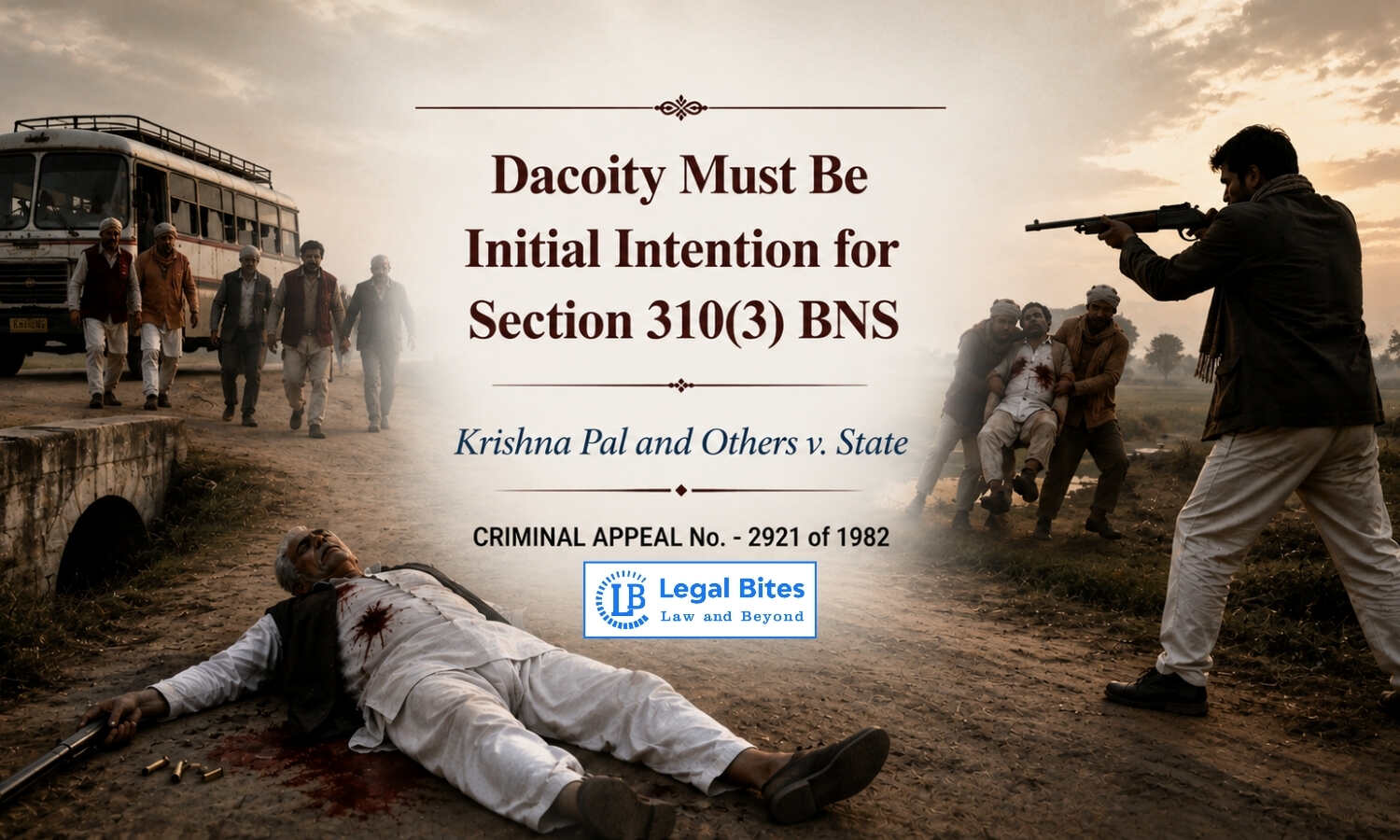
The Allahabad High Court has acquitted the surviving appellant in Krishna Pal and Others v. State, nearly four decades after he was convicted under Section 396 IPC [Section 310(3) of BNS], finding that the prosecution evidence did not establish that the fatal attack on the deceased was committed in the course of a dacoity.
Justice Samit Gopal noted that the prosecution itself portrayed the incident as a sudden encounter arising from previous enmity. Mahavira and his associates encountered Atar Singh on the road and firing ensued, resulting in his death, after which a co-accused took away his gun and cartridge belt. The Court held that this sequence did not establish dacoity as the initial intention of the accused. Since the necessary nexus between dacoity and the murder was missing, the conviction under Section 396 IPC [Section 310(3) of BNS] could not be sustained.
Background of the Case
The criminal appeal arose from an incident dating back to December 30, 1981. The prosecution case was that Atar Singh, along with his son Dhirendra Pal Singh, his brother Raghunath Singh and some other villagers, had alighted from a bus and was proceeding towards his village on foot.
According to the First Information Report, when they reached a culvert near village Chehka, Mahavira arrived there along with a number of armed persons. Mahavira allegedly had previous enmity with Atar Singh because the latter had earlier assisted the police in Mahavira’s arrest.
The prosecution alleged that on encountering Atar Singh, Mahavira told him that they had been looking for him for a long time and immediately opened fire. Atar Singh, who was carrying his licensed gun, fired back. Two persons from Mahavira’s side were allegedly injured during the exchange.
The firing continued and Atar Singh sustained several firearm injuries and fell by the roadside. Thereafter, co-accused Chandrapal allegedly took away Atar Singh’s gun and belt containing cartridges, while the other persons carried away their two injured associates.
On the basis of the written complaint, an FIR was registered at Police Station Patiyali, District Etah, initially under Sections 147, 148, 149 and 302/404 IPC [Section 191(2), 191(3), 190, 103 and 315 of BNS].
Trial and Conviction Under Section 396 IPC [Section 310(3) of BNS]
Following investigation, a charge-sheet was submitted. The trial court framed a charge under Section 396 IPC [Section 310(3) of BNS] against the accused, besides alternative charges under Sections 147 and 302 read with Section 149 IPC [Sections 191(2), 103(1) and 190 of BNS]. A separate charge under Section 404 IPC (Section 315 of BNS) was also framed against Chandrapal.
The prosecution examined three alleged eyewitnesses, Dhirendra Pal Singh, Raghunath Singh and Badam Singh, apart from formal witnesses, including the doctor who conducted the post-mortem and the Investigating Officer.
The eyewitnesses substantially stated that Mahavira and his associates encountered Atar Singh and his companions on the way. Mahavira challenged Atar Singh on account of the previous hostility and fired at him. Atar Singh retaliated with his licensed firearm, following which firing took place from the other side as well.
After Atar Singh fell and ultimately died, his gun and cartridge belt were allegedly taken away by Chandrapal.
The trial court concluded that Mahavira’s group was a gang of dacoits and, since Atar Singh’s gun and cartridges had been taken during the occurrence, the offence fell within Section 396 IPC [Section 310(3) of BNS] rather than Section 302 read with Section 404 IPC.
The accused were consequently convicted under Section 396 IPC [Section 310(3) BNS] and sentenced to 10 years’ rigorous imprisonment.
Appeal Before the Allahabad High Court
The appeal was originally filed by five accused, Krishan Pal, Santu/Sattu, Ram Lal, Chandrapal and Munshi Singh, against the judgment of the Additional District and Sessions Judge (Special Court), Etah dated November 2, 1982.
During the long pendency of the appeal, four appellants died and their appeals stood abated. Consequently, the appeal survived only in respect of appellant Sattu.
The central issue before the High Court was whether the facts established by the prosecution were sufficient to constitute dacoity with murder under Section 396 IPC [Section 310(3) of BNS].
Appellant’s Arguments
The appellant contended that he had been falsely implicated and that no specific overt act had been attributed to him.
More importantly, it was argued that the prosecution’s own version did not disclose an offence under Section 396 IPC [Section 310(3) of BNS]. According to the defence, Mahavira and his associates had met Atar Singh and the others accidentally on the road.
The encounter was followed by firing because of the previous enmity between Mahavira and Atar Singh. There was no evidence to suggest that the group had approached Atar Singh with the pre-existing intention of committing dacoity.
The defence stressed that the gun and cartridge belt were allegedly taken by Chandrapal only after Atar Singh had been shot. Therefore, the taking of the property subsequent to the shooting could not retrospectively convert the incident into dacoity with murder.
It was specifically submitted that the accused did not have any motive or intention to commit dacoity “at the first instance” and that the murder did not occur in pursuance of any such intended dacoity.
State’s Arguments
The State opposed the appeal and maintained that the conviction was proper. It argued that the appellant was named in the FIR and was a member of a gang of dacoits. According to the prosecution, the accused murdered Atar Singh and thereafter looted his gun and belt containing cartridges.
The State also relied upon the evidence of the three eyewitnesses and the firearm injuries found on the deceased to argue that the prosecution case stood corroborated.
It was further contended that Mahavira and his associates had come with the intention of committing dacoity of the gun and had killed Atar Singh during the commission of that offence.
Sudden Encounter Was Crucial to the Court’s Finding
The High Court closely examined the prosecution’s own account of how the occurrence began. The Court noted that Atar Singh and the other persons were walking towards their village after getting off a bus. When they reached the culvert, Mahavira and his associates arrived and Mahavira challenged Atar Singh, saying that he had been searching for him for a long time.
Mahavira then fired upon Atar Singh, who retaliated with his licensed gun. Two persons from Mahavira’s side were allegedly injured. The accused continued firing, resulting in Atar Singh’s death. It was only thereafter that Chandrapal took away the deceased’s gun and cartridge belt.
The High Court considered the sequence of events significant. It observed that the prosecution story itself demonstrated that the meeting between the two sides was “all of a sudden.” The confrontation was triggered by the previous enmity between Mahavira and Atar Singh rather than by an attempt to commit dacoity.
The Court therefore held that, on the prosecution’s own case, the intention of the accused could not be said to have been to commit dacoity with murder.
What Does Section 396 IPC [Section 301(3) BNS] Require?
Section 396 IPC deals with dacoity with murder. It provides for collective criminal liability where one among five or more persons conjointly committing dacoity commits murder while committing that dacoity.
The High Court read Section 396 IPC [Section 310(3) of BNS] together with Section 391 IPC (Section 310 BNS), which defines dacoity.
Under Section 391 IPC (Section 310 BNS), where five or more persons conjointly commit or attempt to commit robbery, or where the persons committing or attempting the robbery together with those present and aiding them amount to five or more, every such person is said to commit dacoity.
The Court emphasised the sequence contemplated by Section 396 IPC [Section 310(3) of BNS]. It observed that the provision envisages dacoity as the first act and a murder being committed in the course of committing that dacoity.
The Court observed:
“The reading of Section 396 I.P.C. [Section 310(3) of BNS] would go to show that the first event in the same is of one or five or more persons conjointly commit dacoity as the first act and then in committing the same commit murder.”
Thus, the mere presence of five or more accused and a subsequent taking away of property would not, by itself, satisfy Section 396. The murder must have the legally required nexus with the dacoity.
Nexus Between Dacoity and Murder Not Established
Applying this principle to the facts, the High Court found that the necessary connection between dacoity and murder was absent.
The prosecution’s version showed that the parties encountered each other unexpectedly. Mahavira challenged Atar Singh because of their previous enmity and fired at him. Atar Singh fired back and injured two persons from the other group. The group thereafter fired at Atar Singh, causing his death.
Only after this sequence did Chandrapal allegedly take the deceased’s gun and cartridge belt. According to the Court, these facts did not establish that the group had initially set out to commit dacoity and that the murder occurred while that dacoity was being committed.
The High Court categorically held:
“In the present case the nexus between the act of committing dacoity and murder while committing so is not established.”
It therefore found the prosecution narrative inconsistent with the conviction recorded under Section 396 IPC [Section 310(3) of BNS].
Dacoity Must Be the First Intention
The most significant aspect of the judgment is the High Court’s emphasis on the initial intention behind the occurrence.
The Court found no sufficient evidence to establish that dacoity was the purpose for which the accused had assembled or confronted the deceased. Rather, the prosecution evidence suggested a sudden encounter followed by an armed confrontation rooted in prior hostility.
The subsequent taking of the deceased’s firearm could not, on the facts proved, establish that the preceding killing had occurred during the commission of dacoity.
The Court concluded that:
“The prosecution has failed to establish that dacoity was the first intention and in committing dacoity murder was committed.”
This distinction was decisive. Section 396 IPC [Section 310(3) of BNS] was therefore held inapplicable.
No Evidence Establishing the Alleged Gang of Dacoits
The High Court also noted another important evidentiary deficiency.
Although the trial court proceeded on the footing that Mahavira headed a notorious gang of dacoits, the High Court observed that there was no evidence on record showing that Mahavira had a gang of dacoits which included the surviving appellant.
The Court further noted that no incriminating material had been recovered either from the possession of the surviving appellant or at his pointing out.
These circumstances reinforced the Court’s conclusion that the ingredients necessary to sustain the conviction under Section 396 IPC [Section 310(3) of BNS] had not been established.
Mere Taking of Property After Murder Is Not Enough
The judgment draws an important distinction between a murder committed in the course of dacoity and a case where property happens to be taken away after a fatal confrontation.
For Section 396 IPC [Section 310(3) of BNS], the murder cannot be treated in isolation from the dacoity. The statutory requirement is that five or more persons must be conjointly committing dacoity and that murder must occur “in so committing dacoity.”
Therefore, the chronology and purpose of the criminal acts become crucial. In the present case, the evidence indicated that the confrontation began because of previous enmity. The firing and killing preceded the taking of the firearm. In the absence of proof that the accused had initially intended to commit dacoity, the subsequent removal of the gun and cartridges was insufficient to bring the entire occurrence within Section 396 IPC [Section 310(3) of BNS].
The ruling therefore underscores that the character of an occurrence must be determined from the prosecution evidence regarding its origin, purpose and sequence, and not merely from the fact that property was ultimately removed from the deceased.
Allahabad High Court Sets Aside Conviction
Having found that the prosecution failed to establish that dacoity was the initial intention and that the murder occurred during its commission, the Allahabad High Court held that the conviction under Section 396 IPC [Section 310(3) of BNS] could not survive.
The Court also noted that despite firing by several persons, no other person from the deceased’s side had been injured and that no incriminating material had been recovered from the surviving appellant.
Accordingly, the Court acquitted appellant Sattu of the charges against him. Since he was already on bail, the Court directed that he need not surrender and ordered that his bail bonds be cancelled and sureties discharged.
The appeal was allowed and the trial court’s judgment and order dated November 2, 1982 were set aside.
Conclusion
The Allahabad High Court’s decision in Krishna Pal and Others v. State clarifies the ingredients necessary for attracting Section 396 IPC [Section 310(3) of BNS] relating to dacoity with murder. The existence of five or more accused, a murder, and the subsequent removal of property cannot automatically be combined to constitute the offence.
The prosecution must establish the necessary nexus between the dacoity and the murder. As explained by the Court, dacoity must constitute the initial act or intention, with the murder being committed while carrying out that dacoity.
Where the prosecution’s own evidence shows a sudden encounter arising out of previous enmity, followed by firing and death, and property is taken only thereafter, the subsequent taking of property cannot by itself transform the preceding occurrence into dacoity with murder.
In the present case, the failure to prove that dacoity was the first intention and that the murder occurred in the course of committing it proved fatal to the conviction under Section 396 IPC [Section 310(3) of BNS]. The High Court consequently set aside the decades-old conviction and acquitted the surviving appellant.