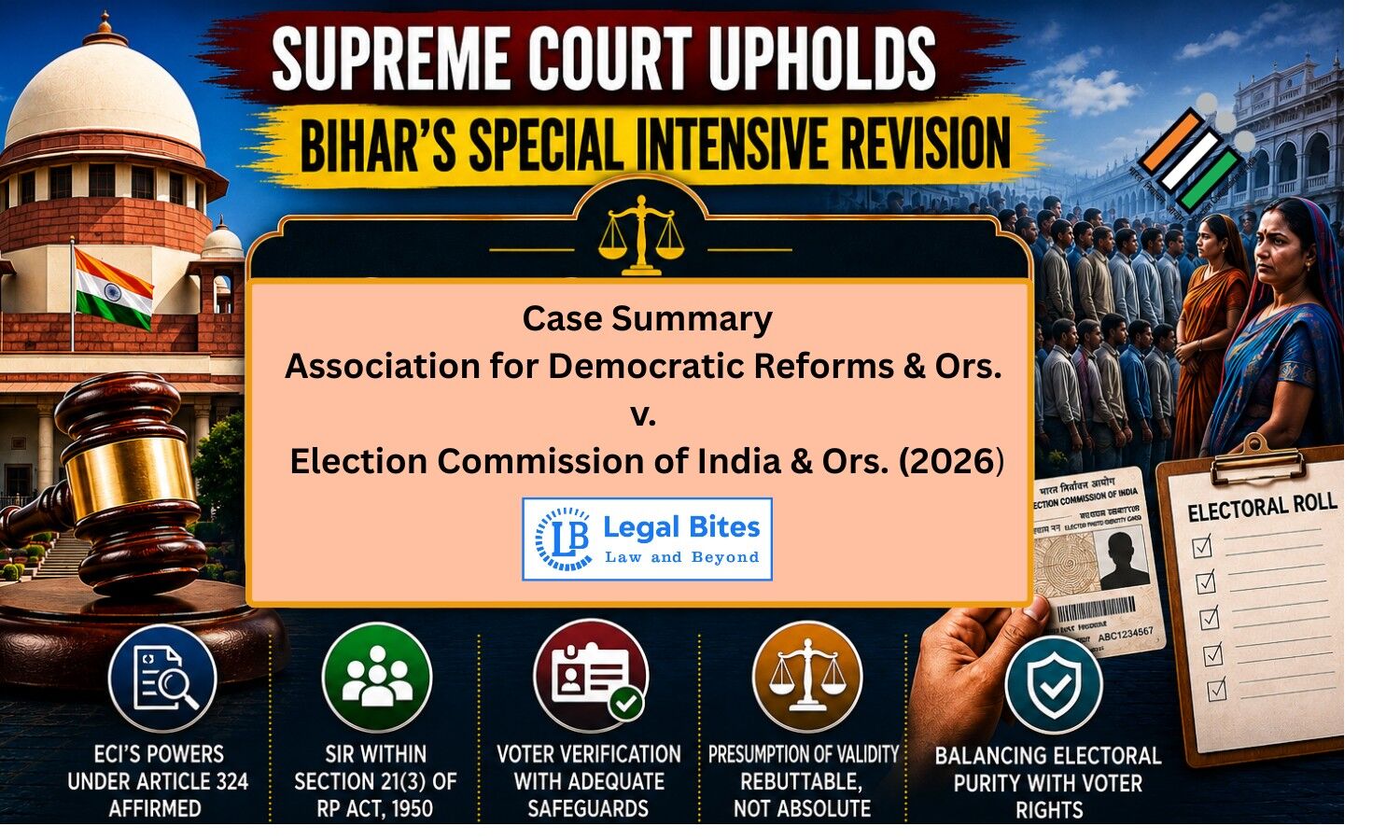
The Supreme Court in Association for Democratic Reforms & Ors. v. Election Commission of India & Ors. examined the legality of the Special Intensive Revision (SIR) of electoral rolls conducted by the Election Commission of India in Bihar. The case raised significant constitutional questions concerning the power of the Election Commission under Article 324 of the Constitution, the scope of Section 21(3) of the Representation of the People Act, 1950, procedural safeguards in electoral roll revision, and the extent to which the Commission may examine citizenship-related eligibility for inclusion in electoral rolls.
The judgment begins with the broader constitutional idea that an electoral roll is not a mere administrative record; it determines the political community entitled to participate in representative government. The Court observed that before a representative government can count votes, it must first know whose votes may be counted. Electoral rolls, therefore, lie at the foundation of democracy.
The dispute was not merely about the mechanics of revision but about balancing two constitutional concerns: no eligible citizen should be excluded, and the electoral roll must accurately reflect the true electorate.
Factual Background
The controversy arose from the Election Commission’s order dated 24 June 2025, directing a Special Intensive Revision of electoral rolls in every Assembly constituency of Bihar. The Commission relied on Article 324 of the Constitution read with Section 21(3) of the Representation of the People Act, 1950. It stated that the last intensive revision in Bihar had taken place in 2003, and that over two decades, the rolls had substantially changed due to urbanisation, migration, deaths, duplicate entries, and shifting of residence by voters without deletion of names from earlier places.
The Commission decided to treat the 2003 electoral roll, with 1 January 2003 as the qualifying date, as probative evidence of eligibility unless rebutted. Persons not listed in the 2003 roll were required to submit one or more prescribed documents to establish eligibility. Enumeration forms were to be submitted by 25 July 2025, failing which the person’s name would not appear in the draft roll.
During the proceedings, the Supreme Court issued several interim directions. It directed the Commission to publish the list of approximately 65 lakh persons excluded from the draft roll, along with reasons, and to give wide publicity. It also directed political parties and their Booth Level Agents to assist voters in filing claims and objections. Later, the Court directed that Aadhaar be treated as the 12th document of identity for the limited purpose of inclusion or exclusion from the revised electoral roll, though it clarified that Aadhaar is not proof of citizenship.
The Commission eventually published the final electoral roll on 30 September 2025. The final roll contained 7.42 crore electors, compared to 7.89 crore electors on 24 June 2025. The Bihar Legislative Assembly elections were then conducted in November 2025, and the results were declared on 14 November 2025.
Issues Before the Court
The Supreme Court framed four principal issues:
- Whether the Election Commission had the power to conduct the Special Intensive Revision.
- Whether the SIR was founded on a legitimate purpose and whether the measures adopted were proportionate.
- Whether the procedure adopted violated the Representation of the People Act, 1950 and the Registration of Electors Rules, 1960.
- Whether the Election Commission could scrutinise the citizenship status while preparing or revising the electoral rolls.
Arguments of the Petitioners
The petitioners challenged the SIR as unconstitutional, arbitrary, exclusionary, and disproportionate. They argued that Article 324 is not an unlimited source of power and cannot be invoked when Parliament has already legislated on electoral rolls under Article 327. Relying on precedents such as Mohinder Singh Gill v. Chief Election Commissioner and A.C. Jose v. Sivan Pillai, they submitted that Article 324 operates only in areas left unoccupied by statute and cannot override the Representation of the People Act or the Rules.
They further contended that Section 21(3) permits special revision only for “any constituency or part of a constituency” and not for an entire State. According to them, the Bihar-wide SIR was beyond the statutory power of the Commission.
Another major argument was that persons already enrolled in the electoral roll enjoy a presumption of citizenship and eligibility. The petitioners relied on Lal Babu Hussein v. Electoral Registration Officer to argue that once a person’s name is included in the roll, it cannot be removed except through the procedure prescribed by law. They objected to the use of the 2003 electoral roll as a cut-off and argued that voters added after 2003 could not be treated as a suspicious class.
The petitioners also submitted that the requirement of fresh documentation was burdensome, especially for poor, migrant, elderly, and marginalised voters. They argued that documents such as Aadhaar, EPIC, and ration cards were widely available and should not have been excluded. They further contended that citizenship determination falls within the domain of the Central Government, particularly the Ministry of Home Affairs, and not the Election Commission.
Arguments of the Election Commission
The Election Commission defended the SIR as a constitutionally mandated exercise to preserve the purity and accuracy of electoral rolls. It argued that Article 324 vests wide powers of superintendence, direction, and control over elections, including preparation of electoral rolls. The Commission submitted that it was not acting contrary to any statute but within the constitutional and statutory framework.
It argued that Section 21(3) expressly empowers the Commission to direct a special revision “at any time” and “in such manner as it may think fit”. According to the Commission, the phrase “any constituency” could include many or all constituencies where the reasons for revision applied across the State.
The Commission also maintained that the 2003 roll was selected because it was the last intensive revision in Bihar, and therefore had greater evidentiary reliability than rolls updated merely through summary revisions.
The Commission justified the documentation framework by stating that it was broader than previous exercises. Aadhaar was not proof of citizenship, EPIC was derivative of the electoral roll itself, and ration cards were not conclusive proof of citizenship. It further argued that its scrutiny was not a final adjudication of citizenship but only an enquiry into eligibility for electoral registration.
Court’s Analysis
The Supreme Court held that Articles 324 and 327 are not competing sources of power. Article 324 vests the Commission with constitutional authority over elections and electoral rolls, while Article 327 permits Parliament to make laws relating to elections. Both provisions must operate harmoniously. Parliamentary law regulates the field, but it cannot extinguish the core constitutional function of the Election Commission.
The Court clarified that Article 324 is not a dead letter merely because Parliament has enacted laws. At the same time, the Commission cannot act contrary to an express statutory prohibition. The Court adopted a balanced position: Article 324 survives as a source of constitutional power, but it must be exercised consistently with the law.
On Section 21(3), the Court held that it is an autonomous and enabling provision. The use of the non-obstante clause, the phrase “at any time”, and the words “in such manner as it may think fit” indicate that the Commission has broad discretion to conduct a special revision when circumstances demand.
The Court rejected the argument that the Commission could revise only one constituency or a few constituencies. It held that where the reasons are State-wide, such as migration, urbanisation, duplication, and long lapse since the last intensive revision, the word “any” may include “many” or “all”.
The Court further held that the Commission had recorded sufficient reasons for the exercise. The order referred to the significant changes in Bihar’s electoral roll since 2003, rapid urbanisation, migration, and repeated entries caused by voters shifting residence without deletion from earlier rolls. These reasons satisfied the requirement under Section 21(3).
Proportionality and Safeguards
The Court applied the principle of proportionality and held that the SIR pursued a legitimate constitutional purpose: restoring the accuracy, completeness, and integrity of electoral rolls.
The Court noted that the process included safeguards such as house-to-house enumeration, publication of draft rolls, claims and objections, assistance by Booth Level Agents, legal aid support through para-legal volunteers, enquiry in doubtful cases, speaking orders, and appellate remedies.
The Court held that the measures were not manifestly excessive. The process, as ultimately implemented, provided multiple avenues for participation, correction, and redress. It therefore satisfied the requirement of proportionality.
Presumption of Validity and Rule 21A
The Court accepted that inclusion in an electoral roll gives rise to a presumption of validity. However, such presumption is rebuttable. It cannot prevent the Election Commission from undertaking a systemic revision of rolls in discharge of its constitutional mandate. The Court distinguished Lal Babu Hussein, holding that it dealt with a different context and did not prohibit a special intensive revision.
Regarding Rule 21A of the Registration of Electors Rules, 1960, the Court held that the rule does not require a rigid or identical format of notice in every kind of revision. What matters is fairness in substance. Since the SIR Guidelines provided for publication, enquiry, opportunity of hearing, speaking orders, and appeals, the process did not violate Rule 21A.
Validity of Documentation Requirements
The Court upheld the documentation framework prescribed by the Commission. It held that the choice of documents falls within the administrative discretion of the Commission, subject to reasonableness. The Court accepted that Aadhaar is not proof of citizenship, though it may be used for identity. It also accepted the Commission’s reasoning that EPIC is a derivative document because it is issued based on inclusion in the electoral roll; allowing EPIC as proof for verifying the correctness of the very roll would make the exercise circular.
The Court also observed that production of documents was only one part of the process and not the sole determinant. Since the framework included enquiry, clarification, adjudication, and appeal, it could not be described as rigid or mechanical. The Court held that the classification of documents had a direct nexus with the objective of maintaining the integrity of electoral rolls.
Citizenship Scrutiny by Election Commission
A crucial issue was whether the Election Commission could scrutinise citizenship status. The Court drew a distinction between formal adjudication of citizenship and limited enquiry into electoral eligibility. It held that the Commission cannot finally determine citizenship under the Citizenship Act. That power belongs to the competent authority under the citizenship framework.
However, under Section 16 of the Representation of the People Act, 1950, non-citizens are disqualified from being registered as electors. Therefore, the Commission must have the power to examine whether a person satisfies the eligibility conditions for inclusion in the electoral roll. This enquiry is limited, prima facie, and contextual. It affects only electoral entitlement and does not amount to a declaration that the person is not a citizen of India.
The Court also directed that if the Commission is not satisfied about a person’s citizenship-related eligibility, the matter must be referred to the competent authority within the Central Government for adjudication. Any deletion on such ground remains subject to the outcome of that adjudication.
Final Decision
The Supreme Court disposed of the writ petitions by upholding the validity of the SIR. It held that the exercise was traceable to Section 21(3) of the Representation of the People Act, 1950 read with Article 324 of the Constitution. It did not conflict with the RP Act or the 1960 Rules and was directed towards securing free and fair elections.
The Court concluded that the SIR was proportionate, legally justified, and supported by adequate safeguards. It further held that inclusion in the electoral roll creates only a rebuttable presumption and does not bar the Commission from conducting a special intensive revision. The documentation framework was upheld, and the Commission’s limited power to examine citizenship for electoral eligibility was recognised.
Conclusion
This judgment is significant because it reaffirms the wide constitutional authority of the Election Commission while also subjecting that authority to statutory limits and procedural fairness. The Supreme Court did not treat electoral roll revision as a routine administrative exercise. Instead, it located the issue at the core of constitutional democracy.
The ruling makes three important contributions. First, it clarifies that Article 324 remains a living source of power, but it cannot be used to violate statutory law. Second, it confirms that Section 21(3) authorises special revision of electoral rolls in a flexible manner, including on a State-wide basis where justified by circumstances. Third, it draws a careful line between electoral eligibility scrutiny and formal citizenship adjudication.
The Court ultimately balanced electoral purity with voter inclusion. It recognised that inaccurate rolls weaken democracy, but arbitrary exclusion of voters is equally dangerous. By upholding the SIR while insisting on notice, hearing, appeal, legal aid, and limited citizenship scrutiny, the judgment seeks to preserve both the integrity of elections and the rights of citizens.