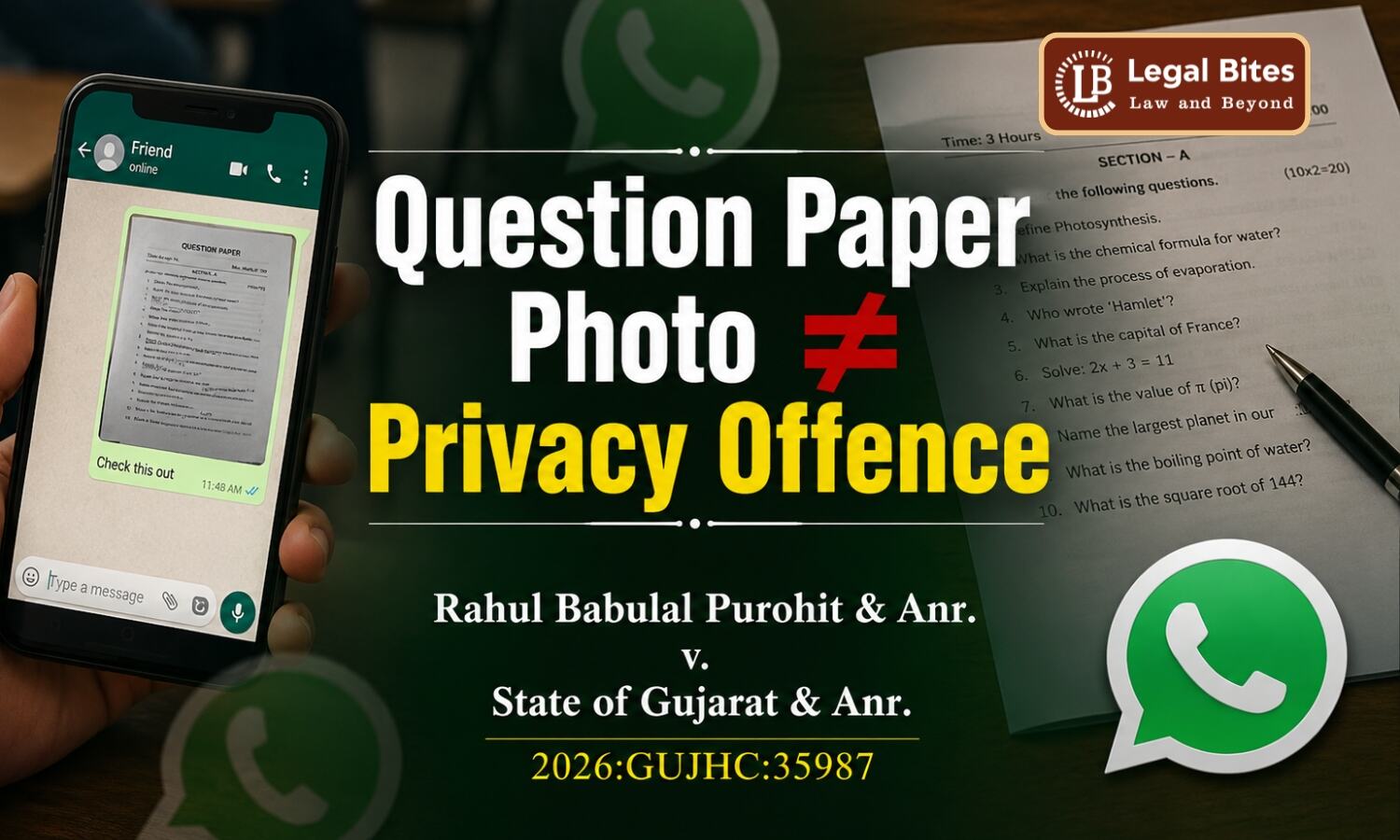
The increasing dependence on smartphones has presented fresh challenges to examination authorities across the country. Cases involving candidates carrying mobile phones into examination halls, photographing question papers, and transmitting them through messaging applications are no longer uncommon. Such incidents raise concerns about the integrity of public examinations and often result in criminal proceedings.
However, the mere use of electronic devices does not automatically convert every act into a cyber offence under the Information Technology Act, 2000. Criminal liability depends upon whether the statutory ingredients of the alleged offence are actually satisfied. This distinction was at the heart of the Gujarat High Court’s order in Rahul Babulal Purohit & Anr. v. State of Gujarat & Anr. (2026:GUJHC:35987), where the Court examined the true scope of Section 66E of the Information Technology Act, 2000.
Synopsis
- Background of the Case
- Section 66E: A Provision Meant to Protect Privacy
- Examination Misconduct v. Privacy Violations
- Photographing and Sharing a Question Paper: The Legal Controversy
- Inapplicability of Section 188 IPC (Section 223 of BNS)
- Continuation of the Investigation
- Broader Legal Impact
Background of the Case
The case arose from an FIR registered after officials conducting a GPSC examination received information that one candidate was using a mobile phone inside the examination hall.
According to the allegations:
The applicants approached the High Court seeking quashing of the FIR insofar as it invoked Section 188 IPC (Section 223 BNS) and Section 66E of the IT Act.
Section 66E: A Provision Meant to Protect Privacy
Section 66E of the Information Technology Act is often invoked whenever photographs or videos are electronically transmitted. However, its scope is considerably narrower than is commonly understood.
The provision criminalises the intentional or knowing capture, publication, or transmission of the image of the private area of any person without his or her consent, under circumstances violating that person’s privacy.
The statute itself defines the important expressions used in the provision.
It explains that:
- “Capture” means photographing, filming or otherwise recording an image.
- “Transmit” refers to electronically sending such an image.
- “Private area” specifically means the naked or undergarment-clad genitals, pubic area, buttocks, or female breast.
- The offence is therefore concerned with protecting bodily privacy, not with every electronic transmission of an image.
The legislative focus of Section 66E is thus the unauthorised invasion of personal privacy, particularly where intimate images are captured or circulated without consent.
Examination Misconduct v. Privacy Violations
The order also reinforces an important distinction between examination malpractice and cyber privacy offences.
Photographing a question paper inside an examination hall may undoubtedly violate:
- examination rules,
- recruitment guidelines,
- service regulations, or
- other provisions of criminal law, depending upon the circumstances.
However, every wrongful act involving a mobile phone is not necessarily a privacy offence.
The Court recognised that the allegations disclosed possible examination misconduct, yet emphasised that Section 66E cannot be invoked merely because a photograph was taken or electronically transmitted. Criminal law requires every ingredient of the particular offence to be established before prosecution can continue under that provision.
Photographing and Sharing a Question Paper: The Legal Controversy
The controversy before the Court arose after a candidate appearing in a GPSC examination was allegedly found carrying a mobile phone inside the examination hall. According to the allegations, he clicked photographs of the examination question paper and forwarded them through WhatsApp to his brother outside the examination centre. Based on these allegations, among other provisions, Section 66E of the Information Technology Act was invoked.
The High Court carefully examined whether these allegations satisfied the statutory ingredients of Section 66E. It concluded that they did not.
The Court observed that what had allegedly been transmitted was only a photograph of the question paper. There was no image of any individual’s private body part, nor was there any allegation that the privacy of any person had been violated.
Consequently, the Court held that the act of forwarding the photograph through WhatsApp could not be described as intentionally or knowingly capturing, publishing, or transmitting the image of the private area of any person, which alone attracts Section 66E.
The order therefore draws a clear distinction between sharing confidential examination material and committing a privacy offence under the Information Technology Act.
Inapplicability of Section 188 IPC (Section 223 BNS)
Apart from Section 66E, the FIR also invoked Section 188 of the Indian Penal Code (Section 223 of BNS), alleging violation of GPSC examination instructions.
The High Court, relying on Govartdhandas Thakoresdas Asrani v. State of Gujarat in Criminal Misc. Application No.24632 of 2015., found the invocation of Section 188 IPC legally untenable.
The High Court observed that the instructions issued by the GPSC regarding prohibited articles inside the examination hall could not automatically be treated as an order duly promulgated by a public servant within the meaning of Section 188 IPC.
The Court further noted that even if such instructions were assumed to fall within the scope of Section 188 of IPC (Section 223 of BNS), Section 195 of the Code of Criminal Procedure (Section 215 in Bharatiya Nagarik Suraksha Sanhita, 2023) bars cognizance of the offence except upon a written complaint by the competent public servant. Therefore, registration of an FIR under Section 188 was itself legally unsustainable.
Accordingly, the Court quashed the invocation of Section 188 IPC as well.
Continuation of the Investigation
Although the High Court found that Section 66E of the IT Act and Section 188 IPC (Section 223 of BNS) had been wrongly invoked, it did not terminate the criminal proceedings altogether.
The Court clarified that only these two provisions were liable to be quashed. If, during investigation, the facts disclosed the commission of any other cognizable offence, the investigating agency would remain free to proceed in accordance with law.
This approach ensured that incorrect invocation of particular penal provisions did not automatically defeat the investigation in its entirety.
Broader Legal Impact
The order carries significance beyond the immediate dispute.
- It reiterates the well-established principle that penal statutes must be interpreted strictly. Courts cannot enlarge the scope of criminal provisions merely because the alleged conduct appears blameworthy.
- The order clarifies the limited scope of Section 66E, reaffirming that it is a privacy protection provision, not a general cyber offence covering every electronic transmission of images.
- The ruling draws an important distinction between breach of examination rules and criminal invasion of privacy, preventing the indiscriminate application of cyber law provisions to situations they were never intended to regulate.
The order serves as a reminder to investigating agencies that criminal charges must correspond to the actual ingredients of the statutory offence, rather than being based solely on the use of digital technology.