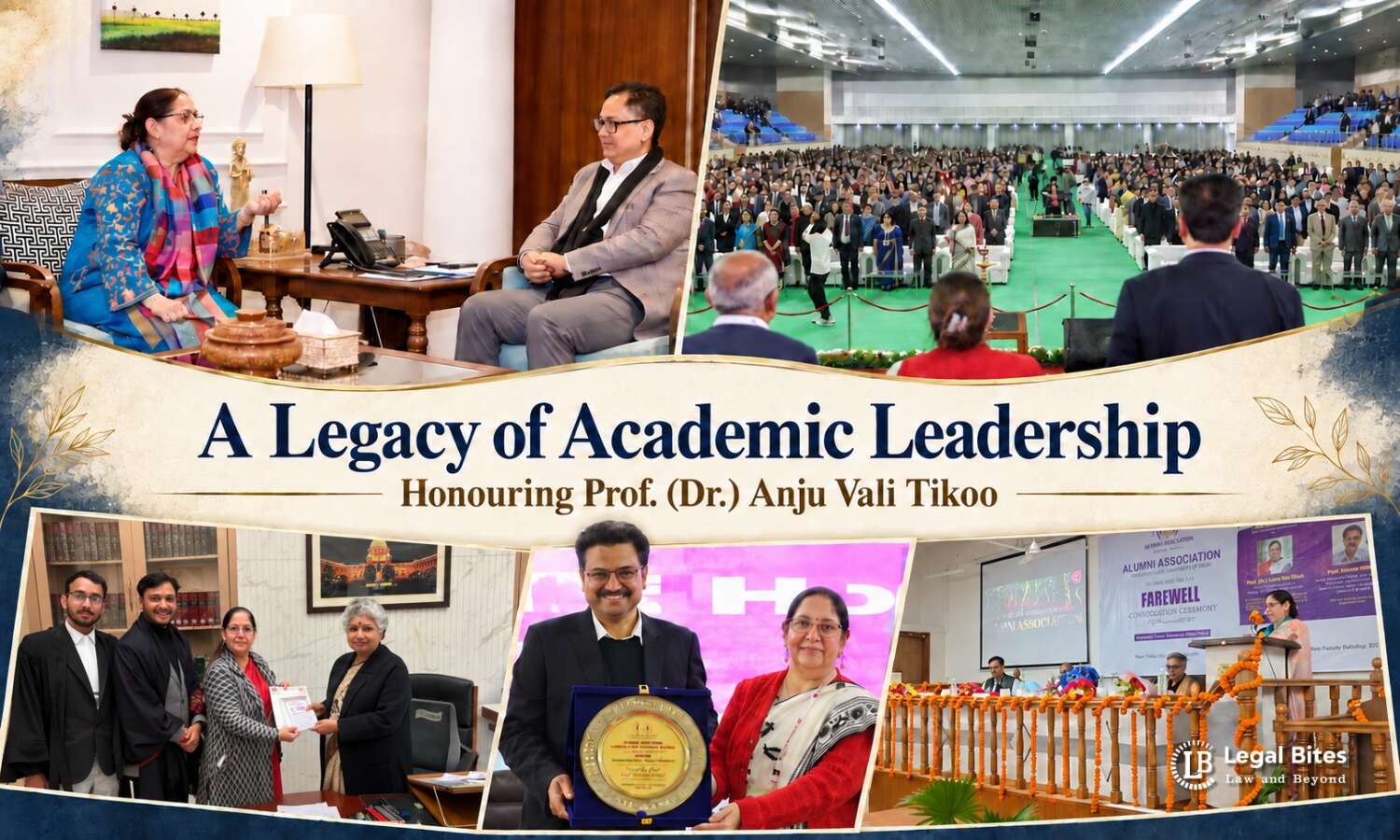
On Friday, 25th September 2026, the Moot Court Hall at Umang Bhawan held a deeply moving aayojan — a Farewell-cum-Welcome ceremony organised by the Alumni Association, honouring outgoing Dean Prof. (Dr.) Anju Vali Tikoo and welcoming incoming Dean Prof. Raman Mittal. What had, by her own account, begun as a small, simple request had by evening’s end escalated into a wave of collective emotion that belonged not just to her, but to the institution itself — because, as she put it, that is precisely where alumni matter most.
From an Introvert to an Institution’s Confidante
Anju Ma’am began with a confession that startled the room: until that very moment, she hadn’t fully known the professional journey of the man introducing her, Sanjay Sir — a small reminder, she said, of how easily even close colleagues can walk parallel paths for years without truly seeing one another.
She then took the gathering back to 1982, the year she joined as a student, and later to 1989, when she joined the Faculty as a hesitant, closed-off young teacher—someone few had ever seen in easy conversation with anyone. So complete was her reticence that although she joined in 1982, she did not have her first cup of tea at the campus’s now-legendary sardar ji ki chai ki dukaan until 2004. She never imagined that a loner like herself would go on to become the person so many turned to — in moments of happiness and, more often, in moments of personal or professional crisis. It was not eloquence that built that connection, she said, but simply listening. And because people sensed they were truly heard, the connection held.
She recalled sitting on the stage that evening, overwhelmed by everything being said about her, unsure if she would find words of her own — until student volunteer Yogesh hummed a line that asked her, gently: what is it you still haven’t achieved, what are you still looking for? It was a question, she admitted, she was still sitting with.
Multicultural Fabric, Pure Intentions, and the Wave That Must Recede
She spoke of the Faculty’s true strength — not its infrastructure, which she acknowledged has its constraints, but its people and their hard work. A student body of 10,000, multicultural, multilinguistic, multiregional — where the student who cannot afford a place to stay and the student who arrives in an Audi sit in the same room, carrying the same aspirations. This, she said, is the ghost — the very soul — of the Faculty of Law, and she urged every student to hold on to that experience for life, because it is here that one learns to balance personal identity against every kind of pressure and competition the world will offer.
On intentions, she was direct: nothing she achieved was asked for — it simply came. If your niyat is clean and your faith in your own effort is intact, niyati — destiny — is left with no choice but to walk alongside you.
She addressed, too, the part of her reputation everyone in the room recognised — the loud voice, the moments that look like scolding. She was clear: it was never anger. It was apnapan she could not suppress even if she tried, expressed through mamta — and if a student ever felt scolded by her, she wanted them to know it was never that; it was simply how she is.
Introducing Prof. Raman Mittal — her “anuj,” the younger colleague now taking charge of the Dean’s office — she was equally clear that her going was not an ending. Some things, she said, may still surface unexpectedly along the way, but she assured everyone that they would face it together, and urged students to extend to him the same openness they had extended to her, noting his willingness to listen and act on their concerns.
She closed with the metaphor that will likely define how this farewell is remembered — institutions, like the ocean, move in waves. One wave rises, crests, and recedes, making way for the one behind it. Her generation, and those before it, have graduated from being law students to law professionals — but that, she reminded everyone, does not mean the learning ever stops. She promised she isn’t gone: for one more year, she remains in the same building, second floor, still available to be sought out, still willing to tokna — to gently pull students up — because, as she put it, no one should think there’s no one left to do that for them.
A Path Already Laid
Prof. Raman Mittal’s transition speech was brief, humble, and pointed. He opened by acknowledging that he had, in his own words, done little yet to deserve the moment — while Anju Ma’am, by contrast, had built the Alumni Association itself, an achievement he said deserved far greater recognition than a single evening could offer. What he could offer, he said, was his intention.
He then recited a poem titled “Forest Trail” — about paths that lead not in straight lines but toward unknown destinations, trails that existed long before man arrived, first marked by the footprints of animals moving toward fresh pastures. Man, arriving later, found these trails already laid, followed them, and eventually paved them into roads and superhighways carrying the weight of civilisation. But beneath every modern highway, he said, an old trail still runs — carrying forward truths, customs, and the accumulated wisdom of those who walked first. That inheritance, he said, is the foundation. And with good intentions, he pledged simply to travel that path and carry the Faculty forward.
A Personal Note
I write this not as an observer of the ceremony, but as someone who owes a considerable part of who I am to Anju Ma’am.
I first came to know her as an LLM student at the Faculty, long before I understood how much that relationship would shape my path. Years later, I had the privilege of returning to campus as guest faculty during her tenure as Dean — a chance to see up close the same quality she spoke of that evening: a woman who listened before she judged, and scolded only because she cared enough to.
As an entrepreneur and the Founder of Legal Bites, I have drawn on lessons I didn’t even realise I was absorbing from her — perseverance that doesn’t announce itself, dedication that never asks for credit. It was under her encouragement that I had the honour of addressing the campus Entrepreneurial Clinic, a moment I still count among the most meaningful of my professional life.
Today, as a PhD scholar at the same Faculty, I find her presence woven into the rhythm of these corridors in ways both large and small. Her signature “Namaskar” — warm, unhurried, instantly recognisable — remains one of the most familiar sounds on campus. Her legacy of institutional building, the kind that never seeks applause but simply endures, continues to shape how I think about building something of my own.
Ma’am, the wave may recede, but the shore remembers every one that came before it. Thank you for the apnapan, the mamta, and for teaching an entire generation what it means to lead with pure niyat. Namaskar, always.