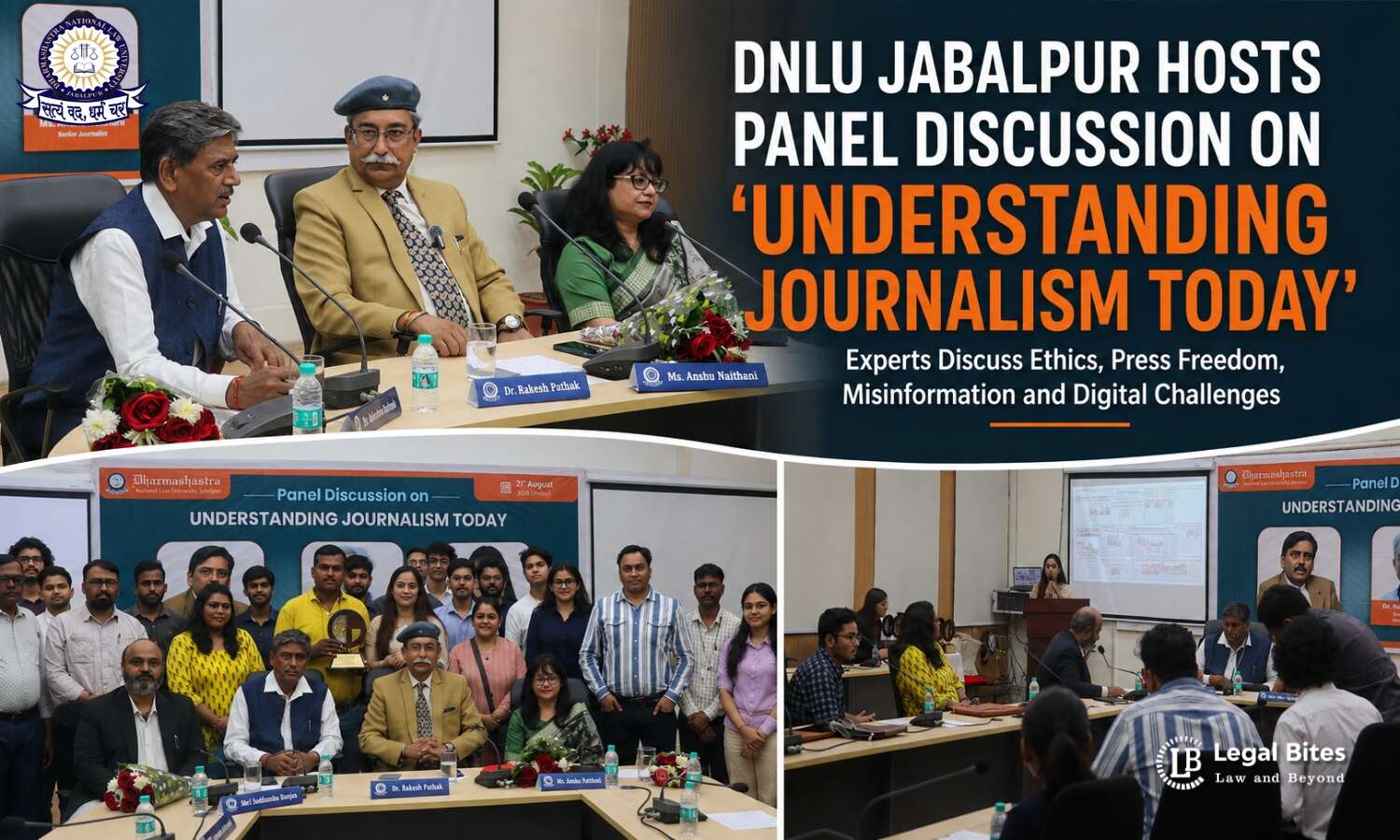
Dharmashastra National Law University (DNLU), Jabalpur organised a panel discussion on “Understanding Journalism Today” on August 21, 2026, bringing together senior media professionals to discuss the changing nature of journalism, ethical challenges, press freedom, misinformation and the responsibilities of journalists in the digital age.
Panel Discussion on the Changing Landscape of Journalism
The programme was organised at the Dharmashastra National Law University, Jabalpur campus under the leadership of Prof. Dr. Manoj Kumar Sinha, Vice Chancellor, and Dr. Praveen Tripathi, Registrar. Dr. Animesh Jha, Assistant Dean of Student Welfare, welcomed the panellists, reporters, journalists, faculty members and students attending the discussion.
The panel featured senior media professionals Dr. Rakesh Pathak, Shri Sudhanshu Ranjan and Ms. Anshu Naithani. The speakers examined the evolving landscape of journalism, the challenges facing the profession and its continuing role in a democratic society.
Ethics, Commercialisation and Misinformation in Journalism
Dr. Rakesh Pathak, senior journalist and Gandhian activist from Madhya Pradesh, spoke about the erosion of ethical standards in regional journalism and the growing pressure of commercialisation on newsrooms. He also underlined the continuing relevance of Gandhian values of truth and restraint in reporting.
Tracing the history of Indian journalism, he described the press as a major instrument of liberation during the independence movement. He also discussed the transition from handwritten and print journalism to electronic and digital formats, while cautioning against the unchecked spread of digital media and its vulnerability to misinformation and fake news.
Journalism continues to carry a responsibility towards truth and restraint even as the medium of reporting rapidly changes.
Press Freedom, Credibility and Accountability in the Digital Age
Shri Sudhanshu Ranjan, senior journalist and former Additional Director General, Doordarshan, Ministry of Information & Broadcasting, Government of India, addressed the changing credibility of mainstream and public broadcasting in the digital era. He highlighted the responsibility of journalists amid information overload and emphasised the need to balance the speed of reporting with accuracy and accountability.
He observed that struggles surrounding civil rights and press freedom are not confined to the present day. Referring to historical developments including Bal Gangadhar Tilak’s trials in 1908 and 1918 and the American War of Independence, he placed contemporary debates over free speech in a wider historical context.
Discussing the constitutional framework governing freedom of expression, he referred to the balance between the Right to Freedom of Speech under Article 19(1) and the reasonable restrictions permitted under Article 19(2). He further noted that governing power remains meaningful only when it is subject to opposition and independent critique.
The speed of reporting must be balanced with accuracy, accountability and independent critique.
Challenges Faced by Reporters and Growing Need for Fact-Checking
Ms. Anshu Naithani, senior journalist, anchor and producer with extensive experience across television and digital media, shared insights from her years of on-ground reporting. She spoke about the challenges faced by reporters, particularly women journalists, while working in the field.
She also stressed the growing importance of fact-checking and verification at a time when news cycles are increasingly influenced by social media.
Guest Speakers Felicitated
Following the discussion, Dr. Praveen Tripathi, Registrar, felicitated the guest speakers with mementos.
A separate felicitation ceremony was also organised to honour local correspondents and journalists working with various media organisations in Jabalpur for their contribution to grassroots reporting and their role in keeping the public informed.
Ms. Shruti Tiwari, Public Relations Officer and Assistant Registrar, served as the master of the ceremony.