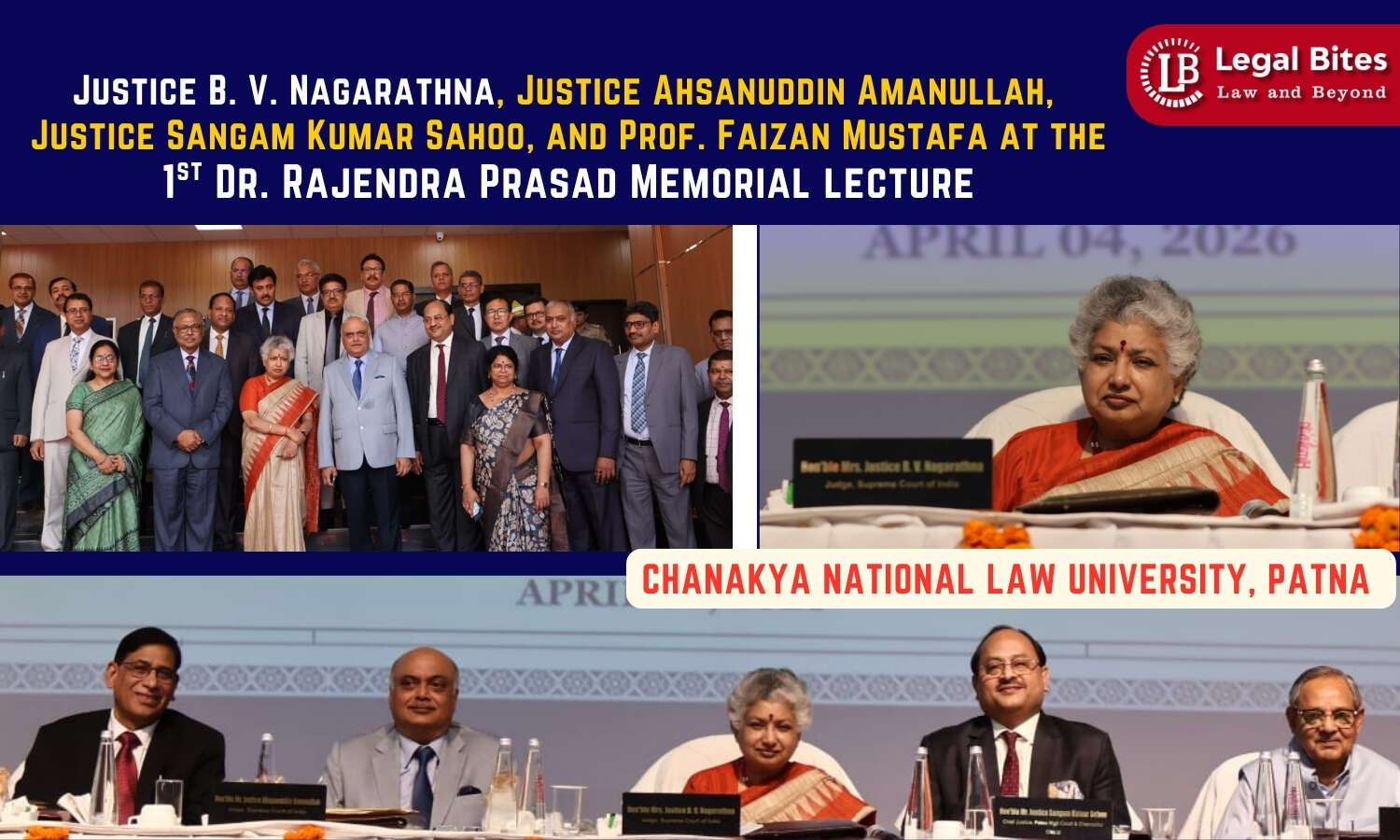
In a significant address on constitutional governance and institutional integrity, Justice B. V. Nagarathna emphasized that States are coordinate units under the Indian Constitution and not subordinate to the Centre. She delivered this powerful message while addressing the 1st Dr. Rajendra Prasad Memorial Lecture at Chanakya National Law University, Patna, on April 4, 2026. The lecture, themed “Constitutionalism Beyond Rights: Why Structure Matters”, highlighted the foundational importance of institutional design in ensuring that constitutional guarantees are meaningful and effective.
Constitutionalism Beyond Rights: Importance of Structure
Justice Nagarathna’s address revolved around the idea that constitutional rights alone cannot sustain a democracy unless supported by a robust institutional framework. She emphasized that the Indian Constitution is not merely a document granting rights but a transformative charter equipped with mechanisms of checks and balances. In a powerful articulation, she stated that “rights without structure is of no use,” underscoring the indispensability of constitutional institutions in translating rights into reality.
Federalism and Centre-State Relations
A central theme of her lecture was the principle of cooperative federalism, which she described as a defining feature of the Indian constitutional framework. Justice Nagarathna clearly asserted that States are not subordinate to the Centre but are coordinate units within the constitutional scheme. She cautioned against a discriminatory or selective approach by the Union Government in implementing development programmes, stating that “there cannot be a pick and choose approach vis-à-vis the States” when it comes to the welfare of citizens. She further stressed that disputes between the Centre and States, as well as inter-State conflicts, should ideally be resolved amicably in the spirit of constitutional dharma and federal balance.
Accountability of Power and Electoral Integrity
Justice Nagarathna placed significant emphasis on the accountability of power, asserting that “power, no matter however legitimate in its source, must always remain answerable.” She highlighted that constitutional governance demands continuous accountability and restraint in the exercise of authority. Raising concerns about electoral neutrality, she observed that if the bodies conducting elections are dependent on those contesting them, the fairness of the democratic process stands compromised. Her remarks underscored the urgent need to preserve the independence of institutions entrusted with safeguarding democracy.
Independence of Constitutional Institutions and Basic Structure Doctrine
The lecture further elaborated on the importance of independent constitutional institutions such as the Election Commission, Comptroller and Auditor General (CAG), Finance Commission, SEBI, and Public Service Commissions, which serve as pillars of democratic governance. Justice Nagarathna explained that while many constitutions across the world guarantee rights, those rights often remain ineffective in the absence of strong institutional frameworks. She reiterated that the Basic Structure Doctrine functions as a safeguard against excessive constitutional amendments, ensuring that the core values of the Constitution remain intact.
She also discussed the significance of horizontal and vertical separation of powers, noting that while legislative and executive actions are subject to judicial review, judicial accountability is firmly rooted within the constitutional framework itself. According to her, the Constitution is sustained through institutional fidelity and restraint in the exercise of power, which together preserve its integrity.
Tribunals and Institutional Coordination
Justice Nagarathna also addressed the functioning of tribunals, emphasizing the need for effective coordination between technical and judicial members to ensure efficiency and fairness in decision-making. She reiterated that the Constitution envisions a well-balanced system of governance, where institutional collaboration is essential for delivering justice.
Tribute to Dr. Rajendra Prasad
Paying tribute to Dr. Rajendra Prasad, Justice Nagarathna highlighted his enduring legacy as a constitutional statesman and visionary leader who played a pivotal role in shaping India’s democratic foundation. She appreciated the efforts of Prof. Faizan Mustafa, Vice-Chancellor of CNLU, for instituting the memorial lecture in honour of Bihar’s most illustrious son, who presided over the Constituent Assembly and later served as India’s first President. She emphasized that the strength of the Constitution lies not only in the rights it guarantees but also in the robustness of its institutional structure.
Addresses by Other Dignitaries
Justice Ahsanuddin Amanullah, in his scholarly remarks, highlighted that moral courage is at the heart of constitutionalism and stressed that the system rests on the rule of law rather than mere rule by law. He emphasized that adherence to constitutional values requires both integrity and courage from all stakeholders within the legal system.
Justice Sangam Kumar Sahoo, Chief Justice of the Patna High Court and Chancellor of CNLU, in his presidential address, observed that the responsibility to protect the constitutional structure lies equally with the judiciary and the legal fraternity. He encouraged law students to engage deeply with constitutional principles and reflected on the remarkable contributions of Dr. Rajendra Prasad, describing him as “Deshratna” and the “Gandhi of Bihar.” He further noted that the Constitution aims to promote equality, liberty, and protection against arbitrariness, with its structural features acting as foundational pillars.
Prof. Faizan Mustafa, in his eloquent welcome address, highlighting the importance of constitutionalism, stated that “the death of constitutionalism is the central event of our times.” He observed that even democracies are declining in several countries, and that many constitutions today focus more on power and control rather than rights and limitations.
He specifically referred to three Constitution Bench decisions in which Justice B. V. Nagarathna courageously delivered dissenting opinions, guided by her belief in the dignity of individuals. He also spoke about notable judgments delivered by Justice Ahsanuddin Amanullah, including the Private University case, appreciating his contribution to constitutional jurisprudence.
Prof. Mustafa further expressed his gratitude to Justice Amanullah, a son of the soil of Bihar, for guiding the University on a path of remarkable transformation and progress.
Conclusion and Policy Insights
The programme concluded with a vote of thanks by Shri P.K. Shahi, Advocate General of Bihar, who highlighted the significant progress made by the State in women’s empowerment. He cautioned that democracy cannot survive without strong constitutional structures, reinforcing the central theme of the lecture. He also announced that the Government of Bihar is working on a policy to financially support law students pursuing legal education, reflecting a commitment to strengthening the legal ecosystem.
The event was attended by judges of the Patna High Court, members of the Bar, senior bureaucrats, academicians, researchers, students, and members of the media, making it a significant academic and constitutional discourse.
Justice Nagarathna’s lecture ultimately reaffirmed that the success of a constitutional democracy depends not only on the recognition of rights but also on the strength, independence, and accountability of its institutional framework, thereby reinforcing the enduring relevance of India’s constitutional vision.