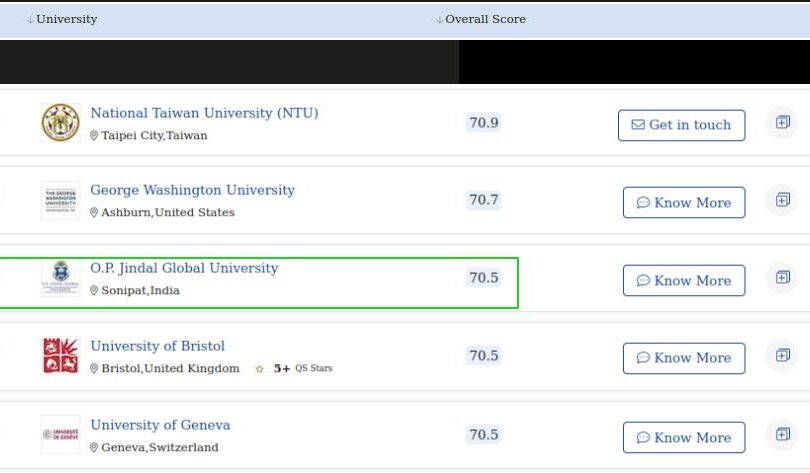
JGLS Sonepat has continued its steady climb up the QS World University Rankings law subject rankings and is now in the top 100 while NLSIU Bengaluru had disappeared, following both having managed to crack the QS’ metrics last year.
In last year’s QS subject rankings, JGLS had been ranked in the broad 101-150th category, while NLS had made it to the 151-200-rank bracket.
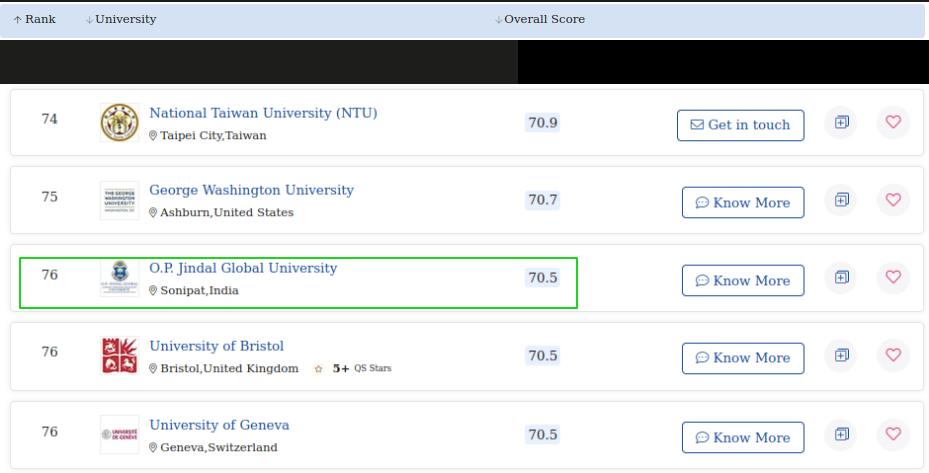
This year, JGLS’ parent university, OP Jindal Global University was ranked 76th with a score of 70.5, which is around 2 points higher than last year’s.
We have reached out to an NLSIU spokesperson and vice-chancellor (VC) Prof Sudhir Krishnaswamy for comment, though we understand that its 2020 inclusion had followed a semi-independent initiative to crack global rankings carried out by a faculty member under the previous VC, Prof Venkata Rao.
A QS spokesperson confirmed that for its subject rankings no specific applications were required by universities to be included, and that those rankings were purely based on objective metrics researched by the company (see below for more details).
We have requested further comment from QS about why NLSIU was not in the list this year.
The rankings may be useful for domestic rankings such as the government’s National Institutional Ranking Framework (NIRF) (which JGLS incidentally has refused to take part in but where NLSIU has been ranked first since the start).
Besides domestic bragging rights, another likely driver to perform well in QS may be to encourage overseas students to join your law school (which has been stated to be important for both JGLS and NLSIU).
Recipe for climb: Research
According to a JGLS press release, its improved performance was primarily due to its improvement in the two research metrics:
JGLS’s current global rank of 76 compared to previous rank in the 101-150 bracket is driven by a 45% increase in research citation and a 25% increase in the H-index of research output of JGLS.
As we had reported last year after inquiry with QS in a more in-depth report about its methodology, those two metrics account for only a total of 20% of the total QS score, which are made up of:
- Academic reputation 50%
- Employer reputation 30%
- H Index citations 15%
- Citations per paper 5%
This year QS has not listed a breakdown of individual rankings on its website but only an overall score, though we have requested more details from QS and will update this article when we hear from them.
Last year, JGLS had got an overall score of around 68 according to that methodology, with the following individual scores:
- academic reputation: 67.7
- employer reputation: 83.3
- H-index: 45.5
- Citations per paper: 55.4
The QS rankings, as all rankings, are of course easily hackable, and JGLS has for at least three years now had an department dealing with improving its performance in league tables (dubbed the Office of Rankings, Benchmarking and Institutional Transformation (ORBIT)).
In the global rankings, JGLS is only 0.2 points behind George Washington University, and is ahead of the universities of Bristol and Geneva, tied at 70.5 points (we are not sure what the tie-breaker criteria are).
Amongst all Asia-region law schools included in the rankings, JGLS came 16th (see below).
While NUS Singapore is at the top with 86.3 and a global rank of 10, the lower Asian ranks are clustered much closer together, with a spread from 73.8 to 69.4 between 7th and 20th place.
Besides NUS, the top 10 of the global QS law rankings include four usual university suspects from the UK and five from the US (Harvard, Oxford and Cambridge are in the top three, followed by Yale, Stanford, LSE, Columbia, NYU and Berkeley).
Due disclosure: JGLS is currently an advertiser on Legally India.
Top 20 Asia law rankings by QS
| Global Rank | Asian University Name | Overall QS Score | |
| 10 | National University of Singapore (NUS) | Singapore, Singapore | 86.3 |
| 21 | The University of Tokyo | Tokyo,Japan | 81.3 |
| 21 | The University of Hong Kong | Hong Kong,Hong Kong SAR | 81.3 |
| 27 | Tsinghua University | Beijing,China (Mainland) | 79.6 |
| 28 | Peking University | Beijing,China (Mainland) | 79.4 |
| 33 | Seoul National University | Seoul,South Korea | 77 |
| 48 | The Chinese University of Hong Kong (CUHK) | Hong Kong,Hong Kong SAR | 73.8 |
| 51 | Renmin (People’s) University of China | Beijing,China (Mainland) | 73.1 |
| 56 | Kyoto University | Kyoto,Japan | 72.5 |
| 58 | Korea University | Seoul,South Korea | 72.2 |
| 67 | Zhejiang University | Hangzhou,China (Mainland) | 71.3 |
| 70 | City University of Hong Kong | Hong Kong,Hong Kong SAR | 71.1 |
| 70 | Shanghai Jiao Tong University | Shanghai,China (Mainland) | 71.1 |
| 70 | Waseda University | Tokyo,Japan | 71.1 |
| 74 | National Taiwan University (NTU) | Taipei City,Taiwan | 70.9 |
| 76 | O.P. Jindal Global University | Sonipat,India | 70.5 |
| 84 | Yonsei University | Seoul,South Korea | 69.7 |
| 87 | Wuhan University | Wuhan,China (Mainland) | 69.5 |
| 88 | Fudan University | Shanghai,China (Mainland) | 69.4 |
| 88 | Keio University | Tokyo,Japan | 69.4 |
‘); $(‘#giphyin’).blur(function(){ if ($(this).val().length > 0) { giphy(0, false); } })
}
//–>