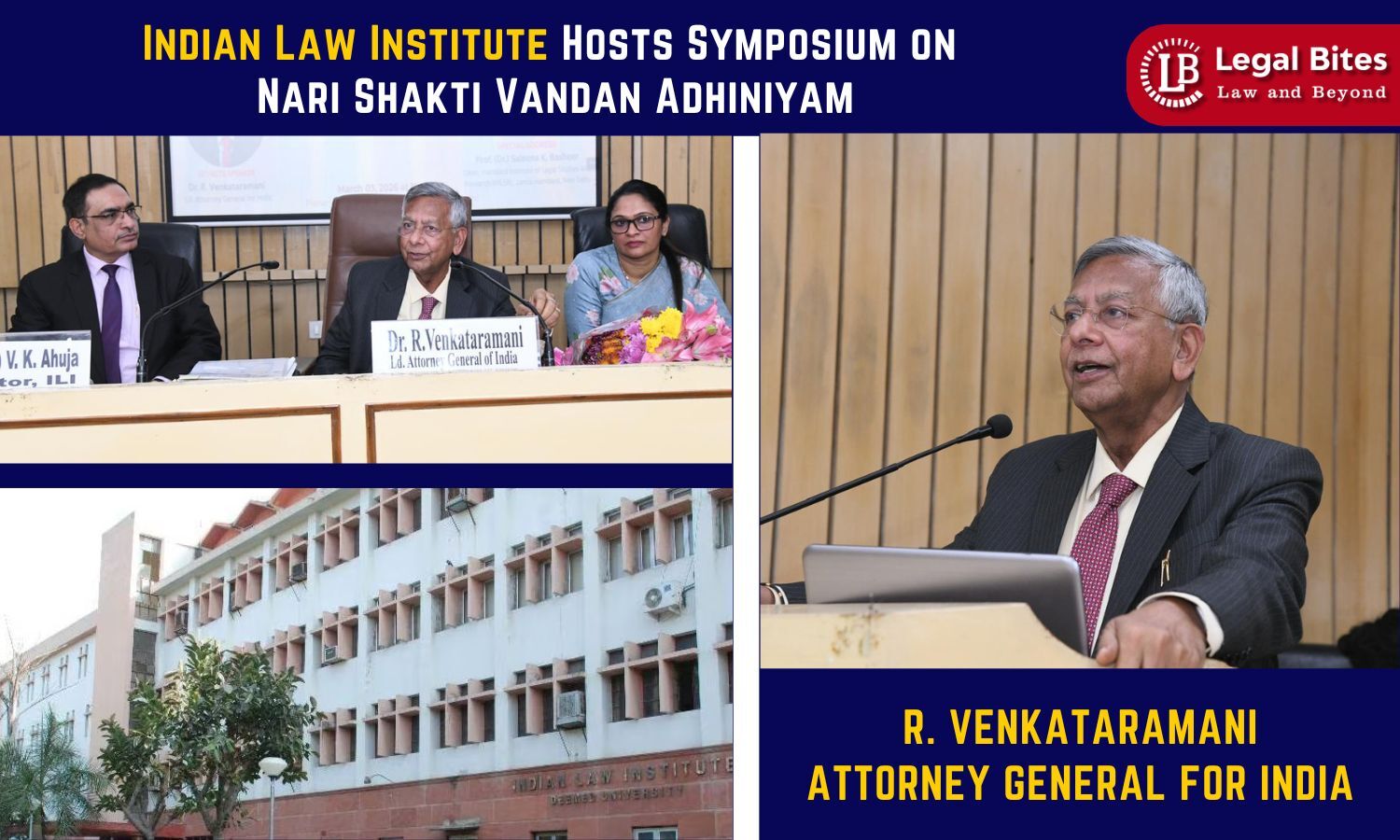
New Delhi: The Indian Law Institute, in collaboration with the Commonwealth Legal Education Association (CLEA), commemorated International Women’s Day by organising a National Symposium on “Nari Shakti Vandan Adhiniyam and its Implementation: 106th Constitutional Amendment Act, 2023.” The event brought together members of the Bar, academia, and students to deliberate on the constitutional and transformative significance of the legislation providing for women’s reservation in legislatures.
Constitutional Vision and Gender Justice
The programme commenced with introductory remarks by Senior Professor (Dr.) V.K. Ahuja, Director of the Indian Law Institute, who underscored the constitutional importance of the Nari Shakti Vandan Adhiniyam, 2023, enacted through the 106th Constitutional Amendment Act. He highlighted the evolving discourse on gender justice within Indian constitutionalism and stressed the need to examine not merely the enactment of transformative legislation, but also its effective implementation.
Professor Ahuja emphasised that constitutional amendments aimed at social reform must be accompanied by institutional preparedness and sustained commitment to equality. The symposium, he noted, was intended to encourage serious academic engagement with the operational aspects of women’s political representation.
Attorney General on Transformative Constitutionalism
Delivering the keynote address, Attorney General R. Venkataramani reflected on the foundational ideals of democracy, civilisation, and the Constitution. Recalling a personal memory of Justice V. R. Krishna Iyer, he remarked that rhetoric too has significance, observing that it evokes emotion and propels reflection.
He urged participants to examine the broader social, political, and subjective contexts in which constitutional reforms take root. According to him, ideas unfold over time and often in unpredictable ways. Drawing parallels with the constitutional abolition of untouchability, he questioned why gender divides continue to persist in modern democratic society.
Describing the 106th Constitutional Amendment within the larger constitutional promise of equality and participatory governance, the Attorney General underscored that transformative constitutionalism is not an abstract aspiration but a continuing process shaped by legislative will, judicial interpretation, and societal readiness.
Implementation Timeline and Institutional Processes
Addressing concerns regarding the operationalisation of the Amendment, Venkataramani clarified that constitutional amendments entail layered institutional procedures. He explained that processes such as delimitation exercises and administrative restructuring are essential prerequisites for implementation and require time to ensure compliance with constitutional mandates.
He observed that any delay must be understood in light of procedural and structural necessities rather than legislative reluctance. Characterising the Amendment as a significant democratic milestone, he remarked that enduring social reform through law depends not only on constitutional design but also on calibrated execution.
Commending the government for introducing the measure, he stated that had the matter been left solely to political discretion, such reform might have taken much longer to materialise. He concluded by emphasising the need for greater accountability among political parties and reaffirmed the role of law as an instrument of social transformation.
Symbolism and Nomenclature
Prof. (Dr.) Saleena K. Basheer, Dean of the Hamdard Institute of Legal Studies and Research, framed her remarks within the moral and civilisational ethos of women’s political participation. Invoking the Sanskrit dictum “Yatra naryastu pujyante ramante tatra devataḥ,” she underscored the cultural roots of gender dignity and respect.
She drew particular attention to the title “Nari Shakti Vandan Adhiniyam,” noting that legislative nomenclature carries symbolic meaning and conveys constitutional intent. Appreciating the choice of “Nari Shakti Vandan” instead of a more conventional terminology such as “Mahila Arakshan,” she observed that the adopted title signifies empowerment rather than mere reservation.
Prof. Basheer also reflected on the growing presence of women in constitutional offices, noting that the leadership of women in key national positions exemplifies the spirit underlying the Amendment.
Commitment to Inclusive Governance
The Indian Law Institute reaffirmed its commitment to advancing constitutional values of equality and representation, endorsing the Nari Shakti Vandan Adhiniyam as a progressive step toward inclusive governance and gender justice in India. The deliberations emphasised that implementation of the Amendment is not a mere procedural formality, but part of a broader constitutional project aimed at social transformation through law.
Ms. Ruchi Sharma, Joint General Secretary of CLEA, also addressed the gathering, highlighting the contemporary relevance of inclusive representation in democratic institutions.
The symposium concluded with a vote of thanks delivered by Dr. Arya A. Kumar, Associate Professor at ILI, who expressed gratitude to the dignitaries and participants for their meaningful contributions to the discourse.