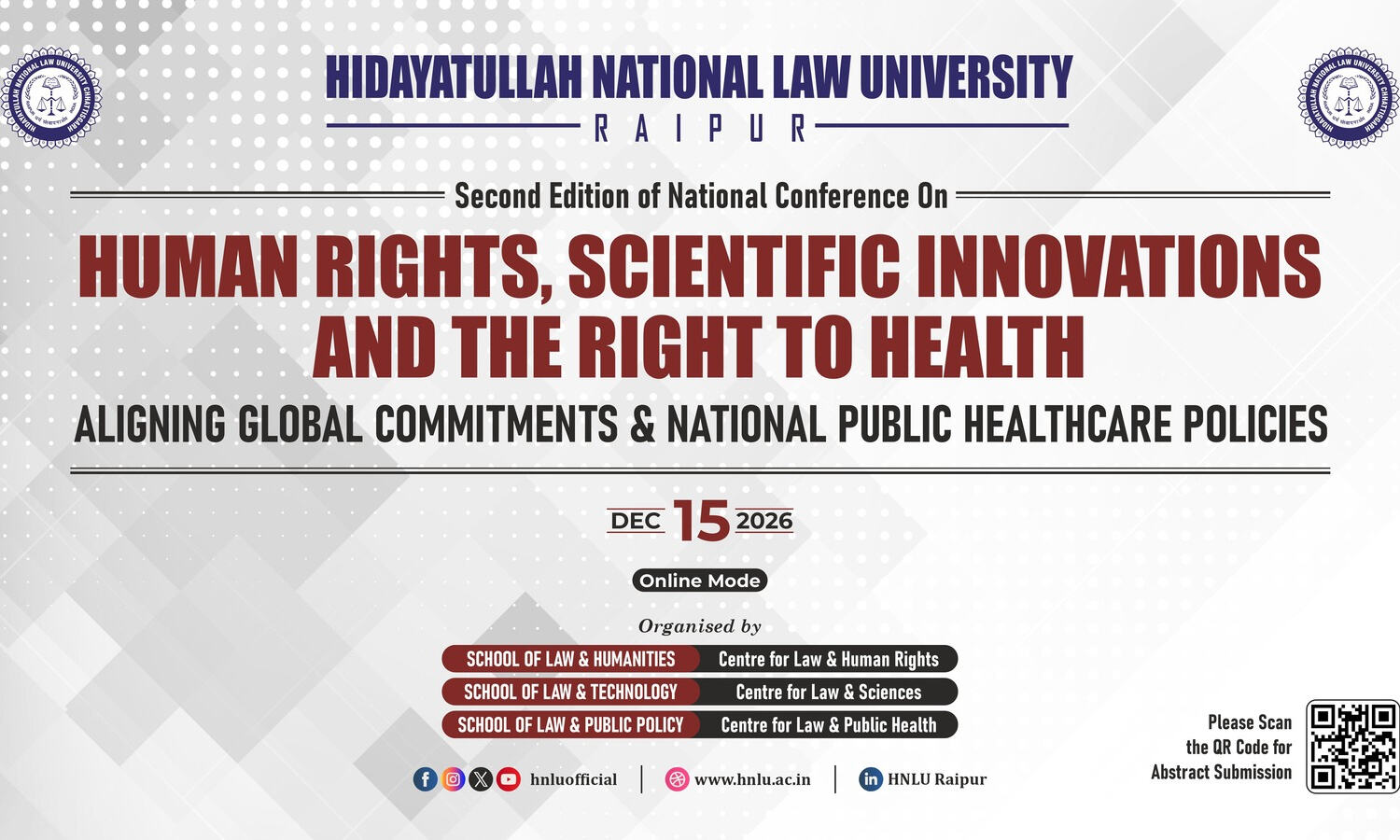
Hidayatullah National Law University (HNLU), Raipur, is organising the Second Edition of the National Conference on “Human Rights, Scientific Innovations and the Right to Health: Aligning Global Commitments and National Public Healthcare Policies” on 15 December 2026 in online mode. Interested participants can submit their abstracts by 30 November 2026.
About HNLU Raipur
Hidayatullah National Law University (HNLU), Raipur, is an institution dedicated to legal education and research. The university promotes interdisciplinary learning, academic research and professional development through initiatives such as Lex Osmose, Ex Arca, HNLU Press, Sui Generis, HEXA, HAAI and its Research Hub and Spoke (R-HaS) model.
About the Conference
The conference is jointly organised by the Centre for Law and Human Rights under the School for Law and Humanities, the Centre for Law and Sciences under the School for Law and Technology, and the Centre for Law and Public Health under the School for Law and Public Policy at HNLU Raipur.
The conference examines the relationship between scientific advancement, human rights and access to healthcare. Developments in biotechnology, artificial intelligence, medical research and digital healthcare have created new opportunities for improving public health while raising concerns regarding affordability, intellectual property rights, privacy, technological inequalities and human dignity.
The discussions will focus on the interaction between Articles 12 and 15(1)(b) of the International Covenant on Economic, Social and Cultural Rights (ICESCR), which recognise the right to health and the right to benefit from scientific progress.
The conference seeks to explore legal, ethical and institutional frameworks for ensuring equitable access to scientific innovations while protecting human rights and supporting effective national healthcare policies, particularly for developing countries and vulnerable populations.
Theme of the Conference
Human Rights, Scientific Innovations and the Right to Health: Aligning Global Commitments and National Public Healthcare Policies
Sub-Themes
1. Scientific Innovation as a Public Good and the Right to Health
- Universal Access to Healthcare Technologies and Health Equity
- Publicly Funded Medical Research and Equitable Access to Innovations
- Scientific Progress as a Public Good: State Obligations under Articles 12 and 15 of the ICESCR
2. Reproductive Technologies, Human Rights and Regulatory Frameworks
- Assisted Reproductive Technologies: Human Rights and Regulatory Challenges
- Right to Access Advanced Reproductive Technologies
- Artificial Womb Technology: Emerging Legal and Ethical Frameworks
- Cross-border Reproductive Care
3. Emerging Biomedical Technologies and Human Dignity
- Therapeutic Gene Editing and Genomic Medicine: Regulatory Challenges
- Human Cloning, Heritable Genome Editing and the Limits of Biomedical Intervention
- Genetic Discrimination, Eugenic Practices and International Human Rights Standards
4. Artificial Intelligence, Digital Health and Patient Rights
- AI-assisted Clinical Decision-making and Professional Liability
- Algorithmic Bias, Non-discrimination and Health Equity in Digital Healthcare
- Protection of Electronic Health Records, Genetic Data and Patient Privacy
- Big Data, Predictive Healthcare and Patient Rights
5. Intellectual Property, Innovation and Global Public Health
- Intellectual Property Rights and the Right to Health
- TRIPS Flexibilities, Compulsory Licensing and Technology Transfer
- Public Funding and Open Science for Medical Innovations
6. Clinical Research, Biomedical Ethics and Human Rights Protection
- Ethical Standards in Clinical Trials and Biomedical Research
- Inclusive Clinical Research and the Protection of Vulnerable and Under-represented Populations
- Biobanking, Biospecimen Collection and Governance of Human Biological Materials
7. Pandemic Preparedness, Global Health Governance and National Legal Frameworks
- Equitable Vaccine Distribution, Global Solidarity and Access to Essential Medical Technologies
- Public Health Emergencies: Balancing Collective Health Interests and Individual Rights
- Strengthening Healthcare Governance through International Cooperation and Comparative Legal Approaches
Note: The above sub-themes are indicative. Participants may select any topic relevant to the main theme of the conference.
Submission Guidelines
Abstract Submission
- The abstract should be approximately 400–500 words, inclusive of 5 keywords.
- A brief author profile of 50 words must accompany the abstract, mentioning the author’s email ID, contact number, designation and official address.
- The abstract must follow these formatting requirements:
- Font: Times New Roman
- Font Size: 12
- Line Spacing: 1.5
- Alignment: Justified
- Margins: 1 inch on all sides
- Paper Size: A4
- File Format: MS Word only
- The attachment must be named in the prescribed format, for example, JohnDoe_abstract.
- Authors must provide details of the problem identified in their research.
- Authors must specify the conference theme to which their paper belongs.
- Submission of an abstract grants the organisers permission to publish it in hard copy and electronic formats for distribution during the conference.
Full Paper Submission
- Authors of selected abstracts will receive a link for full-paper submission after the conference.
- A full paper is not required for presenting at the conference.
- Detailed guidelines for full-paper submission will be circulated separately after the conference.
- Selected papers, following scrutiny, may be published in an edited book with an ISBN.
- Presentation of a paper does not guarantee publication.
Registration Fees
Participants whose abstracts are accepted must complete the registration process through the link provided by the organisers and pay the applicable registration fee.
- Faculty Members and Professionals: ₹1,500
- Research Scholars and Students: ₹1,000
Important Registration Instructions
- A maximum of two authors per paper is permitted.
- For co-authored papers, both authors must register individually and pay the applicable registration fee separately.
- The registration fee is non-refundable, including when a registered participant is unable to attend the conference.
- Conference certificates will be issued only to registered participants who attend the Inaugural and Valedictory Sessions online and actively participate in their respective scheduled paper presentation sessions.
- Acceptance of an abstract does not automatically confirm participation. Registration and payment of the prescribed fee are mandatory for confirmation.
Important Dates
- Abstract Submission Deadline: 30 November 2026
- Notification of Selected Abstracts: 10 December 2026
- Date of Conference: 15 December 2026
How to Submit?
Interested authors must submit their abstracts through the official Google Form provided by the organisers before 30 November 2026.
[Click Here to Submit Abstract]
Downloads
Brochure: [Click here to view]
Contact
For further information or queries, contact:
Dr. Kiran Kori
Head, Centre for Law and Human Rights
Organising Secretary
Mobile: 93297 14863
Dr. Debmita Mondal
Head, Centre for Law and Sciences
Organising Secretary
Mobile: 88271 16648
Email: [email protected]