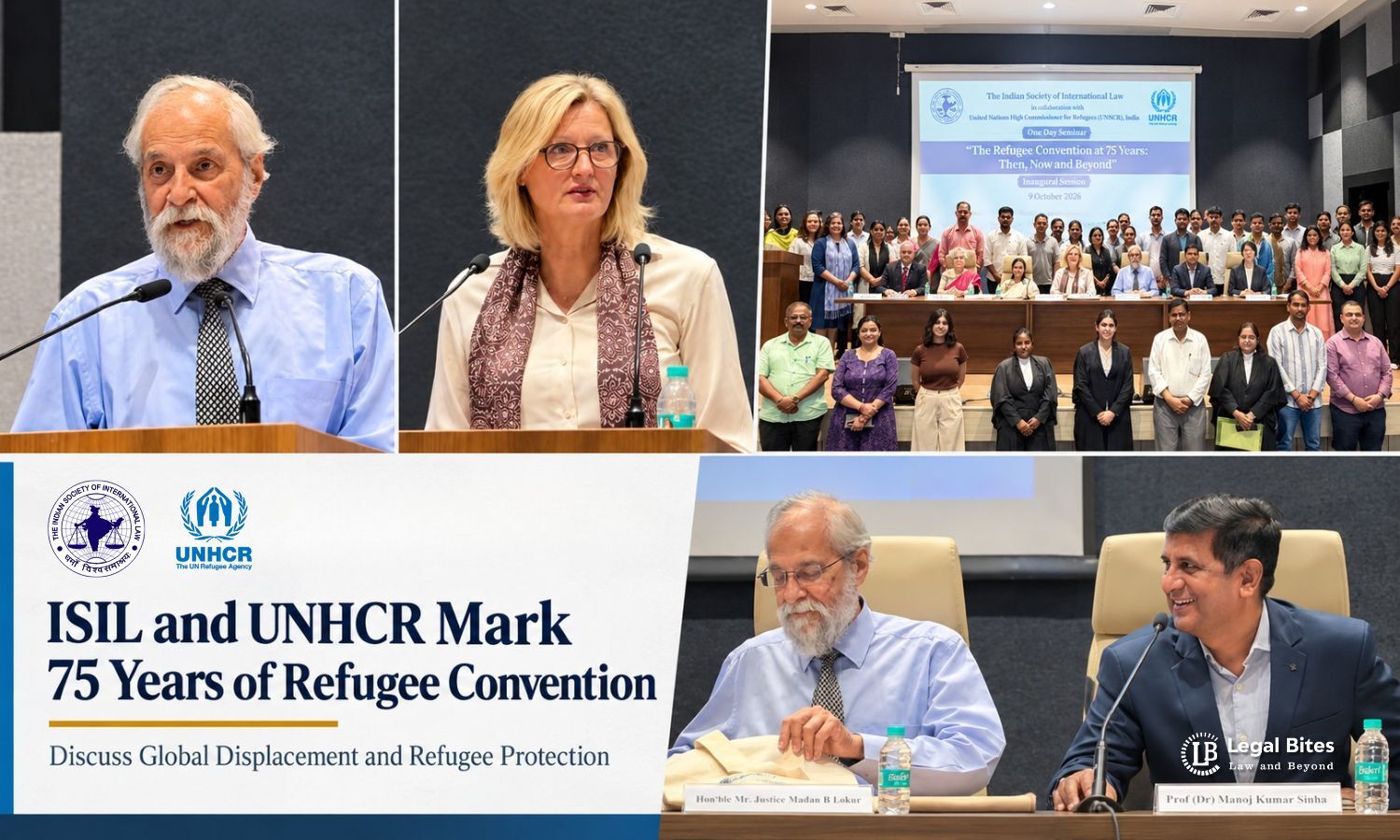
New Delhi, October 9, 2026: The Indian Society of International Law (ISIL), in collaboration with the United Nations High Commissioner for Refugees (UNHCR), India, organised a one-day seminar titled “The Refugee Convention at 75 Years: Then, Now and Beyond” on October 9, 2026. The event brought together eminent jurists, representatives of international organisations, legal scholars and researchers to deliberate on the evolution of international refugee law, contemporary displacement challenges and the future of refugee protection.
The inaugural session featured Prof. (Dr.) Manoj Kumar Sinha, President of ISIL; Hon’ble Mr. Justice Madan B. Lokur, Chairperson of the United Nations Internal Justice Council and former Judge of the Supreme Court of India; and Ms. Margriet Veenma, Deputy Chief of Mission, UNHCR India. Dr. U.C. Jha, Secretary General of ISIL, delivered the vote of thanks.
Prof. Manoj Kumar Sinha Highlights Evolution of Refugee Law
Delivering the welcome address, Prof. (Dr.) Manoj Kumar Sinha traced the historical development of international refugee law, observing that the emergence of specialised branches of international law gained momentum following the Second World War.
He explained that international refugee protection preceded the 1951 Refugee Convention, referring to the introduction of the Nansen passport in 1922 and subsequent institutional developments. He noted that the Convention was initially framed with temporal and geographical limitations, reflecting the belief that refugee crises were temporary. However, subsequent conflicts demonstrated the continuing nature of forced displacement, eventually leading to the adoption of the 1967 Protocol.
Highlighting the contemporary humanitarian situation, Prof. Sinha referred to approximately 129.4 million refugees, displaced persons and stateless individuals worldwide, underscoring the growing challenges confronting international refugee protection.
He also recalled ISIL’s pioneering efforts in promoting refugee law education in India through academic programmes developed with support from UNHCR, the International Committee of the Red Cross (ICRC) and the National Human Rights Commission (NHRC).
Discussing India’s evolving immigration framework, Prof. Sinha emphasised the need for greater public awareness, academic engagement and institutional discussion on legislative developments affecting foreign nationals and refugee protection.
UNHCR Calls for Stronger Protection and International Cooperation
Addressing the gathering, Ms. Margriet Veenma, Deputy Chief of Mission, UNHCR India, highlighted the continued relevance of the 1951 Refugee Convention amid growing global displacement.
Referring to humanitarian crises in Sudan, Syria, Afghanistan, Gaza and Myanmar, she observed that millions of people continue to flee conflict and persecution in search of safety and dignity.
She emphasised the fundamental principle of non-refoulement, which prohibits returning refugees to territories where their lives or freedom would be threatened.
Ms. Veenma stressed that refugee protection and national security are not conflicting objectives, explaining that fair and effective asylum procedures enable States to identify individuals requiring international protection while addressing legitimate security concerns.
Discussing India’s refugee protection framework, she acknowledged the country’s longstanding tradition of providing refuge to communities from Tibet, Sri Lanka, Afghanistan, Myanmar and other regions.
She noted that although India is not a signatory to the 1951 Refugee Convention or its 1967 Protocol, it has developed different arrangements for refugee communities. She suggested that a more coherent national framework could provide greater consistency and predictability while remaining aligned with India’s national priorities.
Highlighting increasing pressure on humanitarian resources, she called for stronger international cooperation, fair asylum procedures and renewed commitment to protecting individuals fleeing persecution. She also referred to UNHCR’s ongoing consultations aimed at shaping its protection agenda for 2027.
Justice Madan B. Lokur Calls for Comprehensive National Refugee Policy
Hon’ble Mr. Justice Madan B. Lokur, Chairperson of the United Nations Internal Justice Council and former Judge of the Supreme Court of India, delivered the inaugural address, highlighting India’s historical tradition of providing refuge to persecuted communities and the contemporary legal challenges surrounding refugee protection.
Tracing India’s history of accommodating displaced populations, Justice Lokur referred to the arrival of Parsis, Baháʼís and Jewish refugees, including those who sought shelter in India during the Second World War. He also recalled the influx of Tibetan refugees in 1959, displacement during the Bangladesh Liberation War in 1971, and the arrival of refugees from Sri Lanka, Afghanistan and Myanmar.
Despite this longstanding humanitarian tradition, Justice Lokur expressed concern over the absence of a comprehensive national legal framework for refugees. He observed that India is neither a signatory to the 1951 Refugee Convention nor its 1967 Protocol, and highlighted the implications of the Immigration and Foreigners Act, 2025, which replaced the earlier Foreigners Act, 1946.
He noted that the existing legal framework largely distinguishes between Indian citizens and foreigners without providing a separate statutory category for refugees and asylum seekers. This, he observed, creates difficulties for individuals fleeing persecution who enter India without valid travel documents.
Discussing constitutional protections, Justice Lokur emphasised that Articles 14 and 21 of the Constitution of India extend important fundamental rights to all persons, including foreigners and refugees. He highlighted the role of the Supreme Court in protecting the life, liberty and dignity of non-citizens through constitutional interpretation.
Referring to judicial developments, he discussed the Subaskaran case (2025) concerning Sri Lankan Tamil refugees and the pending Mohammad Salimullah v. Union of India proceedings relating to the deportation of Rohingya refugees. He raised concerns over the prolonged pendency of important constitutional questions concerning the treatment and deportation of displaced persons.
Justice Lokur also addressed the principle of non-refoulement, which prohibits the return of refugees to territories where their lives or freedom may be threatened. He discussed its significance under international law and India’s obligations under international human rights instruments, particularly when read alongside the constitutional guarantees under Article 21.
Expressing concern over the treatment of Rohingya refugees, he referred to a reported incident in May 2025 involving refugees allegedly being transported near the Andaman Islands and forced into the sea. He questioned the compatibility of such actions with constitutional protections and international humanitarian principles.
He further examined the contrasting treatment of displaced communities under the Citizenship Amendment Act (CAA), which provides a pathway to citizenship for specified communities from Pakistan, Bangladesh and Afghanistan, while other asylum seekers may continue to face detention or deportation.
Justice Lokur called for a consistent, humanitarian and comprehensive national refugee policy, supported by parliamentary legislation, constitutional safeguards and wider consultation with civil society, legal scholars and other stakeholders. He emphasised the importance of developing a transparent and predictable framework that recognises the particular vulnerabilities of refugees and asylum seekers.
The inaugural session concluded with a vote of thanks by Dr. U.C. Jha, Secretary General of ISIL, who recalled his association with ISIL’s refugee law diploma programme and acknowledged the contributions of Prof. Sinha, UNHCR representatives and other distinguished participants.
Technical Sessions Examine Emerging Challenges in Refugee Protection
The seminar featured three technical sessions examining contemporary developments in international refugee law.
Session I: Complementary Pathways, Immigration Detention and Refugee Rights
Session I, chaired by Ms. Sakura Ozaki, Deputy Secretary General, Asian-African Legal Consultative Organization (AALCO), addressed complementary pathways for refugees, alternatives to immigration detention, refugee protection in non-signatory States, sexual violence as persecution and property rights of displaced populations.
The session featured presentations by Saie Shetye and Hamsa Vijayaraghavan, Kadiri Raghu Vamsi, Dr. Sudhakaran, Ms. Himani Jha, Ms. Alisha Syali, Ms. Yash Sinha and Ms. Shabnam Khan.
Session II: Forced Displacement, Statelessness and Human Rights
Session II, chaired by Ms. Sumbul Rizvi, examined forced displacement, sovereignty and human rights, refugee protection obligations beyond the 1951 Convention, statelessness, constitutionalism and comparative refugee governance.
Presentations were scheduled from Ms. Aysha Saifi and Dr. Balajinaika B.G., Ms. Antarnihita Mishra, Dr. Vijay Kumar Verma and Mr. Sanskar Sihoriya, Mr. Govinda Pandey, Mr. Avinash Kumar Paswan, Ms. Adhirai Devi S., Mr. Shobhit Pratap Singh and Ms. Rajnandani Ghawri.
Session III: Refugee Children, Climate Displacement and Rohingya Refugees
Session III focused on unaccompanied refugee children, non-refoulement, climate-induced displacement, refugee governance in non-signatory States and the gendered experiences of Rohingya displacement.
Speakers included Dr. Kanika Sharma, Mr. Aditya Bhura and Ms. Adrija Bhura, Dr. Shirish Dattaraya Kulkarni and Ms. Mathy Kutty, Dr. Chemmalar, Ghada Elfatih, Dr. Parul Shukla and Mr. Bijendra Shandilya, and Ms. Mreetika Ganguly.
The seminar underscored the continuing relevance of the 1951 Refugee Convention and the importance of international cooperation, legal scholarship and effective national frameworks in addressing the challenges of forced displacement and ensuring the protection, safety and dignity of refugees.