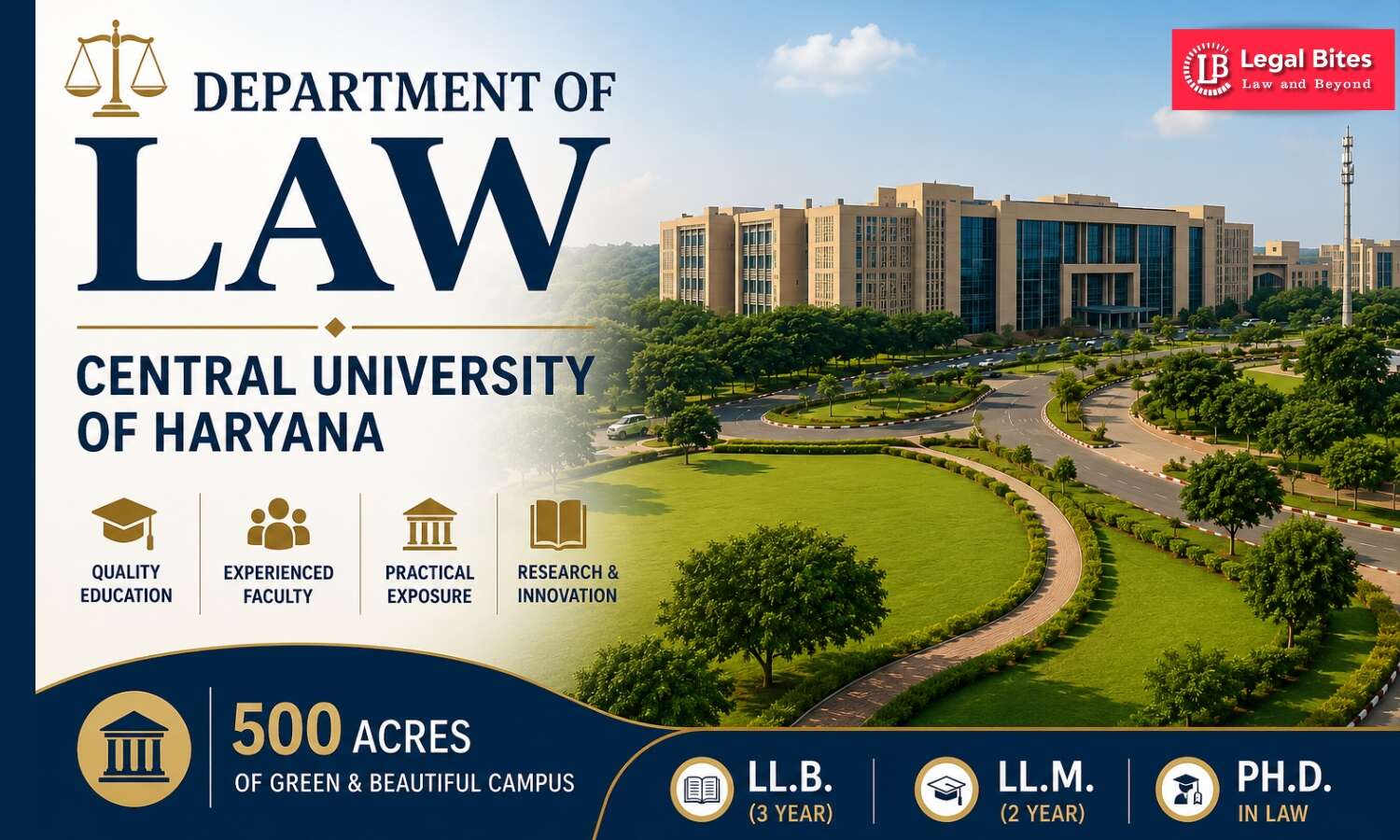
Established in 2009 under the School of Law, Public Policy & Management, the Department of Law offers a vibrant academic environment for students aspiring to build careers in law, research and public service. Set within a beautiful and expansive campus spread across nearly 500 acres, the Department combines academic learning with practical exposure, providing students with an engaging setting for legal education and overall development.
The Department is supported by a highly qualified and dedicated faculty actively involved in teaching, research and the academic advancement of students. Practical legal education forms an important part of the learning experience, with students encouraged to participate in legal aid programmes, moot court competitions, court visits and other outreach activities. Visits to various High Courts and the Supreme Court of India are also organised from time to time, enabling students to gain valuable exposure to the functioning of the judicial system.
To keep pace with developments in law and legal practice, the Department regularly updates the curricula of its programmes. It currently offers the LL.B. (3-Year Professional Course), LL.M. (Two-Year Course) and Ph.D. in Law, catering to students at different stages of legal education and research.
College Overview
College Name: Department of Law, Central University of Haryana (CUH)
Location: Jant-Pali Village, Mahendergarh, Haryana – 123031, India
Established: 2010 (Central University established in 2009)
University: Central University of Haryana
University Type: Central University established under the Central Universities Act, 2009
Recognition: University Grants Commission (UGC)
Accreditation: NAAC ‘A’ Grade
Approval: Bar Council of India (LL.B. Programme)
Campus: Approximately 484-acre residential campus
Official Website: https://www.cuh.ac.in
About Central University of Haryana
The Central University of Haryana (CUH) was established under the Central Universities Act, 2009 by the Government of India. Located at Jant-Pali, Mahendergarh, the University functions as a fully funded Central University under the University Grants Commission (UGC).
Spread across nearly 484 acres, the University has developed modern academic infrastructure equipped with smart classrooms, laboratories, digital libraries, hostels, sports facilities, and research centres. The University presently comprises 8 Schools, 35 Departments, and offers 91 academic programmes across undergraduate, postgraduate, doctoral, and professional disciplines. The institution follows an interdisciplinary model of education and encourages research, innovation, and skill development across disciplines.
The University has also received NAAC ‘A’ Grade accreditation, reflecting its commitment to quality teaching, research, governance, and student development.
About the Department of Law
The Department of Law functions under the School of Law and has established itself as an important centre for legal education within the University. Since its inception, the department has focused on producing legally competent professionals who possess analytical ability, ethical values, and social responsibility.
Unlike traditional legal education that focuses solely on classroom lectures, the Department emphasises experiential learning through:
- Case law analysis
- Moot court exercises
- Legal research projects
- Clinical legal education
- Legal aid and community outreach
- Seminars and workshops
- Internship programmes
The Department aims to develop graduates who understand both the theoretical foundations and practical applications of law.
Courses Offered
The Department presently offers the following programmes:
LL.B. (Three-Year Programme)
The three-year LL.B. programme is designed for graduates from any recognised discipline who wish to pursue a professional career in law.
The curriculum follows the Choice Based Credit System (CBCS) aligned with NEP 2020, integrating compulsory papers, electives, clinical courses, and practical training.
Core subjects include:
- Constitutional Law
- Law of Contracts
- Law of Torts
- Family Law
- Criminal Law
- Property Law
- Administrative Law
- Labour Law
- Company Law
- Jurisprudence
- Environmental Law
- Civil and Criminal Procedure
- Evidence Law
- Professional Ethics
- Drafting, Pleading and Conveyancing
LL.M.
The Department also offers a two-year LL.M. programme with advanced coursework aimed at strengthening research and analytical skills.
Students study subjects such as:
- Legal Theory
- Public International Law
- International Humanitarian Law
- Administrative Law
- Family Law
- Constitutional Law
- Research Methodology
- Various elective papers based on specialization and contemporary legal developments.
Ph.D. in Law
The Department also offers Doctoral (Ph.D.) programmes, encouraging advanced legal research in emerging and traditional fields of law. Scholars undertake coursework followed by independent research under faculty supervision.
Admission Process
Admissions are conducted strictly according to the norms prescribed by the University and the Government of India.
Generally:
- LL.B. admissions are based on CUET (PG) scores followed by counselling conducted by the University.
- LL.M. admissions are also based on CUET (PG) and University admission procedures.
- Ph.D. admissions follow University regulations, including entrance examination and interview wherever applicable.
Applicants should regularly check the University’s admission portal for eligibility criteria, reservation policies, counselling schedules, and important dates.
Curriculum and Teaching Methodology
The Department follows an outcome-based curriculum prepared in accordance with the CBCS, Learning Outcome-Based Curriculum Framework (LOCF), and National Education Policy (NEP) 2020.
Teaching methods include:
- Classroom lectures
- Case study discussions
- Interactive tutorials
- Research assignments
- Student presentations
- Project work
- Seminar papers
- Practical drafting exercises
- Moot court participation
- Legal research methodology
Continuous Internal Assessment (CIA), semester examinations, presentations, project work, and practical exercises collectively evaluate student performance.
The curriculum aims to ensure that students not only understand legal doctrines but are also capable of applying them to real-life legal problems.