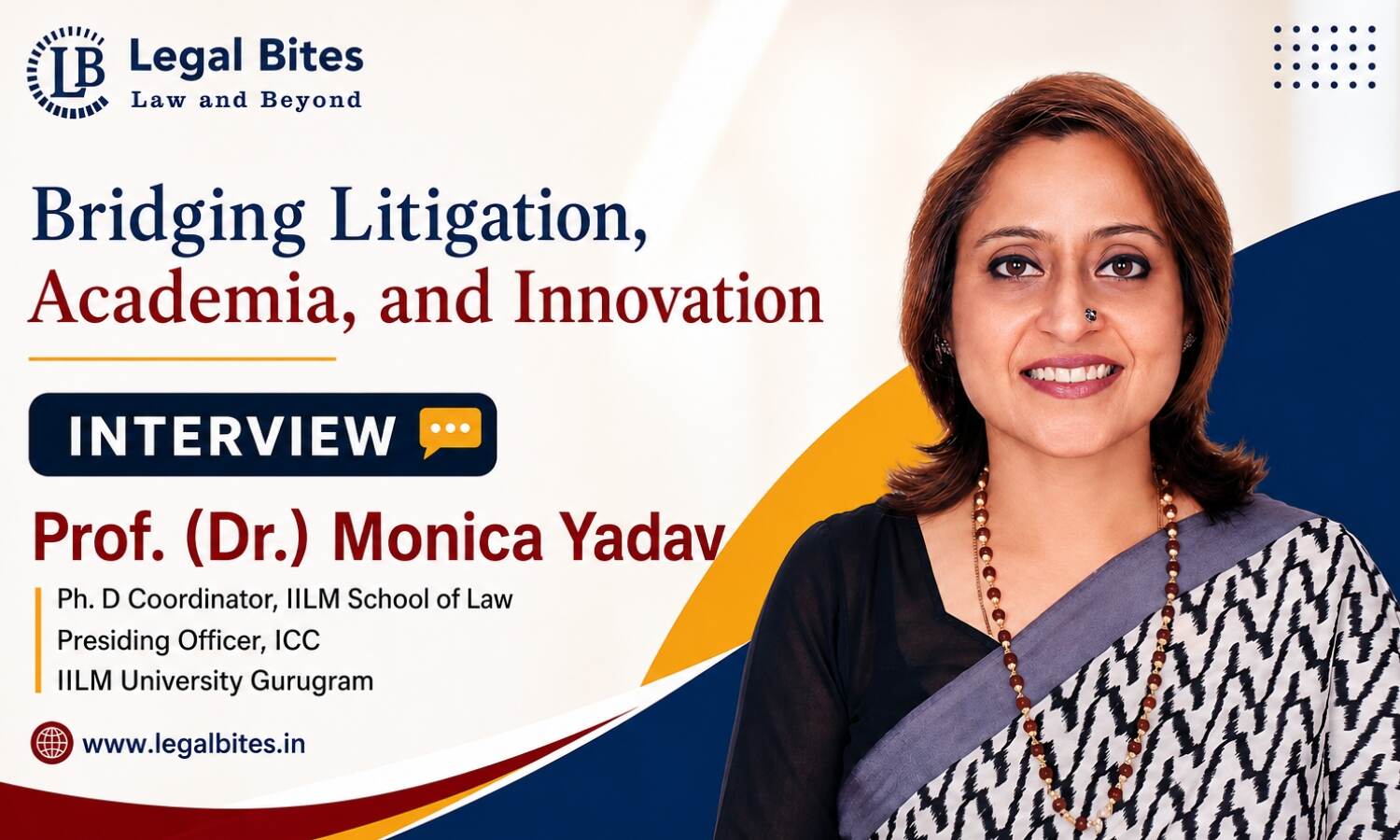
Prof. (Dr.) Monica Yadav is an accomplished academician, legal professional, and researcher with expertise in Corporate and Business Laws, White-Collar Crime, Taxation Laws, Property Law, and Corporate Governance. She holds a Ph.D. in Law from Amity University Haryana and an LL.B. from Campus Law Centre, Faculty of Law, University of Delhi. Before entering academia, she gained over 15 years of experience in litigation and legal consultancy.
A prolific researcher and educator, Dr. Yadav has published in national and international journals, contributed chapters to edited books, and supervised research scholars and postgraduate students. She has also served as an invited speaker, resource person, and judge at various academic and moot court events, effectively combining practical legal experience with academic scholarship.
Interview: Prof (Dr.) Monica Yadav |Ph.D. Coordinator, IILM School of Law
Legal Bites: One idea that comes through in your work is that many financial frauds are ultimately failures of governance rather than technology. Do you think we still spend too much time fixing systems and too little time fixing institutions?
Dr. Monica Yadav: Over the years, my research and understanding of the area of financial frauds has solidified my belief that frauds, irrespective of scale or sector, are ultimately governance failures. It is not the technology that failed; rather, it was bypassed.
In almost every case I have examined, the systems in place were technically adequate. What gave way was the human layer around them: an approval that was rubber-stamped, a red flag that was diluted before it reached the right desk, a culture where raising a concern carried more professional risk than staying quiet. This is compounded by the pace of technological change itself.
Systems evolve faster than the training built around them, and people are naturally slower to adapt than the technology they are asked to use, which leaves gaps that have nothing to do with the system’s design and everything to do with how prepared the people operating it actually are.
We continue to respond to fraud by investing in firewalls, audit software, and monitoring tools, because that is the visible and fundable response. Fixing an institution is harder. It means holding people in positions of authority accountable, investing in training that keeps pace with the technology itself, and building a culture where dissent is safe rather than penalised. Until that shift happens, better technology will keep being bypassed by the same governance gaps, just with a longer delay before detection.
Legal Bites: Digital banking has made life easier, but it has also changed the way fraud works. What is the one thing you wish every customer understood before clicking “Proceed”?
Dr. Monica Yadav: Digital banking has undeniably eased the way we transact today, but that same ease is exactly where the danger lies. The basic knowledge of the pitfalls of using technology without adequate caution has not kept pace with how widely the technology itself has spread.
A significant proportion of users are still not well versed with the technology, or even the language in which security warnings and instructions are framed, and that gap in familiarity is precisely what adds to their vulnerability. Banks and platforms do issue warnings and security awareness messages, but these are routinely ignored or clicked past as one more formality standing between the user and the transaction they want to complete.
If I had to leave every customer with one habit, it would be this: pay heed to the basic dos and don’ts you have already been told and never click on a link without independently verifying where it actually leads. Almost every digital fraud I have studied relies on making the victim act before they think: a countdown, a threat of account suspension, a “limited time” verification.
If a transaction or a message is designed to make you feel like you cannot afford thirty seconds to pause and verify, that itself is the warning sign. Never verify through the link, number, or app that raised the alarm in the first place. Go back to the source you trust and check from there.
Legal Bites: Corporate scandals often leave us looking for one person to blame. In reality, is poor governance usually the result of one bad decision or many small compromises that go unnoticed?
Dr. Monica Yadav: Almost always the latter. The single dramatic decision that ends up in the news is usually the last domino, not the first. What precedes it is a series of small, individually defensible compromises: an overlooked deviance from the approved plan, a greasing of the palms to cover deficiencies in compliance, budget cuts affecting safety, an unread report, a slightly aggressive accounting treatment approved “just this once,” a red flag from an internal audit that gets diluted in the summary that reaches the board, a whistleblower who is quietly sidelined rather than heard.
By the time regulators or the media identify the breadth and depth of the rot, the culprits are long gone, and the organisation has usually spent years training people not to ask the second question. That is why governance reform has to look at patterns of small compromises, not just headline decisions.
Legal Bites: AI is becoming part of a lawyer’s everyday toolkit. As exciting as that is, where do you think young lawyers should draw the line between using technology and becoming dependent on it?
Dr. Monica Yadav: I tell my students that AI is an excellent first draft partner and a poor final authority. Treat it like a slave and not the master. It is a tool that can reduce your time spent in clerical jobs, but is it reliable enough to do your job? Well, my answer is definitely not. It can find you ten relevant cases in a minute, but it cannot tell you whether those judgments are really relevant to your particular case, or whether the AI is only highlighting portions that happen to match your query. It will state an invented citation with the same confidence as a real one.
The advice I would give is this: use AI to accelerate the parts of legal work that do not require critical thinking, such as research, first drafts, and summarisation, and never let it replace the parts that require judgment, such as analysis, courtroom instinct, and knowing your client’s actual interest. A young lawyer who cannot construct an argument without AI assistance has not actually learned to think like a lawyer; they have learned to operate a tool.
Legal Bites: Alongside teaching and research, you’ve been closely involved in building safer and more accountable institutions through your work with the Internal Complaints Committee. In your experience, what is the biggest gap between having a policy on paper and creating a culture where people actually feel heard?
Dr. Monica Yadav: The ICC is a great initiative and policy on paper. It provides an easily accessible forum to address an issue that is sensitive and stressful for the person experiencing it. However, it solves the compliance problem very easily; it doesn’t always solve the trust problem, and that is the harder one.
The hesitancy of people in approaching the ICC is hardly ever due to a lack of awareness. It stems more from the fear of being judged, of having to prove the allegations, of not being believed, of confidentiality not holding, of retaliation from the accused, and many such reasons. It takes years to build this culture of trust, not through policies on paper, but through actions taken.
An ICC becomes credible only through its track record, not its charter, through consistent, fair, and confidential handling of every complaint, including the uncomfortable or ambiguous ones. That reputation takes years to build and very little to undo.
Legal Bites: Students often ask what field of law has the best future. Do you think that’s the right question, or should they be asking something else?
Dr. Monica Yadav: I don’t think it is a question any student should ask. Instead, the question to be asked should be: what are the fields in which a law graduate could make her or his career? The options open to law graduates have increased well beyond litigation and corporate practice, to policy making, in-house counsel, academia, to name a few.
Law is dynamic and changes as per the needs of society, business, or technology, and honestly, by the time a student graduates, the “hot” field they chose for has usually shifted again. The better question is: which kind of legal problem do I actually enjoy sitting with? A dispute, a transaction, a policy question, a compliance puzzle? Competence and genuine interest transfer across fields far better than a bet on which sector is trending.
I have seen students chase what looked like the best future and burn out in three years, and I have seen students follow what interested them and end up building the “hot” practice area almost by accident.
Legal Bites: You’ve spent years teaching, mentoring and interacting with young lawyers. What’s one quality you notice in students who go on to do really well, regardless of the career path they choose?
Dr. Monica Yadav: Discipline. It is one quality that within itself holds many others: dedication, the ability to bear criticism and improve, the courage to overcome one’s fears and shortfalls, and the consistency to keep at something long after the initial enthusiasm has worn off. A disciplined mind is a clear mind, the ability to use not only its knowledge but also its wit to convert what looks like a disadvantage into something in its favour.
The students I remember years later were not always the most naturally gifted in the room, but they were the disciplined ones, the ones who took criticism as information rather than as an attack and came back with the next draft improved.
Law rewards people who can absorb correction quickly and stay the course, because so much of legal practice, from a judge’s rebuke to a senior partner’s redline, is exactly that.
Legal Bites: Law students today learn from far more than classrooms. Platforms like Legal Bites, webinars, podcasts and online discussions have become part of that journey. From what you’ve seen, how can students make the most of these resources without mistaking information for real learning?
Dr. Monica Yadav: Platforms like Legal Bites have genuinely changed what is available to a law student today, and what I appreciate about a resource like this is the visible effort that goes into verifying what is actually put out. The content is not just aggregated and republished; it is checked before it reaches the reader, which is not something one can say for a great deal of what circulates on the internet. That said, the volume of accessible legal content today is a genuine advantage over what my generation had, but volume is also the trap.
Reading ten articles on a topic and being able to summarise the consensus is not the same as being able to apply that principle to a fact pattern you have never seen before.
My advice to students is to treat every webinar or article as raw material, not as the finished product. Read it, then close it, and try to explain the concept in your own words or apply it to a hypothetical without looking. If you cannot do that, you have consumed the content, not learned it.
Legal Bites: Thank you so much!
Important Link
Law Library: Notes and Study Material for LLB, LLM, Judiciary, and Entrance Exams