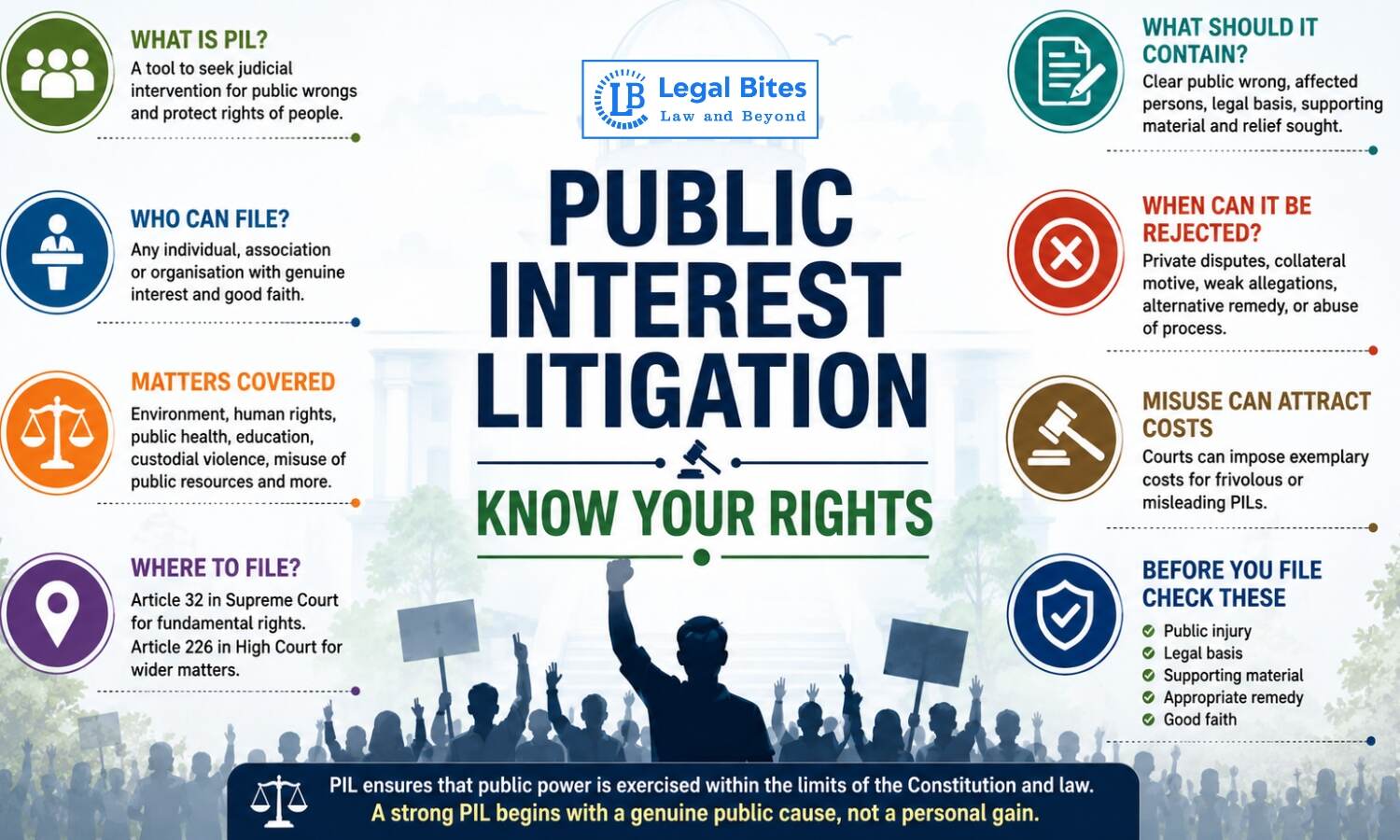
Public Interest Litigation (PIL) gives citizens a powerful means to seek judicial intervention in matters involving genuine public concern. It enables constitutional courts to address violations affecting the community or vulnerable sections of society, even when those directly affected are unable to approach the court themselves.
PIL emerged from the relaxation of the traditional rule of locus standi, under which ordinarily only an aggrieved person could initiate proceedings. Its purpose is to ensure that poverty, disability, social disadvantage or lack of resources does not prevent serious violations of rights from receiving judicial attention.
What Makes a Case a PIL?
The decisive factor is the nature of the grievance, rather than the identity of the person filing the petition. A proceeding assumes a public interest character when it concerns a substantial public wrong, breach of a constitutional or statutory obligation, or violation of rights affecting a section of society. A petitioner acting in good faith may bring such an issue before the court even without suffering personal injury.
PIL, however, is not a separate cause of action created by the Constitution. It is a judicially developed method of invoking constitutional remedies in matters involving genuine public interest.
Who Is Entitled to Approach the Court?
An individual, association or organisation genuinely concerned with the issue may initiate a PIL. The petitioner is expected to have sufficient interest in the subject and must place reliable material before the court.
Courts may examine the petitioner’s credentials before proceeding with the matter. This scrutiny is important because the relaxation of locus standi cannot be used to pursue business rivalries, political disputes, personal grievances or other collateral objectives.
What Kind of Matters May Justify PIL?
PIL has been used across a wide range of public law issues, including:
- Protection of the fundamental rights of disadvantaged communities;
- Environmental pollution and destruction of natural resources;
- Custodial violence and serious human rights violations;
- Non-performance of statutory duties by public authorities;
- Protection of prisoners, bonded labourers, children and other vulnerable persons;
- Public health, sanitation and access to education;
- Illegal or arbitrary exercise of governmental power; and
- Misuse of public resources where a genuine public law issue arises.
There is no exhaustive list. The court considers whether the controversy involves a real public injury requiring constitutional adjudication.
Supreme Court or High Court: Where Should PIL Be Filed?
The appropriate forum depends upon the right sought to be enforced. A petition under Article 32 may be filed before the Supreme Court for enforcement of fundamental rights. Article 32 itself guarantees the right to move the Supreme Court for enforcement of the rights conferred by Part III of the Constitution.
The jurisdiction of High Courts under Article 226 is wider. A High Court may issue writs for enforcement of fundamental rights as well as “for any other purpose”, which includes appropriate cases involving other legal rights and public duties.
Territorial jurisdiction and the nature of the relief sought must also be considered while selecting the forum.
What Should the Petition Contain?
A PIL should clearly identify the public wrong complained of, the persons or class affected, the legal or constitutional obligation involved and the relief sought from the court.
Material allegations should be supported by credible documents or other reliable information. Full disclosure of relevant facts is particularly important because PIL jurisdiction is equitable and discretionary.
A petition founded merely on suspicion, incomplete information or sweeping allegations may fail at the threshold.
When Can a PIL Be Rejected?
Courts closely scrutinise PILs to prevent an extraordinary constitutional remedy from becoming a shortcut for ordinary litigation.
A petition may be refused where:
- The controversy is essentially private: Individual property, contractual, employment or commercial disputes ordinarily have to be pursued through the remedies provided by law.
- The petitioner has a collateral motive: Personal hostility, political rivalry, commercial advantage or publicity can undermine the bona fides of the proceeding.
- The allegations lack credible foundation: Courts need not conduct a roving inquiry on the strength of conjectures or unverified accusations.
- The relief lies outside legitimate judicial review: Courts ordinarily do not substitute their preferred policy for that of a competent government merely because another policy may appear better.
- A more appropriate legal mechanism exists: Availability of an effective statutory remedy may persuade the High Court not to exercise its discretionary jurisdiction, although alternative remedy is not an absolute bar in every case.
- The judicial process is being abused: Concealment of facts, repetitive proceedings or attempts to relitigate concluded issues can result in dismissal and costs.
Courts Can Impose Costs for Misuse
The Supreme Court addressed the need to protect PIL jurisdiction from abuse in State of Uttaranchal v. Balwant Singh Chaufal, (2010) 3 SCC 402.
The Supreme Court directed courts to encourage genuine PILs and curb frivolous ones by verifying the petitioner’s credentials, correctness of claims, and existence of substantial public interest. PILs motivated by personal gain or ulterior motives should be discouraged, including through exemplary costs.
These safeguards ensure that judicial time remains available for causes that genuinely require constitutional protection.
Before Filing a PIL, Check These Essentials
A prospective petitioner should be able to identify:
A Public Injury: The grievance should extend beyond an exclusively personal dispute.
A Legal Basis: The complaint should disclose infringement of a right, violation of law or failure of a public authority to perform a legally enforceable duty.
Supporting Material: Important allegations should rest on verifiable facts and documents.
An Appropriate Remedy: The relief requested should be capable of being granted within the court’s constitutional jurisdiction.
Good Faith: The proceeding should advance the public cause rather than the petitioner’s private interests.
Key Takeaway
PIL opens the doors of constitutional courts to causes that might otherwise remain unheard. Its importance lies not in allowing everyone to litigate every public controversy, but in enabling judicial protection where a genuine public wrong calls for intervention.
A strong PIL therefore begins not with the question, “Can I file a petition?” but with the question, “What public right or legal duty requires the court’s protection?”
Used responsibly, PIL remains a powerful means of advancing access to justice and ensuring that public power is exercised within the limits of the Constitution and law.