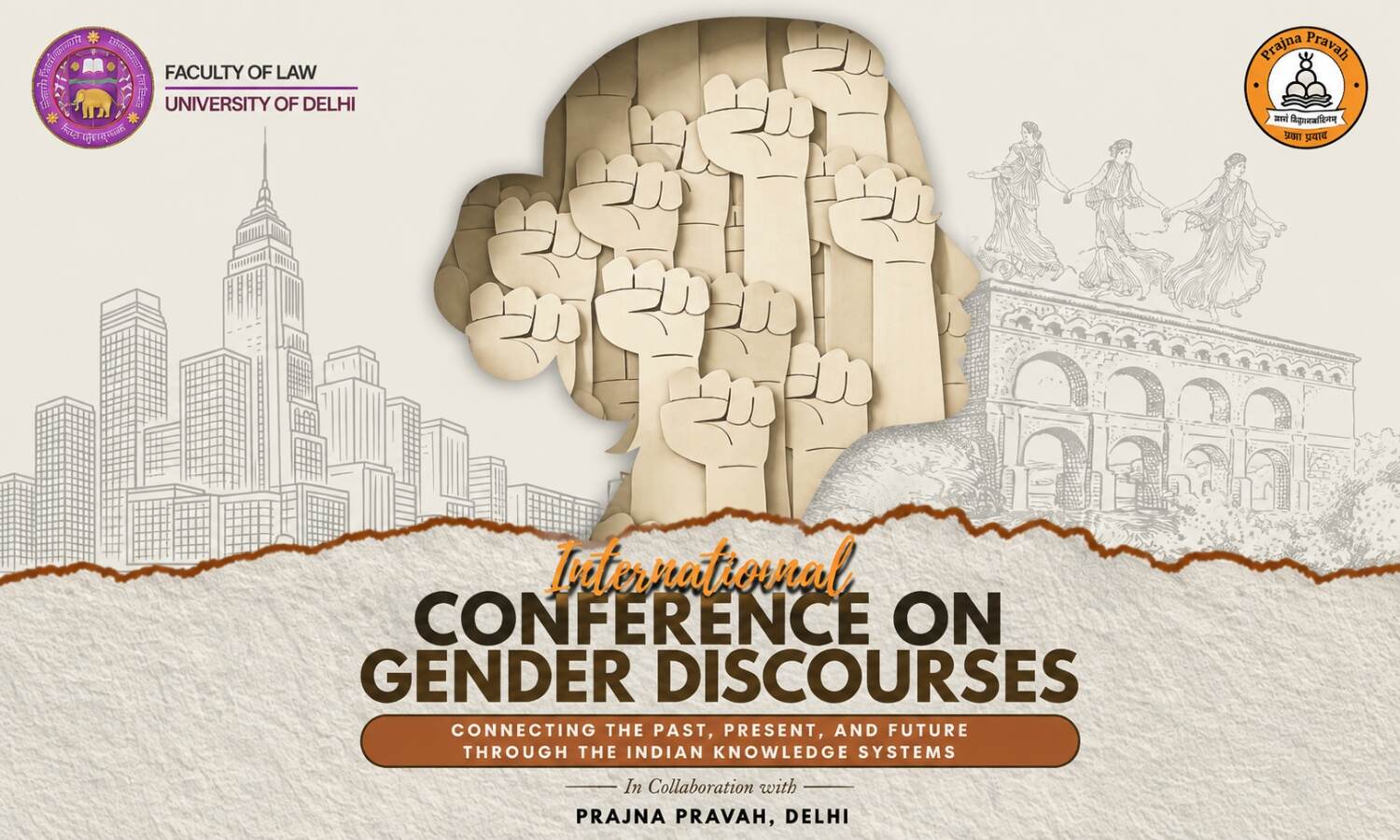
The Faculty of Law, University of Delhi, in collaboration with Prajna Pravah, Delhi, is organising an International Conference on Gender Discourses: Connecting the Past, Present, and Future through the Indian Knowledge Systems on September 17–18, 2026. The last date for submitting abstracts is August 25, 2026.
About the University of Delhi
Established in 1922, the University of Delhi is one of the country’s premier universities. It is recognised for its academic standards, diverse educational programmes, distinguished faculty, alumni, co-curricular activities and modern infrastructure.
The University is committed to excellence in teaching, research and social outreach. Its motto, “Nishtha Dhriti Satyam”, represents Dedication, Steadfastness and Truth.
About the Faculty of Law
Established in 1924, the Faculty of Law is a premier department of the University of Delhi and an institution of national importance under Entry 63 of the Seventh Schedule to the Constitution of India.
The Faculty of Law has produced generations of eminent jurists, judges of the Supreme Court and High Courts, senior advocates, political leaders, policymakers and public intellectuals. It offers B.A. LL.B. (Hons.), B.B.A. LL.B. (Hons.), LL.B., LL.M. and Ph.D. programmes.
About Prajna Pravah
Prajna Pravah is an intellectual movement working to promote Bharatiya traditions, culture and intellectual heritage. It provides a national platform for scholars, researchers and academicians to engage with subjects of contemporary national importance.
The organisation conducts discussions, seminars and workshops on Indian philosophy, law, history, social sciences, literature and related educational initiatives.
About the Conference
The International Conference on Gender Discourses seeks to connect the past, present and future through Indian Knowledge Systems. It aims to examine the understanding of gender, dignity, autonomy, education, family, justice and social order reflected in ancient Indian intellectual traditions.
The conference is based on the premise that ancient Indian texts do not present a single uniform view of women and gender relations. Instead, they reflect a dynamic intellectual tradition in which women participated in knowledge production, philosophical discourse, family life, ritual practices and legal frameworks.
The conference will encourage interdisciplinary dialogue on classical Indian philosophical, legal and cultural traditions and assess their possible contribution to contemporary discussions on gender equality, rights, obligations and justice.
Participants are encouraged to engage with foundational concepts, classical sources and indigenous epistemologies while examining their interpretative possibilities and contemporary relevance.
Objectives of the Conference
The conference seeks to critically engage with gender discourses and Indian Knowledge Systems through questions such as:
- How do concepts such as dharma, complementarity and moral agency inform gender justice in ancient Indian thought?
- Can these frameworks support contemporary understandings of women’s decisional autonomy?
- How do classical texts reflect women’s access to education and intellectual participation?
- How can such insights be applied to empower women in contemporary society?
- How can marriage be revisited as an institution based on consent, companionship and evolving gender roles?
- How do Indian Knowledge Systems understand health, bodily autonomy and dignity in relation to women’s agency?
Themes and Sub-Themes
The themes and sub-themes listed below are indicative. Contributors may select any topic that meaningfully engages with gender, Indian Knowledge Systems and their contemporary relevance.
Theme I: Philosophical Underpinnings—Gender Discourses and IKS
- Concept of dharma and gender discourses
- Concept of gender and power in ancient India
- Equality and complementarity in ancient Indian thought
- Women’s agency, autonomy and power in Vedic traditions
- Decisional autonomy of women
Theme II: Women Education and IKS
- Education of women in ancient India
- Education as empowerment, autonomy and equality
- Epistemic authority of women as composers, debaters and transmitters of knowledge
- Gargi, Maitreyi and Lopamudra as women intellectuals
- Institutional and social structures supporting women’s education
- Gurukul, oral traditions and domestic pedagogy
- Brahmavadinis and Sadyodvahas in ancient India
- Guru-shishya parampara as a gender-neutral pedagogical ideal
Theme III: Concept of Marriage and IKS
- Concept of marriage in ancient Indian texts
- Essentiality of marriage in Indian Knowledge Systems
- Consent and companionship in Indian Knowledge Systems
- Success of marriage as an institution: negotiating failures and evolving realities
- Evolving concept of marriage: obligation or choice
- Marriage and property rights
- Sanctity of live-in relationships
- Transgenders and their status
Theme IV: Women Health and IKS
- Definition of health under Ayurveda, Sushruta, AYUSH and other Indian Knowledge Systems
- Women’s health and agency
- Reproductive health
- Life-cycle diseases
- End-of-life decisions
- Selfhood and dignity
Theme V: Women’s Participation in Public Life
- Status of women in ancient traditions and philosophy
- Women in governance and statecraft
- Participation of women in assemblies, debates and intellectual discourses
- Women’s role in dispute resolution and adjudication
- Women’s employment and economic participation in public spheres
- Reimagining women’s public roles through the lens of Indian Knowledge Systems
Note: Authors must connect their research with authentic classical theories and texts and demonstrate the contemporary relevance and enduring value of Indian Knowledge Systems. Papers should explore the relationship between the past, present and future while developing an IKS-based progressive understanding of gender within the contemporary legal framework.
Eligibility
The conference invites submissions from scholars, academicians, professionals, experts and students from diverse disciplines, including:
- Law
- Political Science
- Sociology
- Economics
- Other social sciences
Abstract Submission Guidelines
- Type of Submission: Extended abstract with keywords
- Word Limit: 600–800 words
- Language: English
- Keywords: 4–5 keywords
- File Format: .doc or .docx
- Font: Times New Roman
- Text Size: 12
- Footnote Size: 10
- Line Spacing: 1.5
- Citation Style: 21st Edition Bluebook citation format
The extended abstract must clearly state:
- The research problem or research question
- Objectives of the study
- Methodology or approach, including theoretical, doctrinal, empirical or interdisciplinary approaches
- Key arguments
- Expected findings or outcomes
- Four to five keywords
Submissions must be original and unpublished and must not be under consideration elsewhere. Abstracts should align with the indicative themes of the conference.
Full Paper Guidelines
- Word Limit: 6,000–8,000 words
- Word Limit Includes: References, tables and figures
- File Format: MS Word
- Citation Style: 21st Edition Bluebook citation format
Review Process
All abstracts will undergo a blind peer-review process. Preference will be given to papers that critically engage with primary ancient texts, including the Vedas, Smritis, Arthashastra and other classical sources, and offer original interpretative insights.
How to Submit?
- Participants must submit their abstracts only through the prescribed Google Form. Abstracts should not be submitted by email.
- Abstract Submission Form: Click here to submit the abstract
- After acceptance of the abstract and payment of the registration fee, participants will receive a separate link for submitting the full working paper.
- Participants must ensure that the details entered during the registration process are correct, as the same details will be used for all purposes, including the issuance of certificates.
Registration Fee
Registration Fee: ₹1,500 inclusive of GST for each author and co-author.
Paper presenters must register through the Google Form link that will be provided after acceptance of the abstract.
Publication Opportunity
Final papers may be submitted after the conference after incorporating the feedback received from the panel during the presentation. Such papers may be considered for possible publication in an edited book.
Important Dates
- Last Date for Abstract Submission: August 25, 2026
- Communication of Selected Abstracts: August 31, 2026
- Last Date to Fill the Registration Form: September 5, 2026
- Last Date for Submission of Working Paper: September 10, 2026
- Date of Conference: September 17–18, 2026
Venue
Faculty of Law, University of Delhi
Contact
For queries, participants may write to:
Email: [email protected]
Downloads
Official Brochure: [Click here to view]