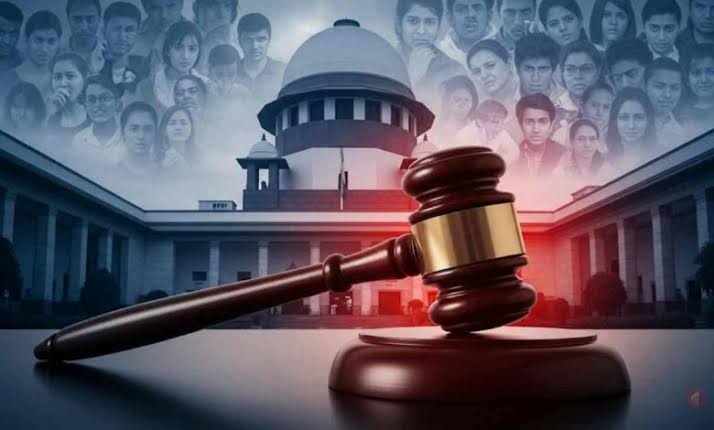
The Supreme Court on Monday expressed concern over the serious consequences of making unsubstantiated allegations of corruption against judicial officers, observing that such claims can irreparably damage their careers and reputations.
The observations came while the Court was hearing a plea filed by YouTuber Gulshan Pahuja, who was recently sentenced to six months’ imprisonment for criminal contempt of court.
Pahuja submitted that his objective has always been to fight judicial corruption and that he had never intended to target any individual judge personally.
The Court responded that while it understood his concerns, allegations of judicial corruption must be supported by credible evidence and should not be made recklessly. It observed that baseless accusations, particularly in the era of social media, can have far-reaching consequences.
The Court remarked that judicial officers face immense harm when corruption charges are made without supporting material. Such allegations, once amplified on social media, can permanently tarnish the reputation and career of a judicial officer.
In May this year, the Delhi High Court sentenced Pahuja to six months’ imprisonment and imposed a fine of ₹2,000 after holding him guilty of criminal contempt of court for making scandalous remarks about the judiciary in his YouTube videos and during court proceedings.
The High Court noted that Pahuja had compared the judiciary to a dictatorship during his arguments, stating that he expected no justice from the Indian judicial system and remarking that “adaalaton ki manmarzi badhti jaa rahi hai aur main koi nyay ki umeed nahi kar raha” (translation: “The arbitrary actions of the courts are increasing and I am not expecting any justice”). He had also stated that “manmarzi ka dusra arth taanashahi hota hai” (translation: “Another meaning of arbitrariness is dictatorship”).
Following the conviction, Pahuja sought additional time to surrender and serve his sentence. After the Delhi High Court rejected his request, he approached the Supreme Court seeking further extension. However, during the pendency of the plea, he surrendered before the authorities.
Taking note of this development, the Supreme Court observed that the petition seeking more time had become infructuous, as Pahuja had already surrendered.
Pahuja’s counsel argued that his client was only attempting to expose corruption within the judiciary and that his actions should not be viewed as an attack on the judicial institution.
The Supreme Court clarified that it was not examining the merits of the contempt conviction during the present proceedings. It also noted that Pahuja had already filed a separate appeal challenging the Delhi High Court’s judgment.
During the hearing, Pahuja’s counsel informed the Court that the appeal had not yet been listed because it contained documents in Hindi that were still awaiting translation into English, a procedural requirement pointed out by the court registry.
The Supreme Court granted Pahuja the liberty to file an application seeking exemption from translating the Hindi documents into English. It directed that once such an application is filed, the registry should place the appeal before the Court for consideration.
The Court also indicated that it would permit Pahuja to argue his case personally during the appeal proceedings.