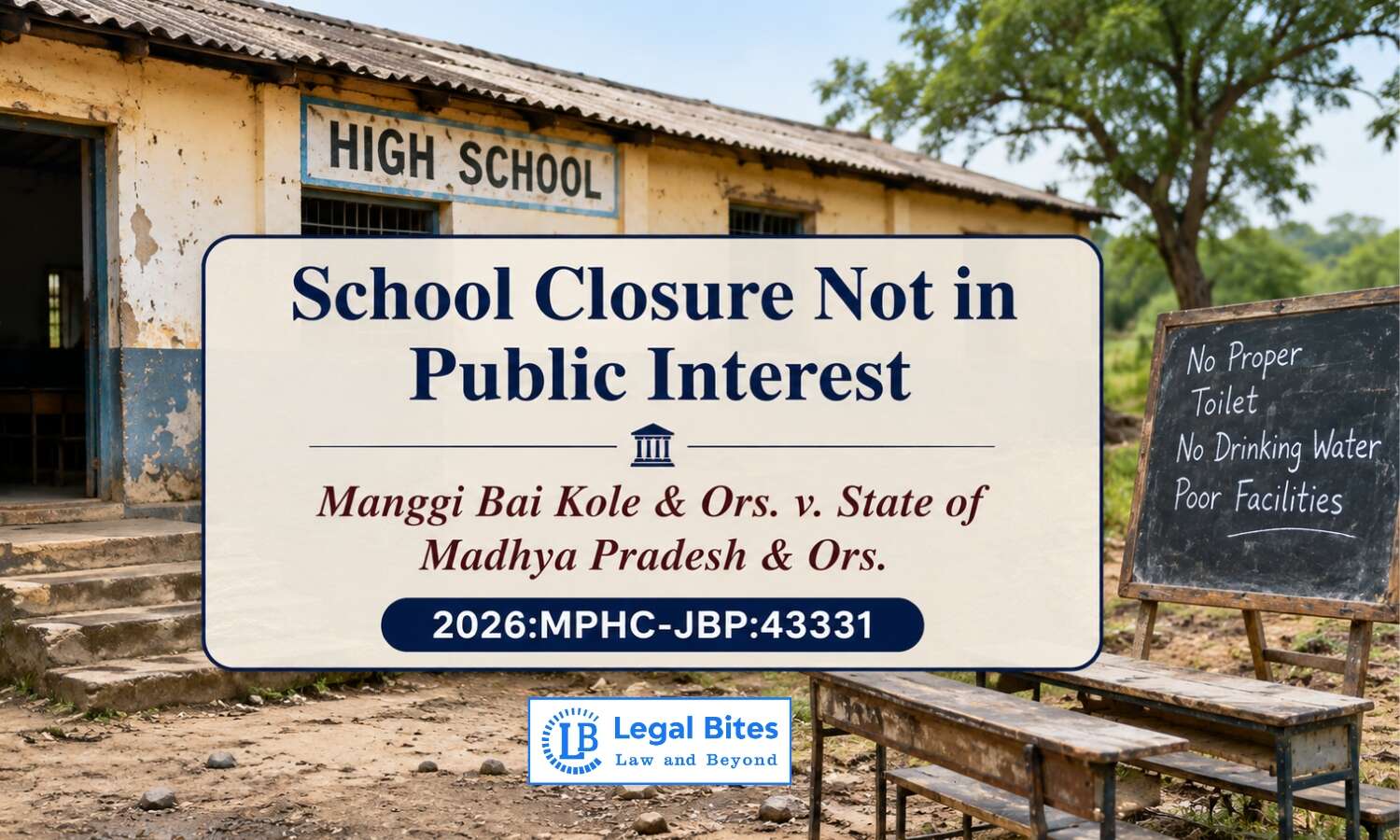
The Madhya Pradesh High Court recently delivered an important order on rural education, holding that the closure of the only school in a village may not serve public interest. The Court emphasised that where a school suffers from infrastructural deficiencies, the proper response should be collective improvement, not immediate closure.
Background of the Case
The petition was filed as a Public Interest Litigation by the Sarpanch and Up-Sarpanch of Gram Panchayat Kotari. They raised concerns regarding Devarsi High School, a private school functioning in the village.
According to the petitioners, the school lacked essential facilities such as proper seating arrangements, toilets, drinking water, blackboards, electricity, safety measures, a playground, and adequate teaching staff. They therefore sought cancellation of the school’s recognition and shifting of students to other recognised schools.
An enquiry was conducted by the Block Education Officer, Manpur. The enquiry report found the condition of the school building unsatisfactory and unsafe, along with deficiencies relating to infrastructure and staff.
Deficiencies Found in the School
The inspection revealed that the school was being run in a building with unsafe structural conditions. Some classrooms were small and overcrowded. Toilet facilities were temporary and inadequate, especially for adolescent students.
The authorities also noticed that blackboards were not properly maintained, classrooms were dark, electrical arrangements were temporary, and drinking water was not available inside the school premises. Students had to use a public hand pump outside the school.
The school also lacked a playground and parking space. There was a shortage of subject-wise teachers, and teachers were allegedly being paid in cash. The school management also failed to produce recognition-related documents during inspection.
The Crucial Fact Before the Court
Despite these deficiencies, the High Court took note of one significant fact: there was no Government school in the Gram Panchayat, and the school run by respondent No. 8 was the only educational institution operating in the area.
This fact became central to the Court’s reasoning. The Court observed that if the school was closed, the academic future of local children would be directly affected. In such circumstances, closure would not solve the problem; it would create a larger one.
Court’s View: Improve, Do Not Abandon
The High Court held that instead of shutting down the school or withdrawing its recognition, efforts should be made to remove the deficiencies.
The Court directed the Gram Panchayat to take up the matter in its General Body Meeting and pass a resolution explaining how the shortcomings could be mitigated with the assistance of local villagers.
The Court observed that constructive and coordinated efforts by all stakeholders were necessary to improve the school in public interest.
Duty of Local Representatives
The Court also reminded the petitioners that, being the Sarpanch and Up-Sarpanch, they had a public duty to facilitate education and civic amenities for villagers and children.
This observation is important because it shows that PIL petitioners cannot merely approach the Court demanding action. Where they themselves hold public positions, they may also be expected to participate in solving the problem.
The judgment therefore places responsibility not only on the school management or education department, but also on the Gram Panchayat and the local community.
Constructive Role of PIL
The ruling also reflects a mature understanding of Public Interest Litigation. The Court noted that while dealing with PILs, High Courts should adopt a constructive approach. In appropriate cases, even petitioners may be directed to undertake certain activities in public interest.
This approach prevents PILs from becoming merely complaint-based proceedings and transforms them into tools for practical public welfare.
Importance for Rural Education
The order is significant because rural education often faces a difficult dilemma. Many village schools do not have ideal infrastructure, but closing them may leave children with no accessible alternative.
For children in remote areas, distance itself can become a barrier to education. If the only nearby school is closed, students may be forced to travel long distances or may even drop out.
The High Court recognised this reality and gave priority to the academic future of children.
Balancing Standards and Access
The order does not mean that schools can ignore safety and infrastructure requirements. On the contrary, the Court acknowledged the deficiencies found during inspection.
However, the Court balanced two concerns:
- First, schools must maintain minimum standards.
- Second, children must not be deprived of education due to lack of alternatives.
The solution, therefore, lies in improvement, monitoring, and community cooperation rather than closure.
Constitutional Significance
The order is closely connected with the constitutional value of education. Article 21A guarantees the right to education. This right becomes meaningful only when children have access to schools within reachable distance.
In villages where educational infrastructure is limited, courts and authorities must ensure that regulatory action does not unintentionally harm students.
The order also strengthens the role of Panchayats in local governance. Education is not only a matter for the State Government; local bodies and communities also have an important role in improving village-level facilities.
Conclusion
The Madhya Pradesh High Court, in Manggi Bai Kole & Ors. v. State of Madhya Pradesh & Ors., has underscored that the closure of the only school in a village cannot be justified merely on the ground of infrastructural or administrative shortcomings. The Court emphasised that such deficiencies must be rectified through collective efforts, ensuring that children continue to have access to education rather than being deprived of their only nearby learning institution.
By directing the Gram Panchayat and the villagers to work collectively to address the shortcomings, the Court adopted a child-centric and community-oriented approach.
The order is a reminder that public interest is not served by closing imperfect institutions when improvement is possible. In rural India, where access to education remains fragile, village schools deserve support, reform, and strengthening, not abandonment.