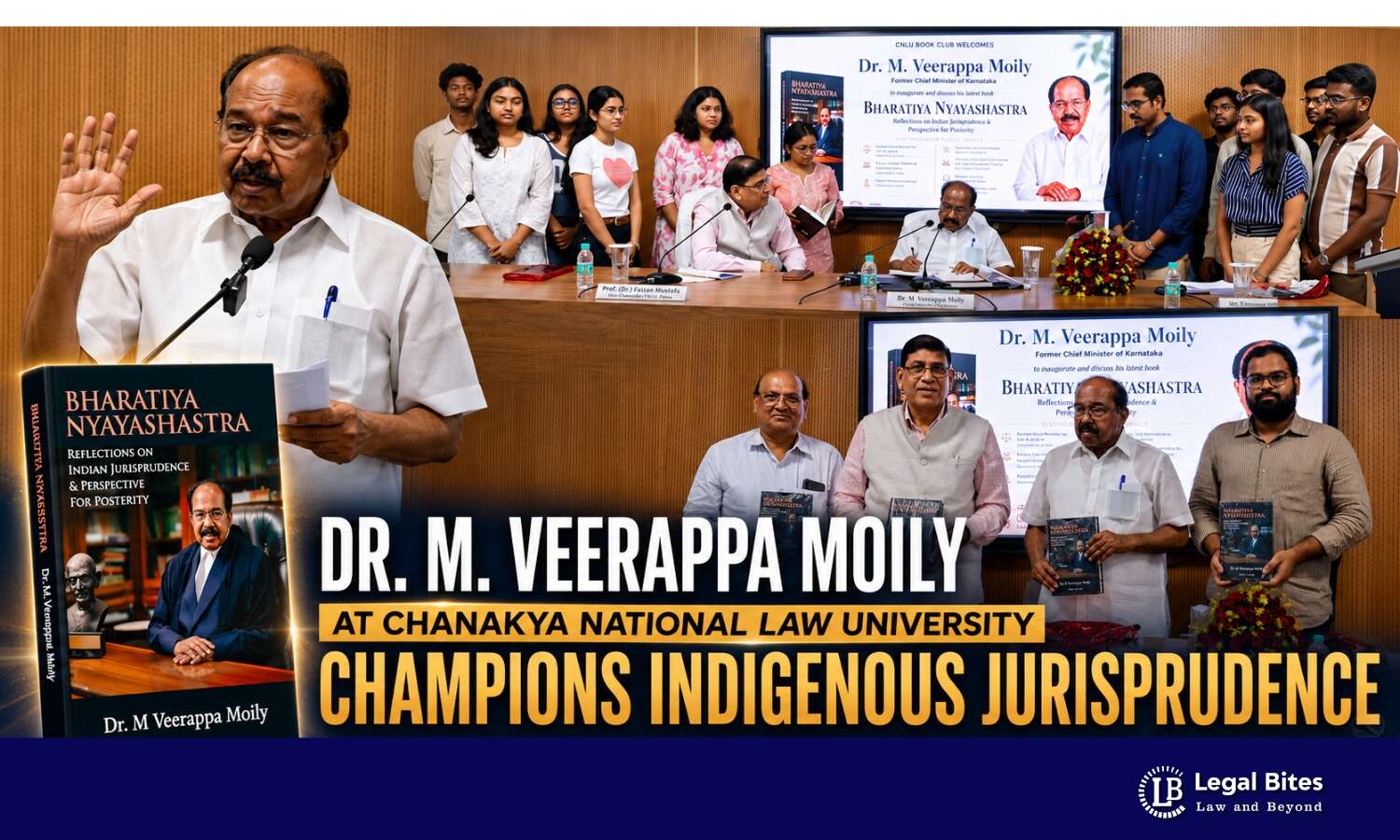
Patna, July 4: Former Union Minister for Law and Justice and former Chief Minister of Karnataka, Dr. M. Veerappa Moily, visited Chanakya National Law University (CNLU), Patna, where he delivered a thought-provoking lecture on his latest book, Bharatiya Nyayashastra: Reflections on Indian Jurisprudence and Perspective for Prosperity. The lecture formed part of CNLU’s ongoing Indology Lecture Series, an initiative aimed at encouraging students to engage with India’s intellectual and civilisational heritage.
Addressing students and faculty members, Dr. Moily defended the philosophical foundations of the ancient Indian social order while responding to questions on the caste system. He explained that the concept of Brahmin originally denoted a person of knowledge, virtue and learning rather than a birth-based caste identity, emphasising that it represented an ideal state of enlightenment rather than hereditary privilege.
The former Law Minister argued that India’s present legal system has drifted away from the country’s rich jurisprudential traditions. According to him, ancient Indian legal thought was intellectually superior to many Western theories of law and justice. He cited historical examples to demonstrate that Indian jurisprudence placed exceptional emphasis on judicial accountability and the rule of law, including the principle that a ruler who failed to deliver justice could forfeit his authority.
While welcoming recent criminal law reforms, Dr. Moily remarked that they remain incomplete and do not fully incorporate the wisdom embedded in India’s ancient legal traditions. He strongly advocated the indigenisation of Indian laws and encouraged CNLU to promote doctoral research comparing Western jurisprudence with ancient Indian legal philosophy.
Dr. Moily also expressed concern over excessive dependence on litigation for dispute resolution, suggesting that not every conflict should reach the courts. Referring to the Truth and Reconciliation Commission of South Africa, he underscored the importance of restorative justice and reconciliation in appropriate cases. He further opined that deeply contentious religious disputes, including those similar to Ayodhya, may not always be best resolved solely through judicial processes.
Highlighting the sophistication of ancient Indian jurisprudence, Dr. Moily asserted that many principles regarded today as modern had already evolved in India centuries ago. He observed that judges delivering unjust decisions were subjected to severe penalties under ancient legal systems and noted that early Indian criminal justice did not ordinarily favour capital punishment. Referring to the accounts of Chinese travellers Sung Yun and Hiuen Tsang, he stated that Indian rulers governed without resorting to corporal punishment.
The programme concluded with Vishwam Prakash, In-charge of the Book Club, introducing the book and conducting the proceedings.