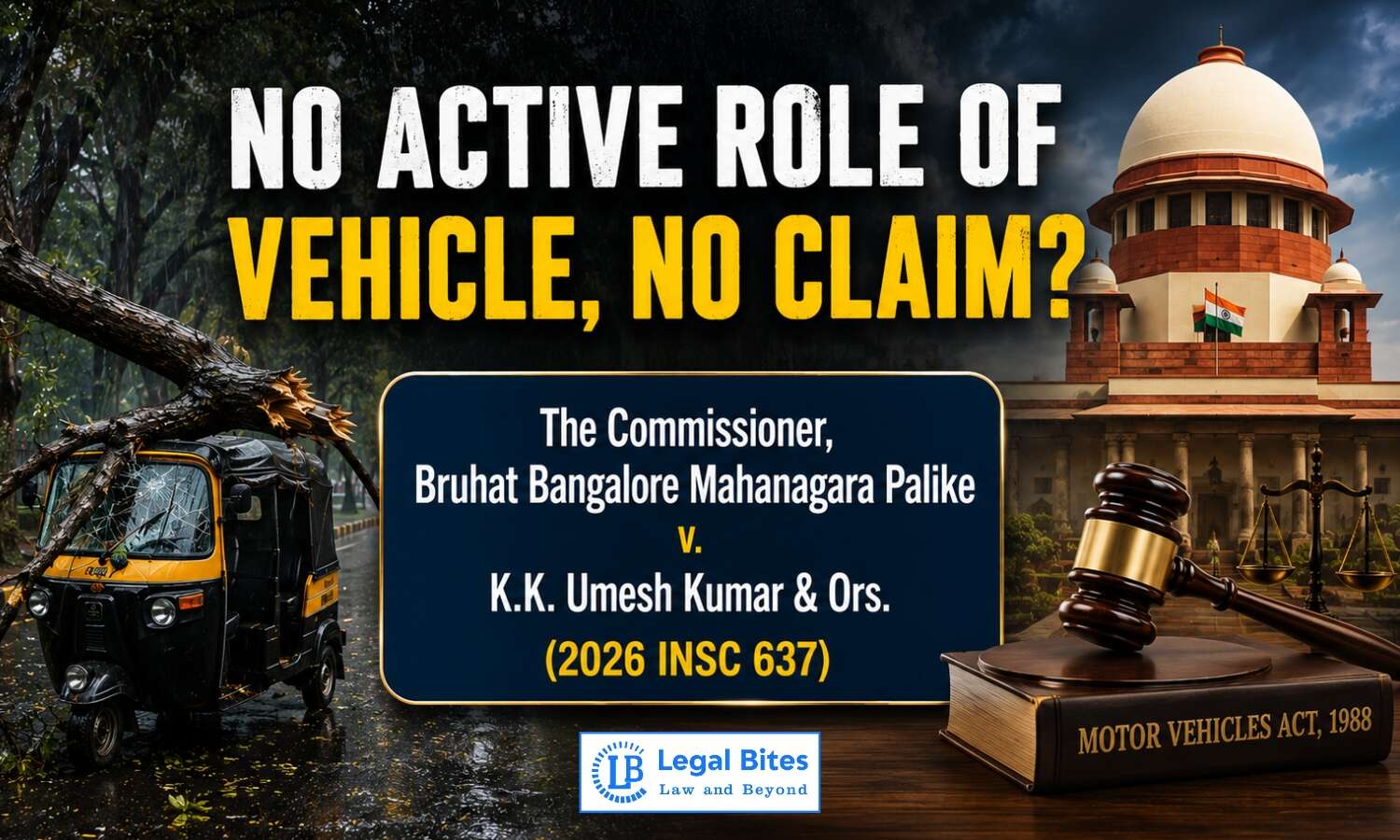
The Supreme Court of India, in The Commissioner, Bruhat Bangalore Mahanagara Palike v. K.K. Umesh Kumar & Ors. (2026 INSC 637), delivered an important ruling clarifying the scope of motor accident compensation claims under the Motor Vehicles Act, 1988. The judgment addresses a significant legal question: Can compensation under Section 166 of the Motor Vehicles Act be awarded when a motor vehicle is merely the location of the injury and does not actively contribute to the accident?
The Court examined the distinction between an accident “arising out of the use of a motor vehicle” and an accident where the vehicle plays no active or proximate role in causing the injury. While reaffirming the liberal interpretation traditionally adopted in motor accident compensation law, the Court held that there must still exist a meaningful causal connection between the use of the vehicle and the accident.
At the same time, invoking its extraordinary powers under Article 142 of the Constitution, the Court ensured that the severely injured victim was not left remediless, thereby balancing legal principles with substantive justice.
Facts of the Case
The case arose from a tragic incident that occurred on 23 June 2007 in Bengaluru. The claimant, K.K. Umesh Kumar, was travelling in an autorickshaw from Queens Road to Chinnaswamy Stadium. During the journey, heavy rainfall began. The claimant requested the driver to stop the vehicle by the roadside until the rain subsided.
The autorickshaw was parked beneath an old roadside tree. While the vehicle remained stationary, a branch detached from the tree and fell onto the autorickshaw, causing severe injuries to the claimant. He was immediately admitted to Mallya Hospital for treatment.
Claiming that the injuries had resulted in permanent disability, the claimant filed a petition before the Motor Accidents Claims Tribunal (MACT) seeking compensation of ₹50 lakh.
Procedural History
Tribunal’s Decision
The Motor Accidents Claims Tribunal dismissed the claim, holding that the incident was the result of a natural calamity and not a motor accident attracting liability under the Motor Vehicles Act.
First Round Before the High Court
The Karnataka High Court also dismissed the claim, primarily on the ground of delay.
Supreme Court’s Earlier Intervention
The claimant approached the Supreme Court, which remanded the matter for reconsideration after addressing issues relating to delay and condonation.
Second Round Before the High Court
Upon reconsideration, the Karnataka High Court awarded compensation of ₹17,10,500 and apportioned liability as follows:
- 25% on the Bruhat Bangalore Mahanagara Palike (BBMP);
- 50% on the insurer of the autorickshaw;
- 25% on the Horticulture Department of the Government of Karnataka.
BBMP challenged the imposition of liability before the Supreme Court.
Issue
The principal question before the Supreme Court was:
Whether an injury caused by a falling tree branch while a person is sitting inside a stationary vehicle can be said to be an accident “arising out of the use of a motor vehicle” under Sections 165 and 166 of the Motor Vehicles Act, 1988?
The answer to this question would determine whether a claim before the Motor Accidents Claims Tribunal was maintainable.
Act of God
Before examining the Motor Vehicles Act, the Court discussed the Act of God (Vis Major).
The Court referred to several landmark authorities explaining circumstances where liability may not arise because the event was caused solely by extraordinary natural forces beyond human control.
Nichols v. Marsland, (1876) 2 Ex D 1
The Court cited the English decision in Nichols v. Marsland, where extraordinary rainfall caused artificial ponds to overflow. The Court held that such unprecedented natural forces constituted an Act of God and provided a defence against strict liability.
The Majestic, 166 U.S. 375 (1897)
The Supreme Court also referred to the American decision in The Majestic, which described an Act of God as an inevitable accident resulting solely from natural causes without human intervention.
Vohra Sadikbhai Rajakbhai v. State of Gujarat, (2016) 12 SCC 1
The Court reiterated its earlier observation that an Act of God is:
A direct, violent, sudden and irresistible act of nature which could not reasonably have been anticipated or prevented by human skill and care.
The Court noted that extraordinary rainfall, storms, floods and similar events may fall within this category.
Municipal Authorities and Duty of Care
The claimant relied upon decisions imposing duties upon municipal bodies to maintain public infrastructure, including roadside trees.
The Court referred to Rajkot Municipal Corporation v. Manjulben Jayantilal Nakum, (1997) 9 SCC 552, where a pedestrian died after a tree fell on him. The Supreme Court had held that municipal authorities can be liable in negligence where they fail to discharge statutory duties intended to protect the public from foreseeable dangers.
The Court acknowledged that municipal authorities do have a duty to maintain roadside trees and ensure public safety. It was observed that periodic maintenance is necessary to prevent accidents.
However, the Court also recognised practical realities. Municipal corporations cannot maintain constant surveillance over every tree in a city. Nor can authorities be expected to remove every old branch merely because it may someday fall.
Thus, while municipal authorities owe a duty of care, every accident involving a tree cannot automatically translate into legal liability.
Interpretation of Sections 165 and 166 of the Motor Vehicles Act
The crucial statutory provision was Section 165(1) of the Motor Vehicles Act, which empowers Claims Tribunals to adjudicate claims relating to:
accidents involving death or bodily injury arising out of the use of motor vehicles.
The Court emphasised that the expression “arising out of the use of motor vehicles” has historically received a broad interpretation.
Liberal Interpretation of “Use of Motor Vehicle”
The Court relied heavily on the landmark judgment in Shivaji Dayanu Patil v. Vatschala Uttam More, (1991) 3 SCC 530. In that case, the Supreme Court held that the term “use” is not confined to a moving vehicle. Even a stationary vehicle may still be in “use” for purposes of the Motor Vehicles Act.
The Court further noted that the expression “arising out of” is broader than the expression “caused by.” While “caused by” requires a direct causal connection, “arising out of” permits a more relaxed and less proximate relationship.
Consequently, courts have generally interpreted motor accident legislation liberally to advance the welfare objective of compensation.
Why the Claim Failed Under Section 166
Despite recognising the liberal interpretation of the statute, the Supreme Court concluded that the present case fell outside the scope of Section 166.
The Court reasoned that the autorickshaw merely served as the place where the claimant happened to be sitting when the branch fell. The vehicle itself neither contributed to nor caused the accident.
To illustrate the point, the Court posed a hypothetical scenario: Suppose the claimant had been standing beneath the same tree as a pedestrian seeking shelter from the rain, and the branch had fallen on him. In such a case, no one would suggest that the accident arose from the use of a motor vehicle.
The Court held that the presence of the claimant inside the autorickshaw did not materially change the nature of the accident.
Most importantly, the Court observed:
The motor vehicle itself did not play an active role in the accident and was not part of the proximate cause of the injury.
Accordingly, a claim under Section 166 of the Motor Vehicles Act was not the appropriate remedy.
Exercise of Article 142 Powers
Having answered the legal question against the claimant, the Court faced a difficult practical problem.
The claimant had suffered devastating injuries.
The medical evidence revealed:
- Total paraplegia of both lower limbs;
- Bladder and bowel incontinence;
- Permanent disability of a severe nature.
The Court observed that forcing such a victim to initiate fresh litigation for compensation would be contrary to justice.
It noted that the compensation awarded by the High Court was inadequate due to an overly technical assessment.
Invoking its extraordinary powers under Article 142 of the Constitution, the Supreme Court enhanced the compensation from ₹17,10,500 to ₹25,00,000 along with interest.
Importantly, the Court left the apportionment of liability undisturbed.
Thus:
- BBMP remained liable for 25%;
- The insurer remained liable for 50%;
- The Horticulture Department remained liable for 25%.
Conclusion
The Supreme Court’s decision in The Commissioner, Bruhat Bangalore Mahanagara Palike v. K.K. Umesh Kumar & Ors. (2026 INSC 637) settles an important question concerning motor accident compensation law. The Court held that a claim under Section 166 of the Motor Vehicles Act cannot succeed merely because the victim happened to be inside a vehicle when the injury occurred.
There must be a meaningful causal connection between the use of the motor vehicle and the accident itself. Where the vehicle plays no active role and the injury results entirely from an independent event, such as the falling of a tree branch, the claim may fall outside the scope of the Motor Vehicles Act.
Nevertheless, recognising the severe hardship suffered by the claimant, the Court invoked Article 142 to enhance compensation and ensure that justice was not sacrificed at the altar of technicality. The judgment thus serves as an important precedent on the limits of motor accident liability while reaffirming the Supreme Court’s commitment to equitable justice.