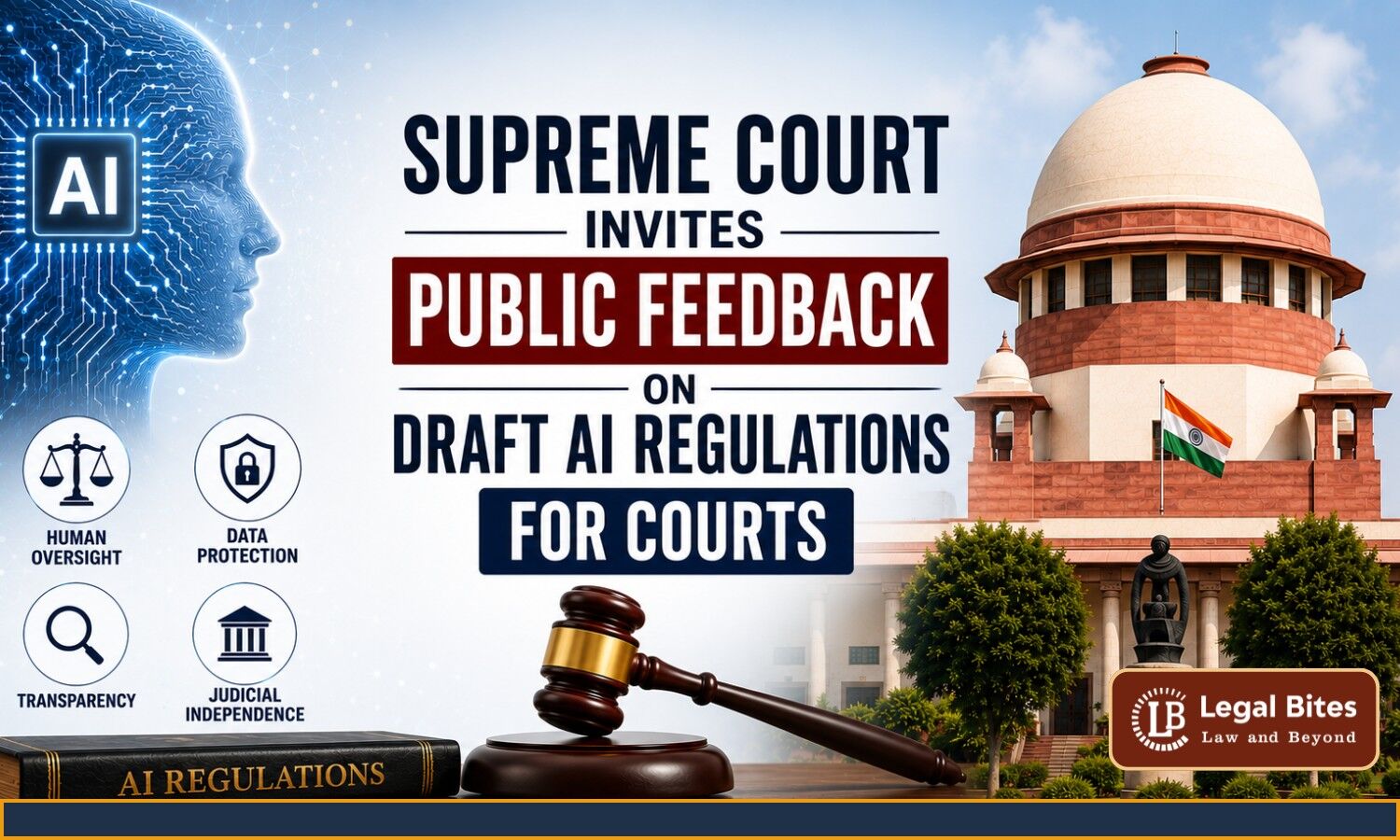
The Supreme Court of India has released a draft regulatory framework governing the use of Artificial Intelligence (AI) in courts and invited comments from stakeholders and the general public. The draft “Regulations for Use of Artificial Intelligence (AI) in Courts, 2026” aims to create a structured framework for AI adoption in the judiciary while preserving judicial independence, transparency, accountability, and data protection. Stakeholders may submit their suggestions to the AI Committee of the Supreme Court by June 20, 2026.
Draft Regulations Released for Public Consultation
In a notice dated June 3, 2026, the Supreme Court stated that the draft regulations have been prepared under the aegis of the Artificial Intelligence Committee after consultations and deliberations. The proposed framework seeks to regulate the deployment and use of AI across courts, tribunals, and statutory commissions performing adjudicatory functions in India.
The Court has invited comments and suggestions from judges, lawyers, academicians, technology experts, researchers, and members of the public before finalising the regulations.
AI to Assist Courts, Not Replace Judges
One of the central features of the draft regulations is the principle of human primacy. The framework clearly states that AI systems shall function only in an assistive capacity and cannot replace judicial decision-making.
The draft provides that the ultimate authority to determine questions of law, facts, rights, liabilities, and justice shall remain exclusively with judicial officers. AI-generated outputs are to be treated only as advisory tools and cannot become a substitute for judicial reasoning.
Proposed Uses of AI in Courts
The regulations permit the use of AI for a range of administrative and support functions, including:
- Case management and docket prioritisation;
- Cause-list preparation and hearing scheduling;
- Automated transcription of court proceedings;
- Translation of judgments and legal documents;
- Legal research and precedent retrieval;
- Citation verification and document summarisation;
- Record management and filing assistance;
- Litigant support through AI chatbots; and
- Accessibility services for persons with disabilities.
The draft emphasises that these functions must remain subject to human supervision and verification.
Strict Restrictions on Judicial Use of AI
The Supreme Court has proposed several safeguards to prevent over-reliance on AI in judicial processes.
The draft expressly prohibits:
- AI-based adjudication or sentencing;
- AI-generated judicial outcomes;
- Risk scoring of accused persons;
- Prediction of recidivism;
- Bail eligibility assessment through AI;
- Evaluation of witness credibility; and
- Behavioural profiling of litigants or advocates.
The regulations further prohibit the use of undisclosed or unexplainable AI systems in matters affecting legal rights or personal liberty.
Disclosure of AI-Generated Content Made Mandatory
Recognising the increasing use of generative AI tools, the draft regulations require parties and legal representatives to disclose AI-assisted content submitted before courts.
Courts may require details regarding the AI tool used, the extent of AI assistance received, and the steps taken to verify the accuracy of AI-generated content.
The draft also clarifies that litigants and lawyers will remain responsible for any false, fabricated, or misleading AI-generated material filed before a court.
National AI Governance Structure Proposed
To oversee AI adoption in the judiciary, the draft proposes the establishment of a permanent Apex Body at the Supreme Court level.
The body would include Supreme Court judges, High Court judges, technology experts, cybersecurity specialists, representatives from the Ministry of Electronics and Information Technology (MeitY), and legal professionals.
The regulations also envisage the creation of AI Committees in the Supreme Court and every High Court, dedicated AI Secretariats, and a Centre of Research and Excellence on Artificial Intelligence (CoRE-AI).
Focus on Data Privacy and Cybersecurity
The draft regulations place significant emphasis on the protection of judicial data. AI systems deployed in courts would be required to comply with the Digital Personal Data Protection Act, 2023, and the Information Technology Act, 2000. Sensitive judicial data would be subject to strict safeguards, and AI tools would undergo regular technical, ethical, and cybersecurity audits.
Engagement with Private AI Companies
Private AI vendors may participate in judicial AI projects only after obtaining prior approval from the relevant authority.
The draft mandates strict contractual safeguards covering:
- Ownership of court data;
- Restrictions on AI training using judicial data;
- Transparency obligations;
- Audit rights;
- Cybersecurity standards;
- Liability for AI-related harms; and
- Protection against misuse of sensitive judicial information.
Importantly, AI systems developed using court resources or judicial data cannot become the exclusive intellectual property of private entities.
Training Judges and Court Staff
Recognising the challenges posed by emerging technologies, the draft mandates regular training for judges, lawyers, and court staff.
Training programmes would focus on:
- AI capabilities and limitations;
- Bias and hallucination risks;
- Ethical and legal issues;
- Data protection principles;
- Cybersecurity; and
- Incident reporting mechanisms.
Public Feedback Open Till June 20
The Supreme Court has invited stakeholders and members of the public to submit their views and suggestions on the proposed regulations by June 20, 2026.
The move marks a significant step towards establishing a formal AI governance framework for the Indian judiciary while ensuring that technological innovation does not compromise judicial independence, fairness, or due process.
Important Link
Law Library: Notes and Study Material for LLB, LLM, Judiciary, and Entrance Exams