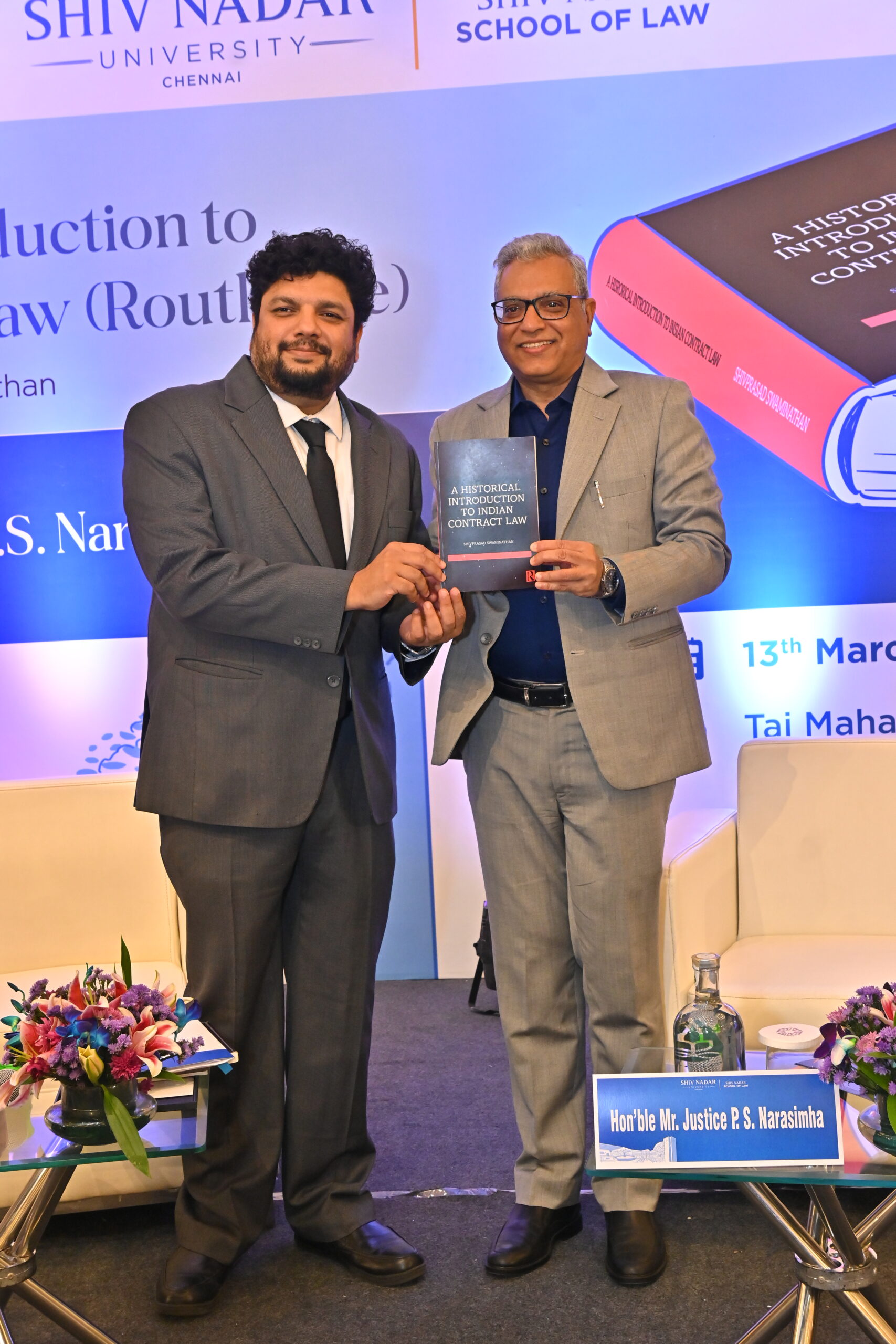
The book explores the historical foundations of the Indian Contract Act, 1872, examining how its core concepts developed from English jurisprudence and were interpreted by Indian courts over time.
NEW DELHI / 13 March, 2026: Scholars and members of the legal fraternity gathered in Delhi for the launch of a new book exploring the historical foundations and evolution of Indian contract law. The event, organised by the Shiv Nadar School of Law, Shiv Nadar University Chennai, was graced by Hon’ble Justice P. S. Narasimha, Judge, Supreme Court of India, as the Guest of Honour, along with Mr. Gaurav Pachnanda, Senior Advocate, Supreme Court of India, Dr. Nilima Bhadbhade, Scholar and Author, and Prof. (Dr.) Umakanth Varottil, Professor, National University of Singapore and Programme Advisor, Shiv Nadar School of Law, as panelists who discussed the book.
Titled A Historical Introduction to Indian Contract Law (Routledge), the book is authored by Prof (Dr.) Shivprasad Swaminathan, Professor and Dean at the Shiv Nadar School of Law. Based on original archival research, it traces how core concepts of Indian contract law traveled from nineteenth-century English jurisprudence into the Indian Contract Act, 1872, and how courts and scholars have interpreted them over the past 150 years. At its core, the book challenges conventional readings of the Act, highlighting instances in which the drafters deliberately departed from English law and offering fresh perspectives for contemporary legal practice and scholarship.
Addressing the audience, Hon’ble Justice P. S. Narasimha, Judge, Supreme Court of India, said: “This book traces how the Indian Contract Law was originally conceived to be transformative, yet over time its interpretation often followed established habits and inherited perspectives. Interestingly, while the text of the Act has remained largely unchanged for decades, the way we interpret it has evolved through judicial decisions and commentary. Revisiting foundational ideas such as offer, acceptance, consideration and privity remind us of the original intent behind the law and encourages us to rethink how these principles should be understood today. Even decades after colonialism ended, the mindset through which we interpret certain laws often continues to influence our thinking, and that perspective needs to change. At the same time, the line between private law and public law is increasingly blurring, particularly in large public contracts and infrastructure projects. As artificial intelligence advances and self-executing smart contracts become a reality, many foundational principles of contract law will have to be revisited. This makes it even more important for lawyers, judges and scholars to re-examine the jurisprudential foundations of contract law and think independently about how the law should evolve in the years ahead.“
Prof. Shivprasad Swaminathan, Dean, Shiv Nadar School of Law, said, “Drawing on original archival research, it traces how core concepts from nineteenth-century English jurisprudence were incorporated into the Indian Contract Act, 1872, and interpreted by Indian courts over the decades. The book presents a novel insight: the drafters did not intend a faithful codification of English law, yet over time, courts and scholars often projected English law onto the Act. By highlighting these nuances and offering fresh perspectives on core doctrines, it also promises to illuminate contemporary legal challenges. Its insights hold the potential to help courts, scholars, and practitioners shape the future interpretation and application of contract law in India.”
Mr. Gaurav Pachnanda, Senior Advocate, Supreme Court of India, said, “In the Indian context over the past few decades, public law has come to play a far more prominent role in our jurisprudence. This has not only been a consequence of the stage of our national development, but also the result of inadequate attention to strengthening the civil and commercial court system. As a result, private law often became a secondary route for resolving private disputes, with many such disputes being channeled through public law remedies. This inevitably meant that private law principles were shaped by public law influences. However, a clear and balanced divide between public law and private law is not undesirable. In many mature jurisdictions, the two operate distinctly yet interact where necessary, ensuring that both systems develop with equal strength.”
Dr. Nilima Bhadbhade, Scholar and Author, added, “In legal education, subjects like contract law are often overlooked despite being fundamental to understanding everyday transactions and commercial relationships. A historical approach to the subject can make it far more engaging for students, allowing teachers to explain how legal principles evolved and why they matter today. Professor Shivprasad Swaminathan’s work is significant because it brings serious doctrinal and historical scholarship to an area where such writing has been limited. By carefully tracing the development of key concepts and examining landmark cases in detail, the book encourages teachers, scholars and students to engage more deeply with contract law and to rethink how the subject is studied and taught in India.”
About Shiv Nadar University Chennai:
Shiv Nadar University Chennai (https://www.snuchennai.edu.in/ ) is a quality-focused University offering wide range of specialized academic programs at the undergraduate level to start with. The University has been set up by the Shiv Nadar Foundation, a philanthropic foundation established by Mr. Shiv Nadar, Founder, HCL – a US$ 14.5 billion leading global technology enterprise. Shiv Nadar University Chennai endeavors to become a pioneering institution of higher education, setting new global academic benchmarks and revolutionizing the education landscape in the country.
The University campus features state-of-the-art infrastructure for learning, including seminar halls, auditoria, libraries, gymnasium, sports complex and hostels for men and women. The campus is entirely wi-fi enabled with 24/7 internet access.
The University offers a holistic educational environment that is continually evolving to bridge the gap between the classroom and professional demands by a group of world-class faculties who are progressive academicians, leading thinkers, eminent professionals and innovative educators from ranked global universities. The University has commenced its journey towards becoming a globally acclaimed center for learning and innovation in engineering, commerce, and management, and economics will continue to add diverse disciplines to its repertoire.
About the Shiv Nadar School of Law
The Shiv Nadar School of Law is the latest initiative of the Shiv Nadar Foundation. The Shiv Nadar School prides itself on its international outlook –with world-class infrastructure and faculty trained at Oxford, Cambridge, Harvard, Columbia, Princeton, Yale, Univesity of Chicago and other leading universities. It is part of Shiv Nadar University’s 250-acre campus in Chennai, located in proximity to Kovalam beach. It offera a 5-year BA-LLB programme which combines a true-blue liberal arts foundation with law courses that focus on an osmotic teaching method with an emphasis on study of doctrine, close engagement with case law and a diet of courses offered by practitioners calculated to develop the student’s tacit knowledge of law.
About Shiv Nadar Foundation:
Established in 1994, by Shiv Nadar, Founder of HCL – a US$14.5 billion leading global technology conglomerate – the Foundation is committed to creating a more equitable, merit-based society by empowering individuals through transformational education and bridging the socio-economic divide. Over the last 30 years, the Foundation has directly touched the lives of over 39,000 alumni and students through its marquee institutions in literacy, K12 and higher education. Today, the Foundation has a community of over 100,000 constituents, which includes not only globally dispersed alumni and students but also faculty members, corporate executives, and extended families.
The Foundation has invested over US$1.7 billion in its seven landmark institutions and initiatives across education and art. Currently, over 18,000 students and over 3,000 faculty and staff are part of the Foundation along with more than 30,000-strong globally dispersed alumni community.
The Foundation’s students have gone to study at some of the best institutions globally, including the Ivy League in the US and top universities in other countries, including Australia, Singapore, China and UK. Students are also working in major corporations, including Goldman Sachs, Honda, HP, Schindler, and several others, both in India and across other geographies. Faculty across the Foundation institutions are drawn from the best Indian and international universities, with a strong focus on research and innovation.
The Shiv Nadar Foundation pursues the philosophy of ‘Creative Philanthropy’. It is a powerful model which envisages creation of institutions that are built to last and continue to impact future generations. It is an approach that allows sustained institutionalized philanthropy for long-term, high-impact, socio-economic transformation.