
Co-Authored by:
- Aniket Sachan, 3rd year B.A. LL.B. (Hons), at Dr. Ram Manohar Lohiya National Law University, Lucknow
“The future of COVID-19 and the lockdown will be determined by the status quo of densely populated districts in India. The aggressive actions is the need of the hour”
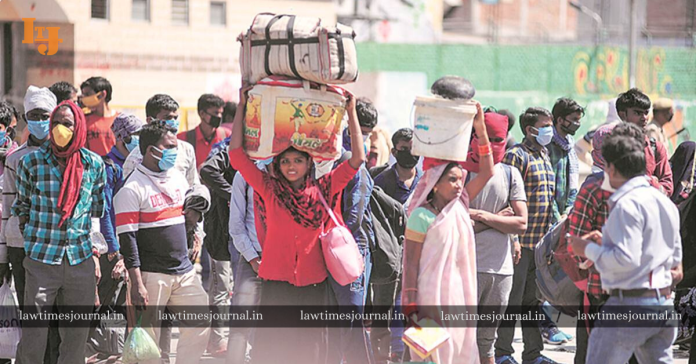
Government strategy to impose nationwide Lockdown to combat the corona pandemic emerged as a crippling tactic for daily, migrant wageworkers. This measure aimed to prevent transmission of virus. However, unorganised sector faced serious implications. Informal contract’s workers are more prone to exploitation. Owing to no permanent income and availability of food and water, the exodus of workers embarked on foot to their homes. This migration not only cast significant economic danger but can also contribute to dissemination of virus in the villages. This measure has also affected farmer’s sustainability. Improper Redressal of this problem will increase Corona cases and will lead to food riots. Lack of Bank accounts disentitle most of these workers form Govt. Relief schemes. Concepts like social distancing and work from home are not for the marginalised. MNREGA programmes have also come to standstill. The need of hour requires food rations, income security, labour friendly provisions to alleviate the unorganized sector employees.
Introduction
The nationwide lockdown imposed to curb the outbreak of Corona pandemic emerged as a weapon of doom for daily, migrant wageworker and contract labourers. This audacious decision of government came with strings attached and is bleeding poor people with thousand cuts. This step was taken to avoid the spread of the coronavirus amidst growing concerns that India could become the next global hotspot for virus, owing to millions living in tight conditions without exposure to sanitation. The announcement of lockdown has left them in a state of crisis. Having no availability of transport, arrangement of food and water facilities and limited money, the entire exodus of the workers has embarked on foot to reach their homes and villages in far off states. The subsequent declaration by the prime minister became an erratic one, leading them to collapse in the aftermath of the Coronavirus pandemic. The informal sector has faced significant consequences. Construction work, taxi services, domestic help and entire unorganized sector has come to standstill. Before enforcing such a huge decision, the government could not come up with a proper plan to make necessary arrangements for these people and provide them sufficient time. The nationwide resolution at 8:00 PM to execute lockdown by midnight was a bad prepared move. Although the move was important, the timing and structure could have been considered. The same announcement could have been delivered at day so that others could utilize the conveyance till night.
Hardship of migrant workers
According to the Indian government’s 2016-17 Economic Survey, internal migrants make up about 20 per cent of the workforce. They contribute an estimated 10 per cent of India’s economic output, according to the UN Educational, Scientific and Cultural Organization. As the Government strive toward to contain the COVID-19, exodus of migrant workers to their village will not only pose a serious threat to the economy but might also act as an agent for the spread of novel virus to the villages. India, already struggles with the high rate of unemployment and this unplanned lockdown will shoot up the rate. The labourers find themselves in very precarious situations as their work on informal contracts which makes them prone to the exploitation. Also, they are devoid of any social securities which brings the fear of being jobless. Moreover, all the funds are currently centered to fight COVID-19. Consequently, lack of investment in agriculture and allied sectors will cripple the rural economy.
Impact on agriculture
The epicenter for the labour force in India is eastern Uttar Pradesh, Bihar and Jharkhand, and also parts of Madhya Pradesh. These labourers migrate to the agriculture region of Punjab, Haryana, Telangana, Maharashtra and other places. The migrant workers working at construction sites transpose to the fields during the harvest time and the current lockdown falls amid the harvest of Rabi season. This has made agriculture sector vulnerable to economic shock from lockdown. The Rabi season starts in November and ends in March or April and contributes to around total 50% food grain production. Wheat, barley, mustard and green peas are the major Rabi crops. Notwithstanding the Kharif crop damage in 2019, the farmers were optimistic for winter crops. The agriculture ministry data also depicted that the sowing of Rabi crop is 6.4% more than the previous year. The projection for Rabi Crop state bumper harvesting is not hidden.[i] The high food grain production of wheat, jowar and corn was expected.[ii] The government’s callousness would not just have an impact on the economy but also on the farmers, sustainability. With limited storage and warehousing facilities, it is difficult to have smooth inventory management thereby disrupting the supply chain of food inventory.
Measures by the Government
The Supreme Court also directed the Centre to ensure food, water, beds, medication and counselling in shelters for the migrants. Central Government has advised States to discourage workers’ movement and to implement relief initiatives by allocating them in relief camps.[iii] States should use Disaster Relief Funds for the following purpose. However, the measures undertaken are insufficient to stem the flow of migrants. Buses deployed by UP and Delhi governments were not enough to transport all workers to outskirts. Nevertheless, the state and the Central Authorities have locked the State and District borders, not allowing movement of these people unless they are screened. The authorities are insisting to subject them to 14-day quarantine in different centres. These centres are overcrowded and cast mockery of Social Distancing measure. The Delhi Government is taking steps but these provisions are not adequate to meet the requirements. Many other state governments must also advance support and aid the weaker section. If a single person out of them is contaminated with Corona, then no measure can help us to avoid stage III transmission of COVID-19.
Struggle for basic necessities
We are witnessing gross deprivation of certain rights notwithstanding the fact that our Constitution guarantees Fundamental Rights of Food[iv] and Shelter[v]. If the following problem is not regulated in time, the condition would not only escalate Corona cases in Indian but also contribute to food riots as well. While relief package for 80 Crore people under Pradhan Mantri Garib Kalyan Yojana worth Rs. 1.70 trillion has been announced[vi], the fear of starvation at time of no income has forced worker and labourers to walk long distances in order to reach their homes. Though 80 crore beneficiaries’ are covered in this scheme, acknowledging the ground realities, many beneficiaries will not be able to get these entitlements. Those who are entitled to this relief package are on the roads, travelling on foot to their villages. While strolling towards Digital Economy, we overlook the fact that not every citizen of India has a bank account to get a part of the sanctioned sum. Those who have accounts, they could not access them as they are restrained from going too far off banks owing to the uncivilised police actions amidst lockdown. The government needs to make provisions for daily wage workers who consume the penny they earn. They might die of hunger before being infected by COVID-19. The stranded truck drivers are also facing issues of shortage of food and other supplies.
Administrative Flaw
When steps were debated around the globe to address the Pandemic of COVID-19; our parliamentarians were engaged in deciding political hegemony in Madhya Pradesh. Ironically, the dissemination of Coronavirus began from the wealthy and middle classes but it has even grappled the downtrodden. The lockdown presents a severe challenge to the employees of the unorganized sector having limited job security and paid leaves. “Work from home” applies only to those who are employed in the workplace, but domestic help, cooks, sweepers and others make a livelihood out of constant contact with others. Hence, the concepts like social distancing and work from home are not for the poor, marginalised and essential services provider.
Moreover, the low spending on healthcare by Indian Government has exacerbated rising inequality and inadequate standard of health services. The bulk of National and State Disaster Response Funds have been utilized due to Capacity Development Post-Disasters. India also has stringent funds of PM Relief Fund and disaster management at disposal to encounter this health emergency.
Conclusion
Government though have passed order for non-collection of one month rent, proper enforcement of this rule must be seen so that the poor ones are not suppressed. Provisions must be incorporated to provide food rations and income security. India lacks legislations providing for social security measures in the wake of sporadic outbreak of epidemic or pandemic. Workers who are employed in factories and establishments are unable to claim compulsory health and insurance[vii] by virtue of Employees’ State Insurance Act, 1948.
The government has requested employers to not reduce their employees’ wages. However, this request not remedies a large section of workers. According to the study carried out by the National Statistical Office in 2017-2018, 71.1 % of regular wage/salaried employees in the non-agriculture sector on a monthly wage had no written job contract.[viii] Hence, such workers can be fired without any entitlement to compensation in the absence of a written contract where the conditions of employment are specifically specified.
The notice released by Ministry of Labour and Employment[ix] calling on public and private organizations not to terminate and reduce staff, especially casual or contractual workers lacked strict punitive nature. In the absence of punishment, the employers retrench many temporary and seasonal employees. Thereby, the employees are suffering from insufficient social security and career stability opportunities. The lock-down process also affected The MNREGA Scheme. The government had earlier increased wages under this MNREGA scheme. Now owing to lock down all the work has been halted and suspended during these 21 days. There is no other recourse left to these regular wage earners.
The migrant labourers make a huge contribution to the Indian Economy but their share in the National Income is minimal. These workers require economic protection not only during the lockdown but also post lockdown.Thus, the urgent need of the hour requires States and Union Territories to explore a solution to alleviate the situation of unorganized sector employees. They should involve the participation of NGO’s and active coordination of various departments to provide food and refuge along with basic facilities such as clean water and hygiene. A variety of preventive steps is required to tackle this emerging issue. The Centre Government should provide for additional Workers’ relief fund in order to complement the State budget, regardless of the minimal State Disaster Relief Fund. Besides DBT, the administration should also supply the regular staff, migrants and contract workers with cash payments equivalent to the state’s minimum wages. Sanitation employees should be provided with proper gears.
Approved & Published – Sakshi Raje
Reference
[i] Gurneel Kaur, Climate Favourable in India for Bumper Rabi Crop in 2020, (Apr. 6, 2020, 15:12 PM), https://www.grainmart.in/news/climate-favourable-in-india-for-bumper-rabi-crop-in-2020/.
[ii] Prabhash K Dutta, Coronavirus makes India wake up to its migrant labourers, (Apr. 6, 2020, 16:11 PM), https://www.indiatoday.in/news-analysis/story/coronavirus-makes-india-wake-up-to-its-migrant-labourers-1661454-2020-03-30.
[iii] Press Information Bureau, State Governments advised to set up Relief Camps along Highways, to provide food and shelter to migrant workers returning to their domicile States, (Apr. 3, 2020, 13:11 PM), https://pib.gov.in/newsite/PrintRelease.aspx?relid=200765.
[iv] People’s Union for Civil Liberties vs. Union of India, Civil Writ Petition 196 of 2001.
[v] Olga Tellis vs. Bombay Municipal Corporation, (1985) 3 SCC 545.
[vi] Press Information Bureau, Finance Minister announces Rs 1.70 Lakh Crore relief package under Pradhan Mantri Garib Kalyan Yojana for the poor to help them fight the battle against Corona Virus, (Apr. 2, 2020, 12:20 PM), https://pib.gov.in/PressReleaseIframePage.aspx?PRID=1608345.
[vii] Employees’ State Insurance Act, 1948, §. 19.
[viii] National Statistics Office, Periodic Labour Force Survey, (Apr. 1, 2020, 09:40 AM), http://www.mospi.gov.in/sites/default/files/publication_reports/Annual%20Report%2C%20PLFS%202017-18_31052019.pdf.
[ix] Ministry of Labour and Employment, In this critical time of the coronavirus (COVID-19) epidemic, the Ministry of Labour and Employment advises all public and private employers to support their employees and workers, (Mar. 25, 2020, 11:40 AM), https://labour.gov.in/sites/default/files/Central_Government_Update.pdf.